Thank you for visiting SNEWPapers!
Sign up free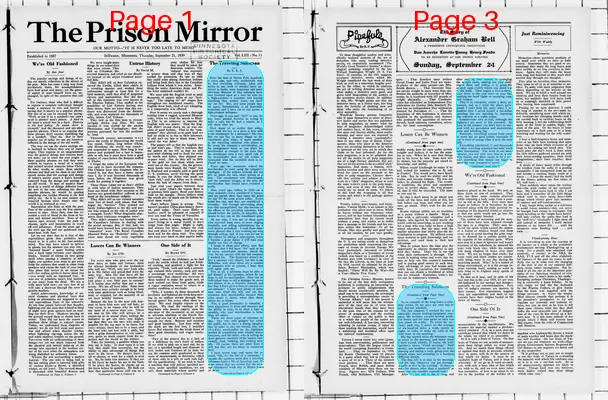
Editorial
September 21, 1939
The Prison Mirror
Stillwater, Washington County, Minnesota
What is this article about?
Editorial by E. B. F. defends the profession of traveling salesmen against stereotypes of laziness and high-pressure tactics, highlighting their role in enabling affordable merchandise and installment plans, and detailing the demanding daily routine and personal experiences of the author.
Merged-components note: Merged continuation of the editorial 'The Traveling Salesman' from page 1 to page 3; relabeled page 3 portion from story to editorial.
Clippings
1 of 2
OCR Quality
98%
Excellent
Full Text
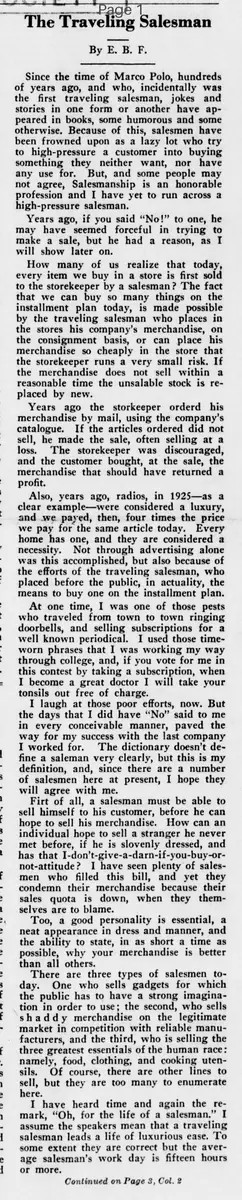
The Traveling Salesman
By E. B. F.
Since the time of Marco Polo, hundreds of years ago, and who, incidentally was the first traveling salesman, jokes and stories in one form or another have appeared in books, some humorous and some otherwise. Because of this, salesmen have been frowned upon as a lazy lot who try to high-pressure a customer into buying something they neither want, nor have any use for. But, and some people may not agree, Salesmanship is an honorable profession and I have yet to run across a high-pressure salesman.
Years ago, if you said "No!" to one, he may have seemed forceful in trying to make a sale, but he had a reason, as I will show later on.
How many of us realize that to-day, every item we buy in a store is first sold to the storekeeper by a salesman? The fact that we can buy so many things on the installment plan to-day, is made possible by the traveling salesman who places in the stores his company's merchandise, on the consignment basis, or can place his merchandise so cheaply in the store that the storekeeper runs a very small risk. If the merchandise does not sell within a reasonable time the unsalable stock is replaced by new.
Years ago the storekeeper ordered his merchandise by mail, using the company's catalogue. If the articles ordered did not sell, he made the sale, often selling at a loss. The storekeeper was discouraged, and the customer bought, at the sale, the merchandise that should have returned a profit.
Also, years ago, radios, in 1925-as a clear example--were considered a luxury, and we paid, then, four times the price we pay for the same article to-day. Every home has one, and they are considered a necessity. Not through advertising alone was this accomplished. but also because of the efforts of the traveling salesman, who placed before the public, in actuality, the means to buy one on the installment plan.
At one time, I was one of those pests who traveled from town to town ringing doorbells. and selling subscriptions for a well known periodical. I used those time-worn phrases that I was working my way through college, and, if you vote for me in this contest by taking a subscription, when I become a great doctor I will take your tonsils out free of charge.
I laugh at those poor efforts, now. But the days that I did have "No" said to me in every conceivable manner, paved the way for my success with the last company I worked for. The dictionary doesn't define a salesman very clearly, but this is my definition, and, since there are a number of salesmen here at present, I hope they will agree with me.
First of all, a salesman must be able to sell himself to his customer, before he can hope to sell his merchandise. How can an individual hope to sell a stranger he never met before, if he is slovenly dressed, and has that I-don't-give-a-darn-if-you-buy-or-not-attitude? I have seen plenty of sales-men who filled this bill, and yet they condemn their merchandise because their sales quota is down, when they themselves are to blame.
Too, a good personality is essential, a neat appearance in dress and manner, and the ability to state, in as short a time as possible, why your merchandise is better than all others.
There are three types of salesmen to-day. One who sells gadgets for which the public has to have a strong imagination in order to use; the second, who sells shoddy merchandise on the legitimate market in competition with reliable manufacturers. and the third, who is selling the three greatest essentials of the human race: namely, food, clothing, and cooking utensils. Of course, there are other lines to sell, but they are too many to enumerate here.
I have heard time and again the remark, "Oh, for the life of a salesman." I assume the speakers mean that a traveling salesman leads a life of luxurious ease. To some extent they are correct but the average salesman's work day is fifteen hours or more.
Continued on Page 3, Col. 2
The Traveling Salesman
(Continued from Page One)
As an example of the long hours a salesman works, let me give my own day-in and day-out schedule.
The last company I worked for was a nationally known cooking-equipment company. My territory covered several southern States, and the time spent on each run was about six weeks. To cover my territory each trip, I drove on the average of six-hundred miles a week, mostly at night, in order to make my calls in the next town in the morning.
My day started when the telephone rang at seven in the morning, and many times I have cursed, silently, of course, the hotel operator's cheery "Good morning." Half awake, one stumbles around for an hour, shaving and taking a bath, going over the sample cases, and attending to a hundred different details.
The first call is at nine in the morning, and the last, whenever you get through; usually at five in the evening. If there is time for dinner, other than a sandwich at noon, you can consider yourself lucky.
After the last call in the evening, and after packing your clothes, re-arranging the sample cases, making out your daily report sheet and orders, it is generally around eight o'clock before you check out of the hotel. Then begins a two-or-three-hour drive to the next town on your list, battling the head lights of oncoming cars, and fatigue.
This is no exception, rather a daily occurrence, and as I write the above paragraph I can't help but smile when I remember how I saved myself a ten-dollar speeding fine one morning by repeating this schedule to a traffic judge.
Summer-time isn't so bad, although the highways are more or less crowded. At least in the summer you don't have to contend with icy pavements and snowstorms, sleet and blinding fog.
Naturally, travelling around from town to town has its good points, especially if one is fond of seeing what is over the next hill.
Everything considered, I, and thousands of other traveling salesmen find sales' work most fascinating. The work is not monotonous, you are your own boss to a certain extent, and there seems to be a certain something that makes one eager to meet the next prospective buyer.
(Continued next week)
By E. B. F.
Since the time of Marco Polo, hundreds of years ago, and who, incidentally was the first traveling salesman, jokes and stories in one form or another have appeared in books, some humorous and some otherwise. Because of this, salesmen have been frowned upon as a lazy lot who try to high-pressure a customer into buying something they neither want, nor have any use for. But, and some people may not agree, Salesmanship is an honorable profession and I have yet to run across a high-pressure salesman.
Years ago, if you said "No!" to one, he may have seemed forceful in trying to make a sale, but he had a reason, as I will show later on.
How many of us realize that to-day, every item we buy in a store is first sold to the storekeeper by a salesman? The fact that we can buy so many things on the installment plan to-day, is made possible by the traveling salesman who places in the stores his company's merchandise, on the consignment basis, or can place his merchandise so cheaply in the store that the storekeeper runs a very small risk. If the merchandise does not sell within a reasonable time the unsalable stock is replaced by new.
Years ago the storekeeper ordered his merchandise by mail, using the company's catalogue. If the articles ordered did not sell, he made the sale, often selling at a loss. The storekeeper was discouraged, and the customer bought, at the sale, the merchandise that should have returned a profit.
Also, years ago, radios, in 1925-as a clear example--were considered a luxury, and we paid, then, four times the price we pay for the same article to-day. Every home has one, and they are considered a necessity. Not through advertising alone was this accomplished. but also because of the efforts of the traveling salesman, who placed before the public, in actuality, the means to buy one on the installment plan.
At one time, I was one of those pests who traveled from town to town ringing doorbells. and selling subscriptions for a well known periodical. I used those time-worn phrases that I was working my way through college, and, if you vote for me in this contest by taking a subscription, when I become a great doctor I will take your tonsils out free of charge.
I laugh at those poor efforts, now. But the days that I did have "No" said to me in every conceivable manner, paved the way for my success with the last company I worked for. The dictionary doesn't define a salesman very clearly, but this is my definition, and, since there are a number of salesmen here at present, I hope they will agree with me.
First of all, a salesman must be able to sell himself to his customer, before he can hope to sell his merchandise. How can an individual hope to sell a stranger he never met before, if he is slovenly dressed, and has that I-don't-give-a-darn-if-you-buy-or-not-attitude? I have seen plenty of sales-men who filled this bill, and yet they condemn their merchandise because their sales quota is down, when they themselves are to blame.
Too, a good personality is essential, a neat appearance in dress and manner, and the ability to state, in as short a time as possible, why your merchandise is better than all others.
There are three types of salesmen to-day. One who sells gadgets for which the public has to have a strong imagination in order to use; the second, who sells shoddy merchandise on the legitimate market in competition with reliable manufacturers. and the third, who is selling the three greatest essentials of the human race: namely, food, clothing, and cooking utensils. Of course, there are other lines to sell, but they are too many to enumerate here.
I have heard time and again the remark, "Oh, for the life of a salesman." I assume the speakers mean that a traveling salesman leads a life of luxurious ease. To some extent they are correct but the average salesman's work day is fifteen hours or more.
Continued on Page 3, Col. 2
The Traveling Salesman
(Continued from Page One)
As an example of the long hours a salesman works, let me give my own day-in and day-out schedule.
The last company I worked for was a nationally known cooking-equipment company. My territory covered several southern States, and the time spent on each run was about six weeks. To cover my territory each trip, I drove on the average of six-hundred miles a week, mostly at night, in order to make my calls in the next town in the morning.
My day started when the telephone rang at seven in the morning, and many times I have cursed, silently, of course, the hotel operator's cheery "Good morning." Half awake, one stumbles around for an hour, shaving and taking a bath, going over the sample cases, and attending to a hundred different details.
The first call is at nine in the morning, and the last, whenever you get through; usually at five in the evening. If there is time for dinner, other than a sandwich at noon, you can consider yourself lucky.
After the last call in the evening, and after packing your clothes, re-arranging the sample cases, making out your daily report sheet and orders, it is generally around eight o'clock before you check out of the hotel. Then begins a two-or-three-hour drive to the next town on your list, battling the head lights of oncoming cars, and fatigue.
This is no exception, rather a daily occurrence, and as I write the above paragraph I can't help but smile when I remember how I saved myself a ten-dollar speeding fine one morning by repeating this schedule to a traffic judge.
Summer-time isn't so bad, although the highways are more or less crowded. At least in the summer you don't have to contend with icy pavements and snowstorms, sleet and blinding fog.
Naturally, travelling around from town to town has its good points, especially if one is fond of seeing what is over the next hill.
Everything considered, I, and thousands of other traveling salesmen find sales' work most fascinating. The work is not monotonous, you are your own boss to a certain extent, and there seems to be a certain something that makes one eager to meet the next prospective buyer.
(Continued next week)
What sub-type of article is it?
Trade Or Commerce
Labor
What keywords are associated?
Traveling Salesman
Sales Profession
Installment Plan
Working Conditions
Merchandise Sales
Commercial Role
What entities or persons were involved?
Traveling Salesmen
Storekeepers
E. B. F.
Editorial Details
Primary Topic
Defense Of Traveling Salesmanship
Stance / Tone
Supportive And Positive
Key Figures
Traveling Salesmen
Storekeepers
E. B. F.
Key Arguments
Salesmanship Is An Honorable Profession Countering Stereotypes Of Laziness And High Pressure Tactics
Traveling Salesmen Enable Installment Plans And Low Risk Merchandising For Stores
Historical Changes In Retail Due To Salesmen, E.G., Radios From Luxury To Necessity
Personal Experiences Build Resilience And Success In Sales
A Good Salesman Must Sell Themselves First With Neat Appearance And Personality
Three Types Of Salesmen: Gadgets, Shoddy Goods, Essentials Like Food And Clothing
Salesmen's Work Involves Long 15+ Hour Days And Extensive Travel