Thank you for visiting SNEWPapers!
Sign up free
Winchester Gazette
Winchester, Virginia
What is this article about?
Reports on Virginia House of Delegates proceedings in late January 1822, including passage of a bill on John Preston's sureties, debates on slave laws, education funding, British trade restrictions, road inquiries, tax bills, legislative session timing, and reception of Kentucky commissioners Henry Clay and George M. Bibb regarding interstate compact.
Merged-components note: These two components are a direct continuation of the report on the Virginia Legislature proceedings, with sequential reading order and continuous text flow.
Clipping
OCR Quality
Full Text
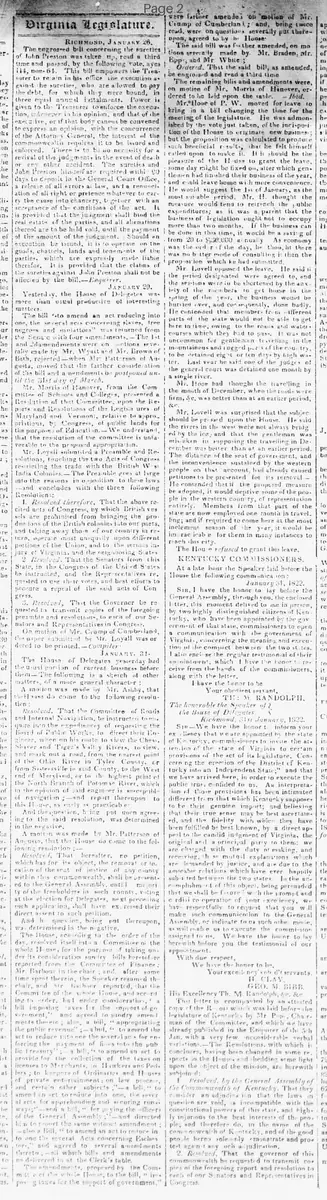
Richmond, January 26.
The engrossed bill concerning the sureties of John Preston was taken up, read a third time and passed, by the following vote, ayes 114, noes 61. This bill empowers the Treasurer to retain in his office the execution against the sureties, who are allowed to pay the debt, for which they were bound, in three equal annual instalments. Power is given to the Treasurer to enforce the execution, wherever in his opinion, and that of the executive, or if that body cannot be convened to express an opinion, with the concurrence of the Attorney General, the interest of the commonwealth requires it to be issued and enforced. There is to be no necessity for a revival of the judgment, in the event of death or any other accident. The sureties and John Preston himself are required within 90 days to deposit in the General Court Office, a release of all errors at law, and a renunciation of all right or pretence whatever to carry the cause into chancery, together with an acceptance of the conditions of the act. It is provided that the judgment shall bind the real estate of the parties, and all alienations thereof are to be held void, until the payment of the amount of the judgment. Should an execution be issued, it is to operate on the goods, chattels, lands and tenements of the parties, which are expressly made liable therefor. It is provided that the claims of the sureties against John Preston shall not be affected by the bill.—Enquirer.
JANUARY 29.
Yesterday, the House of Delegates was more than usual productive of interesting matters.
The bill "to amend an act reducing into one, the several acts concerning slaves, free negroes and mulattoes" was returned from the Senate with four amendments.—The 1st and 2d amendments were on motions severally made by Mr. Wyatt and Mr. Brown of Bath, rejected—when Mr. Patterson of Augusta, moved that the further consideration of the bill and amendments be postponed until the 31st day of March.
Mr. Morris of Hanover, from the Committee of Schools and Colleges, presented a Resolution of that Committee, upon the Reports and Resolutions of the Legislatures of Maryland and Vermont, relative to appropriations, by Congress, of public lands for the purpose of Education.—We understand that the resolution of the committee is unfavorable to the proposed appropriation.
Mr. Lovall submitted a Preamble and Resolutions, touching the two Acts of Congress restricting the trade with the British West India Colonies.—The Preamble goes at large into the reasons in opposition to these laws—and concludes with the three following Resolutions:
1. Resolved therefore, That the above recited acts of Congress, by which British vessels are prohibited from bringing the produce of the British colonies into our ports, and taking away those of our country in return, operate most unequally upon different portions of the Union, and to the serious injury of Virginia, and the neighboring States.
2. Resolved, That the Senators from this State, in the Congress of the United States be instructed, and the Representatives requested to use their votes, and best efforts to procure a repeal of the said acts of Congress.
3. Resolved, That the Governor be requested to transmit copies of the foregoing preamble and resolutions, to each of our Senators and Representatives in Congress.
On motion of Mr. Crump of Cumberland the paper submitted by Mr. Loyall was ordered to be printed.—Compiler.
JANUARY 31.
The House of Delegates yesterday had the usual portion of current business before them—The following is a sketch of other matters, of a more general character:
Motion was made by Mr. Ashby, that the house do come to the following resolution:
Resolved, That the Committee of Roads and Internal Navigation, be instructed to inquire into the expediency of requesting the Board of Public Works, to direct their engineer, when on his route to view the Cheat, Shaver and Tiger's Valley Rivers, to view, and mark out a road, from the nearest point of the Ohio River in Tyler County, or from Sistersville in said County, to the West end of Maryland, or to the highest point of the North Branch of Potomac River, which in the opinion of said engineer is susceptible of navigation;—and report thereupon to this house, as early as practicable:
And the question, being put upon agreeing to the said resolution, was determined in the negative.
A motion was made by Mr. Patterson of Augusta, that the house do come to the following resolution:—
Resolved, That hereafter, no petition, which has for its object, the removal or location of the seat of justice of any county within this commonwealth, shall be presented to the General Assembly, until a majority of the freeholders in such county, voting at the election for Delegates, next preceding such application, shall have expressed their direct assent to such petition.
And the question, being put thereupon, was determined in the negative.
The House, according to the order of the day, resolved itself into a Committee of the whole House, for the purpose of taking under its consideration sundry bills heretofore reported from the Committee of Finance:
Mr. Barbour in the chair, and after some time spent therein, the Speaker resumed the chair, and Mr. Barbour reported, that the Committee of the whole House had, according to order, had under consideration, a bill imposing taxes for the support of government, and agreed to sundry amendments therein; also a bill, "appropriating the public revenue";—a bill, "to amend the act to reduce into one the several acts for enforcing the payment of fines unto the public Treasury"; a bill, "to amend an act to provide for the collection of the taxes on licenses to Merchants, to Jewellers and Pedlars; to Keepers of Ordinaries and Houses of private entertainment; on Lawyers, and certain other subjects"—a bill, "to amend an act to reduce into one, the several acts for apprehending and securing runaways"—and a bill, "for paying the officers of the General Assembly,"—and directed him to report the same without amendment;
—also a Bill, "to amend an act to reduce into one the several Acts concerning Escheators," and agreed to several amendments thereto,—on which bills and amendments Mr. Barbour delivered in at the Clerk's table.
The amendments, proposed by the Committee of the whole House, to the bill, "imposing taxes for the support of government."
were further amended on motion of Mr. Crump of Cumberland; and, being twice read, were on questions severally put thereupon, agreed to by the House.
The said bill was then amended, on motions severally made by Mr. Braden, Mr. Eppes, and Mr. White.
Ordered, That the said bill, as amended, be engrossed and read a third time.
The remaining bills and amendments were, on motion of Mr. Morris of Hanover, ordered to be laid upon the table.—Ibid.
Mr. Hooe of P. W. moved for leave to bring in a bill changing the time for the meeting of the legislature. He was admonished by the vote just taken, of the disposition of the House to originate new business; but the proposition was calculated to produce such beneficial result, that he felt himself called upon to make it. If it should be the pleasure of the House to grant the leave, some day might be fixed on, after gentlemen had finished their business of the year, and could leave home with more convenience. He would suggest the 1st of January, as the most suitable period. Mr. H. thought the measure would tend to retrench the public expenditures; as it was apparent that the business of legislation ought not to occupy more than two months. If the business can be done in this time, it would be a saving of from 20 to $30,000 annually. As economy was the order of the day, he thought there was no better mode of consulting it than the proposition which he had submitted.
Mr. Lovell opposed the leave. He said if the period designated were agreed to, and the sessions were to be shortened by the anxiety of the members to get home in the spring of the year, the business would be hurried over, and consequently, done badly. He contended that members from different parts of the state would not be able to get here in time, owing to the roads and water-courses which they had to pass. It was not uncommon for gentlemen traveling in the mountainous and rugged parts of the country, to be detained eight or ten days by high water. Last year he said one of the judges of the general court was detained one month by a single river.
Mr. Hooe had thought the traveling in the month of December, when the roads were firm, &c. was better than at an earlier period, &c.
Mr. Lovell was surprised that the subject should be urged upon the House. He said the rivers in the west were not always bridged by the ice; and that the gentleman was mistaken in supposing the traveling in December was better than at an earlier period. The distance of the seat of government, and the inconvenience sustained by the western people on that account, had already caused petitions to be presented for its removal—He contended that if the proposed measure be adopted, it would deprive some of the people in the western country, of representation entirely. Members from that part of the state are now employed one month in travel. ling: and if required to come here at the most inclement season of the year, it would be impracticable for them in many instances to reach this city.
The House refused to grant this leave,
KENTUCKY COMMISSIONERS.
At a late hour the Speaker laid before the House the following communication:
January 31, 1822.
Sir,—I have the honor to lay before the General Assembly, through you, the enclosed letter, this moment delivered to me in person, by two highly distinguished citizens of Kentucky, who have been appointed by the government of that state, commissioners to open a communication with the government of Virginia, concerning the meaning and execution of the compact between the two states. I also enclose the regular testimonial of their appointment, which I have the honor to receive from the hands of the commissioners, along with the letter.
I have the honor to be
Your obedient servant,
TH. M. RANDOLPH,
The honorable the Speaker of the House of Delegates.
Richmond, 31st January, 1822.
Sir—We have the honor to inform your Excellency that we are appointed by the state of Kentucky, commissioners to invite the attention of the state of Virginia to certain provisions of the act of its legislature, concerning the erection of the District of Kentucky into an Independent State: and that we have arrived here, in order to execute the public trust confided to us. An interpretation of those provisions has been intimated different from that which Kentucky supposes to be their genuine import; and believing that their true sense may be best ascertained, and the fidelity with which they have been fulfilled be best known, by a direct appeal to the candid judgment of Virginia, the original and a principal party to them: we are charged with the duty of making, and receiving, such mutual explanations which are demanded by justice, and are due to the amicable relations which have ever happily subsisted between the two states. In the accomplishment of this object, being persuaded that we shall be favored with the uniform and cordial co-operation of your Excellency, we have respectfully to request that you will make such communication to the General Assembly, as will indicate to us such other means as will enable us to execute the commission assigned to us. We have the honor to lay herewith before you the testimonial of our appointment.
With due respect,
We have the honor to be
Your Excellency's ob't servants.
H. CLAY.
GEO. M. BIBB.
His Excellency Th. M. Randolph, &c. &c.
This letter is accompanied by an attested copy of the Report on which was laid before the Legislature of Kentucky, by Mr. Pope, Chairman of the Committee, and which we have already published in the Enquirer of the 5th Jan. with a very few inconsiderable verbal variation—The Resolutions, with which it concludes, having been changed in some respects in the House, and shedding some light upon the object of the mission, are herewith subjoined:
1. Resolved, By the General Assembly of the Commonwealth of Kentucky, That they consider an adjudication that the laws in question are void, as incompatible with the constitutional powers of this state, and highly injurious to the best interests of the people; and therefore do, in the name of the commonwealth of Kentucky, and of the good people thereof, solemnly remonstrate and protest against any such adjudication.
2. Resolved, That the governor of this commonwealth be requested to transmit copies of the foregoing report and resolution to each of our Senators and Representatives in Congress.
3. Resolved, That two commissioners be appointed on the part of this Commonwealth, who shall have full power and authority, jointly and severally, if they shall deem it necessary or expedient, to repair to the city of Richmond, in Virginia, and open a communication with that government, concerning the meaning and execution of the compact between this and that state, to obtain, if practicable from Virginia, a declaration of her satisfaction with the construction and performance of said compact on the part of this commonwealth, and, if such declaration cannot be obtained, to invite a discussion of her objections; and with a view to a final adjustment, to co-operate with Virginia in constituting a board of commissioners, as provided for in the 12th article of the compact.
4. Resolved, That the said commissioners be requested to attend the supreme court of the United States, at the next term, and oppose any decision that may be attempted to be procured from the supreme court, that those laws are void, in such manner as they may deem most respectful to the court, and most consistent with the dignity of the state.
5. Resolved, That the election of the two commissioners, contemplated by the foregoing resolutions, shall be by joint vote of both Houses.
To his Report, is subjoined the following testimonial from the Governor of Kentucky, authenticated by the seal of the state:
STATE OF KENTUCKY.
Executive Department.
I, John Adair, Governor of the Commonwealth of Kentucky, do hereby notify, and make known, that Henry Clay and George M. Bibb, Esquires, were, by a joint vote of the Senate and House of Representatives of said state, duly elected commissioners, pursuant to resolutions adopted by the General Assembly of the commonwealth aforesaid, at the October session, one thousand eight hundred and twenty-one, "concerning the occupying claimant laws of this state and the decision of the Supreme Court of the United States thereon"—Approved, December 17, 1821.
In testimony whereof I have hereunto set my hand and caused the seal of the said commonwealth to be affixed at Frankfort this twenty ninth day of December, in the year of our Lord, one thousand eight hundred and twenty-one, and in the thirtieth year of the commonwealth.
By the Governor,
JOHN ADAIR.
J. CALLOWELL BRYCKINRIDGE, Secretary.
On Mr. Sheriff's motion, all these papers were laid upon the table and ordered to be printed.
Yesterday, the most interesting business before the House of Delegates, grew out of the Kentucky mission. It gave rise to some discussion; but we have time only to sketch the character of the proceedings adopted.
Mr. Morris of Hanover submitted the following resolution.—Resolved, that the Governor's Communication from Henry Clay and George M. Bibb, Esquire, on the part of the State of Kentucky, with the documents accompanying the same, be referred to a joint committee of both Houses of the General Assembly.
A motion was made by Mr. Mayo of Washington, to amend this resolution by striking out the words, "a joint committee of both Houses of the General Assembly," and inserting in lieu thereof the words, "a select committee of the House of Delegates," which amendment was, after some debate, rejected.
Some members wished to lay the resolution on the table—others to refer it to a committee of the whole House—finally it was adopted by the House, and Mr. Royall was requested to carry it to the Senate for their concurrence.
We understand, the Senate determined to lay it upon the table, declining to act upon it until they had gathered some information upon the subject through the documents submitted to the House of Delegates.—Enquirer.
What sub-type of article is it?
What keywords are associated?
What entities or persons were involved?
Where did it happen?
Domestic News Details
Primary Location
Richmond, Virginia
Event Date
January 26 31, 1822
Key Persons
Outcome
bill on john preston's sureties passed (ayes 114, noes 61); amendments to slave bill rejected, further consideration postponed; unfavorable resolution on federal education land appropriations; resolutions against british trade restrictions ordered printed; road inquiry resolution rejected; seat of justice petition resolution rejected; tax and revenue bills amended and ordered engrossed or tabled; leave to change legislature meeting time refused; kentucky commissioners' communication referred to joint committee, senate tabled.
Event Details
The Virginia House of Delegates considered and acted on multiple bills and resolutions including those on sureties for debts, slave laws, education funding from public lands, opposition to federal trade restrictions with British West Indies, road and navigation inquiries, county seat petitions, finance and tax bills, and a proposal to shift legislative sessions to January. Additionally, commissioners from Kentucky, Henry Clay and George M. Bibb, presented communications regarding the interpretation of the interstate compact on occupying claimant laws, leading to referral for joint committee review.