Thank you for visiting SNEWPapers!
Sign up free
The Seattle Post Intelligencer
Seattle, King County, Washington
What is this article about?
Olympia legislative report on March 25 detailing new laws: conflicting bills on county commissioners' sessions and bonds; reassessments for local improvements; ratifying county debts; funding consolidated city debts; wharves at highway ends. (187 chars)
Clipping
OCR Quality
Full Text
Conflicting Bills Relative to
County Commissioners.
REASSESSMENTS FOR GRADING.
Funding the Indebtedness of Consolidated
Cities--The Jute Mill at
the Penitentiary.
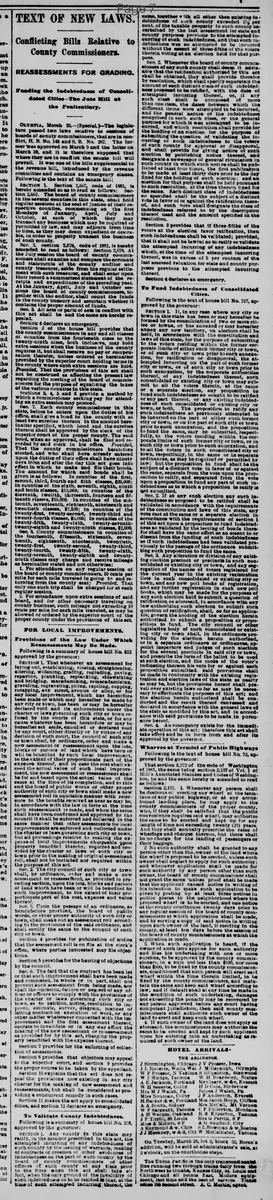
Olympia, March 25.-[Special.]-The legislature
passed two laws relative to sessions of
boards of county commissioners, that are in conflict, H. B. No. 148 and S. B. No. 267. The former
was approved on March 9 and the latter on
March 10, and it is therefore supposed that
where they are in conflict the senate bill will
prevail. It was one of the bills supplemental to
the revenue bill, introduced by the revenue
committee and contains an emergency clause.
Following is the text of the senate bill:
Section 1. Section 2667, code of 1881, is
hereby amended so as to read as follows: Section
2667. The board of county commissioners
in the several counties in this state, shall hold
regular sessions at the seat of justice of their respective counties,
commencing on the first
Mondays of January, April, July and
October, at each of which they may
transact any business which may be required or
permitted by law, and may adjourn from time to
time, as they may deem expedient or desirable, in order to properly transact the business
of such county.
Sec. 2. Section 2678, code of 1881, is hereby
amended to read as follows: Section 2678. At
the July session the board of county commissioners shall examine and compare the accounts
and statements of the county auditor and
county treasurer, aside from the regular settlement
with such treasurer, and shall enter upon
their record a summarized statement of the receipts and expenditures of the preceding year.
At the January, April, July and October sessions the board of county commissioners, together
with the auditor, shall count the funds
in the county treasury and ascertain whether it
contains the proper amount of funds.
Sec. 3. All acts or parts of acts in conflict with
this act shall be and the same are hereby repealed.
Section 4 declares an emergency.
Section 2 of the house bill provides that
the county commissioners in any and all classes
of counties from the fourteenth class to the
twenty-ninth class, both inclusive, may hold
extra sessions when the business of the county
requires it, but shall receive no pay or compensation therefor, unless ordered as hereinafter
provided by the superior court holding terms in
the county where such extra sessions are held.
Provided, That the provisions of this act shall
not be construed as affecting the present law
regarding the meeting of the board of commissioners for the purpose of equalizing the taxes
of the various counties in this state.
Sections 3, 4, 5 and 6 provide a method by
which a commissioner seeking pay for attending
an extra session may proceed.
Sec. 7. Each county commissioner in this
state, before he enters upon the duties of his
office, shall give a bond to the county with at
least two sureties thereon in the amount hereinafter specified, which bond and the sureties
thereon shall be approved by the clerk of the
superior court of the proper county. The said
bond, when so approved, shall be filed and recorded by said clerk in his office.
Provided. That the county commissioners heretofore elected, and who shall have already entered
upon the duties of their office shall have ninety
days from and after the day this act goes into
effect in which to make and file their bonds.
The amount for which said bonds shall be
given is as follows:
In counties of the first, second, third, fourth and fifth classes, $20,000; in counties of the sixth, seventh, eighth, ninth and tenth classes, $15,000; in counties of the eleventh, twelfth, thirteenth, fourteenth and fifteenth classes, $10,000. In counties of the sixteenth, seventeenth, eighteenth, nineteenth and twentieth classes, $7,500; in counties of the twenty-first, twenty-second, twenty-third and twenty-fourth classes, $5,000; in counties of the twenty-fifth, twenty-sixth, twenty-seventh, twenty-eighth and twenty-ninth classes, $2,000.
Sec. 8. County commissioners in counties of
the fourteenth, fifteenth, sixteenth, seventeenth, eighteenth, nineteenth, twentieth, twenty-first, twenty-second, twenty-third, twenty-fourth, twenty-fifth, twenty-sixth, twenty-seventh, twenty-eighth and twenty-ninth classes may charge and receive mileage as hereinafter stated and not otherwise:
1. For attendance on any regular session of
the board of county commissioners, 10 cents per
mile for each mile traveled in going to and returning from the county seat: Provided, That
only one such trip shall be charged for at each
regular session.
2. For attendance upon extra sessions of said
board, and for other necessary traveling on
county business, such mileage not exceeding 10
cents per mile for each mile traveled, as may be
allowed or ordered by the superior court of the
proper county under the provisions of this act.
FOR LOCAL IMPROVEMENTS
Provisions of the Law Under Which
Reassessments May Be Made.
Following is a summary of house bill No. 322
approved by the governor:
Section 1. That whenever an assessment for
laying out, establishing, closing, straightening, altering, widening, grading, regrading, paving, repaving, planking, replanking, sidewalking and bridging, macadamizing, remacadamizing, graveling, regraveling, piling, repiling, capping, recapping, any street, avenue or alley, or for any local improvement, which has heretofore been made or which may hereafter be made by any city or town, has been or may be hereafter declared void and its enforcement under the charter or laws governing such city or town refused by the courts of this state, or for any cause whatever has been heretofore or may be hereafter set aside, annulled or declared void by any court, either directly or by virtue of any decision of such court, the council of such city or town shall, by ordinance, order and make a new assessment or reassessment upon the lots, blocks or parcels of land which have been or will be benefited by such local improvement, to the extent of their proportionate part of the expense thereof, and in case the cost shall exceed the actual value of such local improvement, the new assessment or reassessment shall be for and based upon the actual value of the same at the time of its completion, and to this end the board of public works or other proper authority of such city or town shall make a new assessment roll in equitable manner with reference to the benefits received as near as may be, in accordance with the law in force at the time such reassessment is made, and when the same shall have been confirmed and approved by the council it shall be enforced and collected in the same manner that other assessments for local improvements are enforced and collected under the charter or laws governing such city or town, but all proceedings relative to making the existing local improvements chargeable upon property benefited thereby, required and provided by the charter or laws of such city or town prior to the making of original assessment roll, shall not be included nor required within the purpose of this act.
Sec. 2. The city council of such city or town
shall, by ordinance, order and make a new assessment or reassessment, as provided in preceding section, upon the lots, blocks and parcels of land which have been or will be benefited by such improvement, to the extent of their proportionate part of the cost, expense and value thereof.
Sec. 3. Upon the passage of an ordinance, as
hereinbefore provided, the board of public works, or other proper authority of such city or town, shall make out an assessment roll according to the provisions of the said ordinance, and shall certify the same to the council of such city or town.
Section 4 provides for publication of notice that the assessment roll is on file at the clerk's office, where parties interested may file objections.
Section 5 provides for the hearing of objections by the council.
Sec. 6. The fact that the contract has been let or that such improvement shall have been made and completed, in whole or in part, shall not prevent such assessment from being made, nor shall the omission, failure or neglect of any officer or officers to comply with the provisions of the charter or laws governing such city or town, as to petition, notice, resolution to improve, estimate, survey, diagram, manner of letting contract on execution of work, or any other matter whatsoever connected with the improvement and the first assessment thereof, operate to invalidate or in any way affect the making of the new assessment or re-assessment as provided for by this act, charging the property benefitted with the expense thereof.
Section 7 provides for the enforcing of collection of assessments.
Section 8 provides that objectors may appeal to the superior court, and section 9 provides the proper course to be taken by the appellant.
Section 10 explains that the act does not repeal the provisions now existing in any city charter for the making of new assessment and reassessments, but shall be considered as providing a concurrent remedy in such cases.
Section 11 makes the act apply to consolidated cities, and section 12 declares an emergency.
To Validate County Indebtedness.
Following is a summary of house bill No. 205, approved by the governor:
Section 1. Any county in this state may ratify, in the manner prescribed in this act, the attempted incurring of any indebtedness of such county by the issuing of warrants, making of contracts or creation of other evidences of indebtedness on the part of such county by the board of county commissioners or other officers of such county at any time prior to the time when this act shall take effect, when the only ground of the invalidity of such indebtedness so to be ratified is that, at the time of such attempted incurring thereof, the same, together with all other then outstanding indebtedness of such county exceeded 1 per cent. of the taxable property in such county ascertained by the last assessment for state and county purposes previous to the attempted incurring of such indebtedness, and that such indebtedness was attempted to be incurred without the assent of three-fifths of the voters therein voting at an election held for that purpose.
Sec. 2. Whenever the board of county commissioners of any such county shall deem it advisable that the ratification authorized by this act shall be obtained, they shall provide therefor by resolution, which shall specify separately the amount of each distinct class of such indebtedness proposed to be ratified, with the date of attempted incurring thereof, or, if any each class shall composed of more than one item, the dates between which the different items were attempted to be incurred, and the general nature of the indebtedness comprised in each such class, or the general purpose for which it was attempted to be incurred, and which resolution shall provide for the holding of an election for the purpose of submitting the question of validating the indebtedness to the voters of such county for approval or disapproval, and shall provide for giving notice of such election by publishing notice thereof, and designate a newspaper of general circulation in such county in which such notice shall be published at least four times, the first publication to be made at least thirty days prior to the day fixed for the holding of such election; and an election for that purpose shall be held pursuant to such resolution, at the time therein fixed for the same. Each distinct class of indebtedness so specified shall be the subject of a distinct vote in favor of or against the ratification thereof, and such vote shall designate the class of indebtedness referred to by the description thereof used and the amount specified in the resolution.
Section 3 provides that if three-fifths of the voters at the election favor ratification, then such indebtedness shall be validated; provided, that it shall not be lawful so to ratify or validate the attempted incurring of any indebtedness which, at the time of the attempted incurring thereof, was in excess of 5 per centum of the last assessed valuation for state and county purposes previous to the attempted incurring thereof.
Section 4 declares an emergency.
To Fund Indebtedness of Consolidated Cities.
Following is the text of house bill No. 217, approved by the governor:
Section 1. If, in any case where any city or town in this state has been or may hereafter be formed by the consolidation of two or more cities or towns, or has annexed or may hereafter annex any new territory, an election shall be held, in accordance with the constitution and laws of this state, for the purpose of submitting to the voters residing within the former corporate limits of either such former city or town, or of such city or town prior to such annexation, for ratification or disapproval, the attempted incurring on the part of such former city or town, or of such city or town prior to such annexation, by the corporate authorities thereof, of any indebtedness thereof, such consolidated or existing city or town may submit to all the voters therein, at the same or a separate election, any proposition to fund such indebtedness so sought to be ratified or any part thereof, or any existing indebtedness of such consolidated or existing city or town, or both. The proposition to ratify any such indebtedness so previously attempted to be incurred on the part of either such former city or town, or on the part of such city or town prior to such annexation, and the proposition to fund the same, may be submitted, respectively, to the voters residing within the corporate limits of such former city or town, or in such city or town prior to such annexation, and to all the voters in such consolidated city or town, respectively, in the same or in separate ordinances, as may be required or permitted by law; but the proposition to fund shall be the subject of distinct vote in favor of or against the same, separate from the vote upon the proposition to ratify, and separated from the vote upon a proposition to fund any part of such indebtedness as to which a proposition to ratify is not submitted.
Sec. 2. If at any such election any such indebtedness so proposed to be ratified shall be validated in accordance with the requirements of the constitution and laws of this state, any vote cast at the same or a separate election in accordance with the requirements of section of this act upon a proposition to fund indebtedness so validated by the issuing of bonds therefor shall have the same effect as an assent to or dissent from the funding of such indebtedness as if such indebtedness had been validated previously to the passage of the ordinance submitting such proposition to fund the same.
Sec. 3. Any alteration or division of any existing election precinct or precincts in such consolidated or existing city or town, and any segregation of the names of voters registered for the current year in the existing registration lists in such consolidated or existing city or town, and any new poll books of registration, and any further registration in such new poll books, which may be made for the purposes of any such election held to submit question of ratification as aforesaid, in accordance with any law authorizing such election to submit such question of ratification, shall, so far as applicable, govern the holding of the election herein authorized to submit a proposition or propositions to fund. The city council or other legislative body of such consolidated or existing city or town shall, in the ordinance providing for the election herein authorized, or in a separate ordinance or ordinances, appoint inspectors and judges of such election for the several precincts in said city or town, and prescribe the form of the ballot to be used at such election, and the mode of the voter's indicating thereon his vote for or against each proposition submitted. Said provisions shall be made in conformity with the existing registration and election laws of the state as nearly as may be, but the provisions hereof shall prevail over existing laws so far as may be necessary to effectuate the purposes of this act; and the election herein authorized shall be conducted and the result thereof canvassed and declared in accordance with the general laws of the state as modified by this act, and in accordance.
Sec. 4. An emergency exists for the immediate operation of this act; therefore this act shall take effect and be in force from and after its approval by the governor.
Wharves at Termini of Public Highways
Following is the text of house bill No. 72, approved by the governor:
That section 3272 of the code of Washington of 1881, the same being section 2137 of Vol. 1 of Hill's Annotated Statutes and Codes of Washington, be and the same hereby is amended to read as follows:
Section 2137.
1. Whenever any person shall be desirous of erecting any wharf at the terminus of any public highway, or at any accustomed landing place, he may apply to the county commissioners of the proper county, who, if they shall be satisfied that the public convenience requires said wharf, may authorize the same to be erected and kept up for any length of time not exceeding twenty (20) years. And they shall annually prescribe the rates of wharfage and charges thereon, but there shall be no charge for the landing of passengers or their baggage.
2. No such authority shall be granted to any person other than the owner of the land where the wharf is proposed to be erected, unless such owner shall neglect to apply for such authority; and whenever application shall be made for such authority by any person other than such owner, the board of county commissioners shall not grant the same unless proof shall be made that the applicant caused notice in writing of his intention to make such application to be given by posting up at least three notices in public places in the neighborhood where the proposed wharf is to be erected, and one notice at the county courthouse twenty days prior to any regular session of the board of county commissioners at which application shall be made, and by serving a copy of said notice in writing upon such owner of the land, if residing in the county, at least ten days before the session of the board of county commissioners at which the application is made.
3. When such application is heard, if the owner of such land applies for such authority and files his undertaking with one or more sureties, to be approved by the county commissioners, in a sum not less than $100, nor more than $500, to be fixed by the county commissioners, conditioned that such person will erect said wharf within the time therein limited, to be fixed by the county commissioners, and maintain the same and keep said wharf according to law; and if default shall at any time be made in the condition of such undertaking, damages not exceeding the penalty may be recovered by any person aggrieved before any court having competent jurisdiction, then said county commissioners shall authorize such owner of the land to erect and keep such wharf.
4. If such owner of the land does not apply as aforesaid, the commissioners may authorize the same to be erected and kept by such applicant upon his entering into an undertaking as required of such owner of the land.
HOTEL Arrivals
THE ARLINGTON
J Simmington, Chicago J V Prosser, Iowa
J L Roberts, Walla Walla J Millspaugh, Olympia
W F Prosser, N Yakima S Gilpatrick, Stanwood
W J Mudge, Tacoma
W H Beardsley, Blaine
A E Jackson, Portland
Mr Cleary, W & S, Everett
W H Scearce, Colby
H D Cole, Birdsview
Mrs M J Walsh, Pa
James J Walsh, Po
Miss Neuman, Colby
J F Anderson, Everett
M Barker & w. Portland Mrs Jacob Hopp, Clifton
A A Booth, Sidney
Mr McCall, Mr Vernon
W F Sargeant, Tacoma
C F Fullerton, Montana
A H Werum, Oakland
R S Edgerton, Tacoma
J P Tirrill, St Louis
Mrs G Perrin, S F
Miss A Miliett, S F
A G Sunfield, City
A Raymond & w. Chic
S L Bowman & w. Boston
J Hackney, W & S, Chi W McCallister, Tacoma
What sub-type of article is it?
What themes does it cover?
What keywords are associated?
Where did it happen?
Story Details
Location
Olympia, Washington
Event Date
March 25
Story Details
The legislature passed conflicting bills on county commissioners' sessions (H.B. No. 148 approved March 9, S.B. No. 267 approved March 10), with the senate bill amending sessions to first Mondays of January, April, July, October, and requiring fund counts and annual statements. The house bill allows extra sessions without pay unless court-ordered, specifies bonds by county class, and mileage rates. House bill No. 322 enables reassessments for void local improvement assessments. House bill No. 205 allows ratification of county indebtedness exceeding 1% but not 5% via voter election. House bill No. 217 permits funding indebtedness of consolidated cities via elections. House bill No. 72 amends wharf erection at highway termini.