Thank you for visiting SNEWPapers!
Sign up free
Rhode Island American And Gazette
Providence, Providence County, Rhode Island
What is this article about?
Testimony of Edward Giddens in a trial about the 1826 abduction and confinement of William Morgan by Freemasons near Fort Niagara, describing Morgan's capture, ferry crossing to Canada, imprisonment in the fort's magazine, and failed attempts to dispose of him, involving the defendant.
Clipping
OCR Quality
Full Text
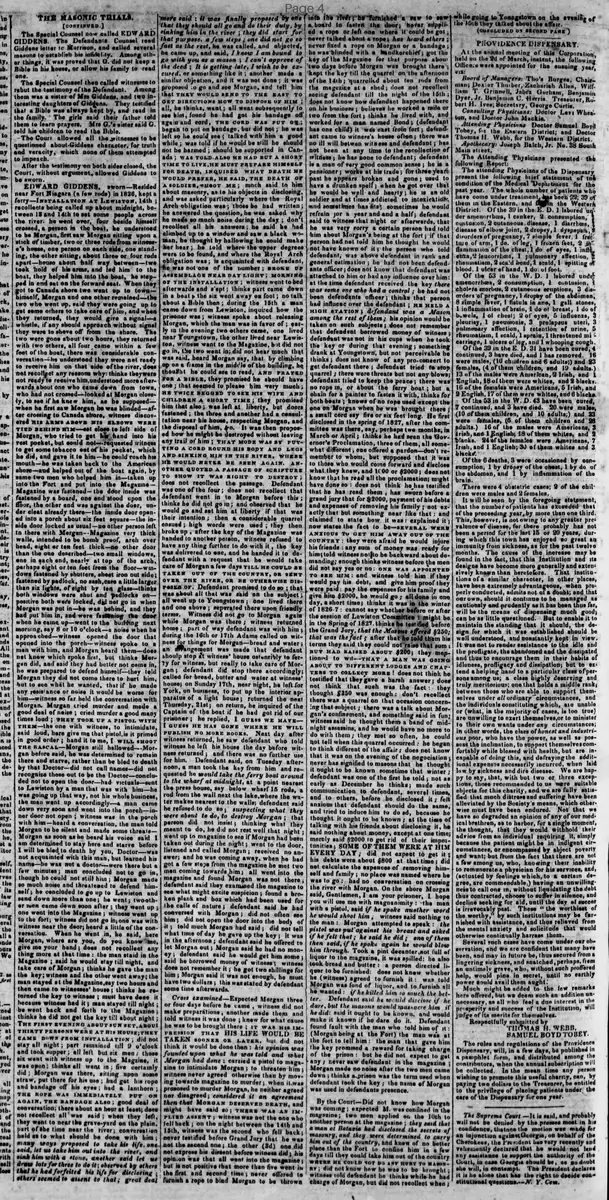
EDWARD GIDDENS, sworn—Resided near Fort Niagara (a few rods) in 1826, kept a ferry—Instalation at Lewiston, 14th; recollect being called up about midnight, between 13th and 14th to set some people across the river: he went over, four beside himself crossed, a person in the boat, he understood to be Morgan, first saw Morgan sitting upon a stick of timber, two or three rods from witness's house, one person on each side, one standing, the other sitting, about three or four rods apart—house about half way between—two took hold of his arms, and led him to the boat, they helped him into the boat, he stepped in and sat on the forward seat. When they got to Canada shore two went up to town—himself, Morgan and one other remained the two who went up, said they were going up to get some others to take care of him, and when they returned, they would give a signal—a whistle, if any should approach without signal they were to shove off from the shore. The two were gone about two hours, they returned with two others, all four came within a few feet of the boat, there was considerable conversation—he understood they were not ready to receive him on that side of the river, does not recollect any reasons why: thinks they were not ready to receive him, understood more afterwards about one who came down from town, who had not crossed—looked at Morgan closely to see if he knew him, as he supposed—when he first saw Morgan he was blinded—after crossing to Canada shore, witness discovered his arms above his elbows were tied behind him—sat close to left side of Morgan, who tried to get his hand into his vest pocket, but could not—requested witness to get some tobacco out of his pocket, which he did, and gave it to him—he could reach his mouth—he was taken back to the American shore—and helped out of the boat again, by same two men who helped him in—taken up into the Fort and put into the Magazine—Magazine was fastened—the door inside was fastened by a board, one end stood upon the floor, the other end was against the door, under cleat already there—the inside door opened into a porch about six feet square—the inside door locked as usual—no other person left in there with Morgan—Magazine very thick walls, intended to be bomb proof, arch over head, eight or ten feet thick—no other door than the one described—two small windows, one in each end, nearly at top of the arch, perhaps eight or ten feet from the floor—windows fastened by shutters, sheet iron outside; fastened by padlock, no sash, case a little larger than six lights, of eight by ten glass—thinks both windows were shut and padlocks on—positive both were locked, did not go in when Morgan was put in—he was behind, and they had put him in, and were fastening the door when he came up—went to the building next morning, say 8 or 10 o'clock—a noise when he approached—witness opened the door that opened into the porch—witness spoke to a man with him, and Morgan heard them—does not know which spoke first, but thinks Morgan did, and said they had better not come in, he was prepared to defend himself—they told Morgan they did not come there to hurt him, but to see what he wanted, that if he made any resistance or noise it would be worse for him—witness so far held the conversation with Morgan. Morgan cried murder and made a good deal of noise; cried murder a good many times loud; they took up a pistol with them—the one with witness, to intimidate, said loud, here give me that pistol, is it primed in good order; hand it to me, I will shoot the rascal—Morgan still hallowed—Morgan before said, he was determined to remain there and starve, rather than be bled to death by that Doctor—did not call names—did not recognize those out to be the Doctor—concluded not to open the door—had victuals—sent to Lewiston by a man that was with him—he was going up that way, not his whole business, the man went up accordingly—a man came down very soon and went into the porch—inner door not open; witness was in the porch with him—heard a conversation, the man told Morgan to be silent and made some threats—Morgan as soon as he heard his voice said I am determined to stay here and starve before I will be bled to death by you, Doctor—was not acquainted with this man, but learned his name—he was not a doctor—were there but a few minutes; man concluded not to go in, though he could not still him; Morgan made so much noise and threatened to defend himself; he concluded to go up to Lewiston and send down more than one; he went; two other men came down soon after; they went up; one went into the Magazine; witness went up to the fort; witness did not go in; one was with witness near the door; heard a little of the conversation. When he went in, he said, here Morgan, where are you, do you know me, give me your hand; does not recollect any thing more at that time: the man staid in the Magazine; said he would stay till night, and take care of Morgan; thinks he gave the man the key; witness and the other went away; the man stayed at the Magazine, say two hours and then came to witness's house; thinks he returned the key to witness; must have done it because witness had it; man stayed till night; he went back and forth to the Magazine; thinks he did not get the key till about night; the first evening about sun set, about thirty persons were at his house; they came down from installation; did not stay all night; part remained till 9 o'clock and took supper; all left but six men; those six went with witness up to the Magazine, it was open; thinks all went in; five certainly did; Morgan was there, sitting upon some straw, put there for his use; had got his rope and bandage off his eyes; had a lantern; the rope was immediately put on again, the bandage also; good deal of conversation; there about an hour at least; does not recollect all was said; when they left, they went to near the grave-yard on the plain. Part of the time near the river; conversation held as to what should be done with him; many ways proposed to take his life, one said, let us take him out into the river, and sink him with a stone, another said let us draw lots for three to do it; observed by others that he had forfeited his life for disclosing; others seemed to assent to that; great deal that they should all go and do their duty, by sinking him in the river; they did start for that purpose, a few steps; one did not go so fast as the rest, he was called, and objected, he came up, and said, I know I am bound to go with you as a mason; I can't approve of the deed; It is getting late, I wish to be excused, or something like it; another made a similar objection, and it was not done; it was proposed to go and see Morgan, and tell him that they would send to the East to get directions how to dispose of him; all, he thinks, went; all went subsequently to see him, found he had got his bandage off again and cord, the cord was put on; began to put on bandage, but did not; he was left so he could see; talked with him a good while; was told if he would be still he should not be harmed; should be supported in Canada; was told also he had but a short time to live, he must prepare himself for death, inquired what death he would prefer, he said, the death of a soldier, shoot me; much said to him about masonry, as to his objects in disclosing and was asked particularly where the Royal Arch obligation was; those he had written; he answered the question, he was asked why he made so much noise during the day; don't recollect all his answers; he said he had climbed up to a window and saw a black woman, he thought by hallowing he could make her hear; he told where the upper degrees were to be found, and where the Royal Arch obligation was; is acquainted with defendant, he was not one of the number; broke up assemblage near day light; morning of the installation; witness went to bed afterwards and slept; thinks part came down in a boat the six went away on foot; no talk about a Bible then; during the 15th a man came down from Lewiston, inquired how the prisoner was; witness spoke about releasing Morgan, which the man was in favor of; early in the evening two others came, one lived near Youngstown, the other lived near Lewiston, witness went to the Magazine, but did not go in, the two went in; did not hear much that was said, heard Morgan say, that by climbing up on a rafter in the middle of the building, he thought he could see to read, and prayed for a Bible, they promised he should have one; that seemed to please him very much; he twice begged to see his wife and children a short time; they promised him that also; was left at liberty, but doors fastened; the three and another had a consultation near his house, respecting Morgan, and the disposal of him, &c. It was then proposed how he might be destroyed without leaving any trail of him; that mode was by putting a cord round his body and legs and sinking him in the river, where he would never be seen again. Another quoted a passage of Scripture to show it was right to destroy; does not recollect the passage. Defendant was one of the four; does not recollect that defendant went in to Morgan before this; thinks he did not go in; and observed that he would go and set him at liberty if that was their intention; then a considerable quarrel ensued; high words were used; they then broke up; after the key of the Magazine was handed to another person, witness refused to have any thing further to do with it, the key was delivered to one, and he handed it to defendant with a request that he would take care of Morgan a few days till he could be taken out of the country, or sent over the river, or be otherwise disposed of. Defendant promised to do so; that was about all that was said on the subject; all went up to Youngstown; one lived there and one above; separated there upon friendly terms. Witness did not go to Morgan again while Morgan was there; witness returned home; part of way defendant was with him; during the 16th or 17th Adams called on witness for things for Morgan—bread and water; an arrangement was made that defendant should stop at witness's house ostensibly to ferry for witness, but really to take care of Morgan; defendant did stop there accordingly; called for bread, butter and water at witness's house; on Sunday 17th, near night, he left for York, on business, to put up the interior apparatus of a light house; returned the next Thursday, 21st; on return, he inquired of the Captain of the boat if he had got rid of our prisoner; he replied, I guess we have—I guess he has gone where he will publish no more books. Next day after witness returned, he saw defendant who told witness he left his house the day before witness returned; and there was no further use for him. Defendant said, on Tuesday afternoon, a man took the key from him and requested he would take the ferry boat around to the wharf at midnight, at a point nearest the press house, say below wharf 15 rods, a rod from the wall next the lake, where the water makes nearest to the walls; defendant said he refused to do so; suspecting what they were about to do, to destroy Morgan; that person did not insist; thinking what they meant to do, he did not rest well that night; went up to magazine to see if Morgan had been taken out during the night; went to the door, listened and called Morgan; received no answer; and he was coming away, when he had got a few steps from the magazine he met two men coming towards him; all went into the magazine and found Morgan was not there; defendant said they examined the magazine to see what might excite suspicion; found a broken plank and box which had been used for the calls of nature; defendant said he had conversed with Morgan; did not even see him; did not open the door into the body of it; told much Morgan had said; did not tell what time of day he gave up the key; it was in the afternoon; defendant said he offered to let Morgan out; Morgan said he had no money; defendant said he would get him some; said he borrowed money of witness; witness does not remember it; he got two shillings for him; Morgan said it was not enough, he must have two dollars; this was stated by defendant some time afterwards.
Cross examined—Expected Morgan three or four days before he came, witness did not make preparations; another made them and told witness it was done; knew for what cause he was to be brought there; it was his impression that his life would be taken sooner or later, but did not think it would be done then: his opinion was founded upon what he was told and what Morgan had done: carried a pistol to magazine to intimidate Morgan; to threaten him; witness never agreed otherwise than by moving towards magazine to murder; when it was proposed to murder Morgan, he neither agreed nor disagreed; considered it an agreement then that Morgan deserved death, and might have said so; there was an implied assent; witness was not the one who fell back; on the night between the 14th and 15th, witness was the second who fell back; never testified before Grand Jury that he was not the second one; the other (3d) one did not express his dissent before witness did; his opinion was that all went into the magazine; but is not positive that more than five went in the first and second time; never offered to furnish a rope to bind Morgan to be thrown into the river; is furnished says saw to— a board to fasten the door: never supplied a rope or left one where it could be got never talked about a rope; has heard others; never fixed a rope on Morgan or a bandage; he was blinded with a handkerchief; got the key of the Magazine for that purpose about two days before Morgan was brought there; kept the key till the quarrel on the afternoon of the 14th; quarrelled about ten rods from the magazine at a shed; does not recollect seeing defendant till the night of the 15th; does not know how defendant happened there on his business; believes he worked a mile or two from the fort; thinks he lived with, and worked for a man named Bond; (defendant has one child) it was east from fort; defendant came to witness's house often; there was no ill will between witness and defendant; has not been at any time to the recollection of witness; he has none to defendant; defendant is a man of very good common sense; he is a pensioner; works at his trade; for three years past he appears broken and gone; used to have a drunken spell; when he got over that he would be well and hearty; he is an old soldier and at times addicted to intoxication and sometimes has fits sometimes he would remain for a year and a half; defendant said to witness that night or afterwards, that he was very sorry a certain person had told him about Morgan's being at the fort; if that person had not told him he thought he would not have known of it; the person who told defendant; was above defendant in rank and general estimation; he had not been defendant's officer; does not know that defendant was attached to him or had any influence over him: at the time defendant received the key there was some one who had a control; he had not been defendant's officer; thinks that person had influence over the defendant; he held a high station; defendant was a Mason among the rest of them; his opinion would be taken on such subjects; does not remember that defendant borrowed money of witness; defendant was not in his cups when he took the key or during that evening; something drank at Youngstown, but not perceivable he thinks; does not know of any pre-concert to get defendant there; defendant tried to stop quarrel; there were threats but not any blows; defendant tried to keep the peace; there was no rope in, or about the ferry boat; but a chain for a painter to fasten it with, thinks for both boats; knows of no rope used except the one on Morgan when he was brought (here a small cord say five or six feet long. He first disclosed in the spring of 1827, after the committee was there, say, perhaps two months, in March or April; thinks he had seen the Governor's Proclamation, three of them, all somewhat different; one offered a pardon—don't remember to whom, but supposed that it was to those who would come forward and disclose what they knew, and $1000 or $2000; does not know that he read all the proclamation; might have done so: does not think he has testified that he has read them, has sworn before a grand jury that for $2000, payment of his debts and expenses of removing his family; not exactly that but something near like that: and claimed to state how it was: explained it; now states the fact to be—several were anxious to get him away out of the country: they were afraid he would injure his friends: any sum of money was ready for him; told witness not to be backward about demanding; enough thinks witness before the men did not say yes or no: one was appointed to see him: and witness told him if they would pay his debt, and give him proof they were paid: pay the expenses for his family and give him $2000, he would go; all done in one day, a short time; thinks it was in the winter of 1826-7: cannot say whether before or after the session of Lewiston Committee: might be in the Spring of 1827; thinks he testified before the Grand Jury, that the Masons offered $250; that was the fact after that he told them his terms they said they could not raise that sum: but had raised about $200; they mentioned to witness—that a man was going about to different lodges and chapters to collect more! does not think he testified that they gave a harsh answer; does not think that such was the fact: they thought $250 was enough: don't recollect there was a quarrel on that occasion concerning that subject; there was a talk about Morgan's confinement, and something said in fun; witness said he thought them a band of midnight assassins, and he would have no more to do with them; they met so often, he could not tell when this quarrel occurred: he began to think different of the affair; does not know that it was on the evening of the negociation; never has signified to masons that he thought it ought to be known sometime that winter; defendant was one of the first he told; not as early as December he thinks; made such communication to defendant, several times, and to others, before he disclosed it; felt anxious that defendant should do the same, and tried to induce him to do so, because he thought it ought to be known; at the time of talking with his friends about disclosing it, he said nothing about money, except at one time; merely said $2000 to get rid of their importunities; some of them were at him every day; did not expect to get it; his debts were about $800 at that time; did not calculate the expenses of removing himself and family; no place was named where he was to go; had no conversation on crossing the river with Morgan. On the shore Morgan said, Gentlemen, I am your prisoner, I hope you will use me with magnanimity: the man with a pistol, said if he spoke another word he would shoot him; witness said nothing to the man: Morgan attempted to speak: the pistol was put against his breast and asked if he felt that; he said he did; one of them then said, if he spoke again he would blow him through. Took a pint decanter, not full of liquor to the magazine, it was spilled: he also took bread and butter: a person directed liquor to be furnished: does not know whether he (witness) agreed to furnish it: was told Morgan was fond of liquor, and to furnish all he wanted: if he killed him so much the better. Defendant said he would disclose if he dare, but the masons would massacre him if he did: said it ought to be known, and would make it known if he dare do it. Defendant found fault with the man who told him of it: (Morgan being at the Fort) the man was at the fort to tell him: the man that gave him the key promised a reward for taking charge of the prison: but he did not expect to get any; never saw defendant in the magazine; Morgan made no noise after the two men came down; thinks a prison was the term used when defendant took the key; the name of Morgan was used in defendant's presence.
By the Court—Did not know how Morgan was coming; expected M. was confined in the magazine; two men applied on the 10th to another person at the magazine; they said that a man at Batavia had disclosed the secrets of masonry, and they were determined to carry him out of the country, and knew of no better place than the Fort to confine him in a few days till they could take him out of the country where he could not do any hurt to Masonry; did not know how he was to be brought; witness told defendant he thinks while he had charge of Morgan, but did not recollect when; while going to Youngstown on the evening of the 15th they talked about the affair.
(CONCLUDED ON SECOND PAGE)
What sub-type of article is it?
What themes does it cover?
What keywords are associated?
What entities or persons were involved?
Where did it happen?
Story Details
Key Persons
Location
Near Fort Niagara
Event Date
1826
Story Details
Edward Giddens testifies about ferrying blinded William Morgan across the Niagara River in 1826, his confinement in Fort Niagara's magazine by Freemasons, attempts to silence and dispose of him by drowning, a quarrel among conspirators, and the defendant's reluctant involvement in guarding Morgan before his disappearance.