Thank you for visiting SNEWPapers!
Sign up free
Story
April 19, 1802
The National Intelligencer And Washington Advertiser
Washington, District Of Columbia
What is this article about?
A speaker in Congress defends the constitutionality of repealing a law to remove judges, counters threats of armed resistance from opponents, contrasts with Maryland's temporary judicial law, and refutes claims that inferior courts are constitutionally entrenched.
Clipping
OCR Quality
75%
Good
Full Text
Constitution from the share
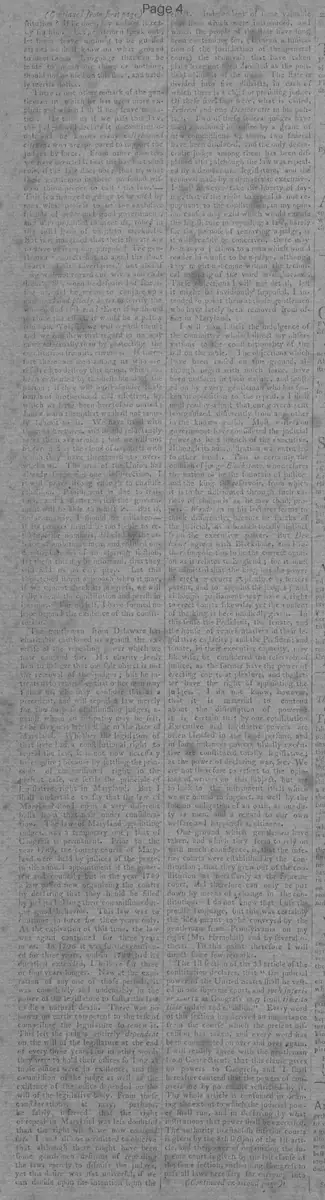
institution? If it does, no answer is ready for him. Let gentlemen speak out; let them leave nothing to be guessed at; and we shall all know on what ground to meet silence. Language that can be made to mean anything or nothing should not be used on this floor, and hardly merits notice.
There is one other remark of the gentleman in which he has been more explicit and which I shall beg leave to notice. He tells us if we pass this law the judges will declare it unconstitutional, and he knows many enlightened citizens who are prepared to support the judges by force. From other quarters we have learnt, that the bayonet will rule, if the law does not; that is, what these gentlemen in their profound wisdom do not think proper to call this law.
This is strange language to be used by men who profess to be the exclusive friends of order and good government, and who parade field to meet us, robed in the militia garb of captain, colonel.
But is it right guided that these threats are to drive us from our purpose? The gentleman expects not to appal the hearts of his adversaries, but asks if we will not regard our lives as in danger. Yes, when he despaired of alarming us, he meant to conjure up a fray amid bloody riots to terrify the world and? Even if he should sue this effect it would be a policy triumph. Yes, sir, we will regard them; and we can show that regard in no way more essentially than by protecting the constitution from such menaces. If therefore there are men among us who are resolved to subvert this union, which has been cemented by the best blood of the nation; if they will burst asunder the bonds of brotherhood and affection, by which we have been heretofore united; I do warn them, that we shall not tamely submit to it. We have lived with them as brethren, and should reluctantly see them as enemies; but we will not be terrified by the cloud of bayonets with which they have threatened to overwhelm us. The arm of the Union has already stamped one insurrection, I trust, proud enough to chastise greater. Punishment is due, sir, and I feel persuaded the government will be able to justify it. But if unhappily I should be mistaken-- if its powers should be too feeble to repress numbers, deluded by the arts and ambitions men, and enlisted under the banner of an aspiring faction, let them this day be informed, that they will find us no easy prey. Let this threatened storm approach when it may, if we cannot check its progress, we will rally round the constitution and perish in its ruins. For me, self, I have formed no hopes beyond the existence of this constitution.
The gentleman from Delaware has charitably cautioned us against the exercise of the repealing power which we now contend for. His charity leads him to believe that our sole object is not the removal of the judges: but he entreats us to remember that other men may allow us, who may consider this as a precedent, and will repeal a law merely for the purpose of dismissing judges, against whom an antipathy may be felt, as he says was lately done in the state of Maryland. Whether the legislature of that state had a constitutional right to repeal the law, it is not now necessary to enquire; because by settling the principle of congressional right in the present case, we settle the principle of legislative right in Maryland. But I shall undertake to say that the law of Maryland stood upon a very different basis from that now under consideration. The law of Maryland appointing judges was a temporary one; that of Congress is permanent. Prior to the year 1782, the County courts of Maryland were filled by justices of the peace, in the annual appointment of the governor and council; but in the year 1782 a law passed now organizing the courts by declaring that they should be filled by judges holding their commissions during good behavior. This law was to continue in force for three years only. At the expiration of this time, the law was again continued for three years more. In 1796 it was further continued for three years, and in 1799 had its duration extended, I believe for three or four years longer. Now at the expiration of any one of those periods, it was completely and undeniably in the power of the legislature to let the law die a natural death. There was no power on earth competent to the task of compelling the legislature to renew it. This left the judges entirely dependent on the will of the legislature at the end of every three years; or in other words they were to hold their offices so long as those offices were in existence, and the commission of the judge as well as the existence of the office depended on the will of the legislative body. From these considerations, it may, perhaps, be fairly inferred that the right of repeal in Maryland was less doubtful than the right which we now contend for. I could still be permitted to observe that although there might have been some gentlemen desirous of repealing the law, merely to dismiss the judges, yet this design was not universal, if we can decide upon the intention from the which the people of the state have long been contending for, (I mean a limitation of the jurisdiction of the general court) the removals that have taken place have not been directed at the political opinions of the men. The state is divided into five districts, in each of which there is a chief or presiding judge. Of these five, four were, what is called, Federal and one Democratic in his politics. Two of these federal judges have been continued in office by a grant of new commissions to them, two federal have been displaced, and the only democratic judge among them has been displaced also; although the law was repealed by a democratic legislature, and the removal made by a democratic executive.
I shall however take the liberty of saying, that if the right to repeal is not repugnant to the constitution, in my opinion causes may exist which would excuse the legislature in repealing a law, barely for the purpose of removing a judge, as it will readily be conceived, there may be many objections to a man which would render him unfit to be a judge, although they might not come within the technical meaning of the word misbehavior. These objections I will not detail, lest it might be invidiously supposed, I intended to point them at those gentlemen who have lately been removed from office in Maryland.
I will now solicit the indulgence of the committee while I direct my observations to the constitutionality of the bill on the table. The objections which have been raised on this ground, although urged with much force, have been uniform in their nature, and insisted on by every gentleman who has spoken in opposition to the repeal. I shall most readily admit that our government is organized differently from any other in the known world. Most writers on government have considered the judicial power to be a branch of the executive, although its administration was entrusted to other hands. This is certainly the opinion of Sir William Blackstone, who declares the nation to be the fountain of justice and the king the reservoir, from which it is to be distributed through such variety of channels as he may think proper. Woodeson in his lectures seems to think differently, because he speaks of the judicial, as a branch totally distinct from the executive power. But Delolme agrees with Blackstone, and I rather suppose this to be the correct opinion as it relates to England; for it must be admitted that the king has the power of erecting courts at pleasure, by letters patent, and to appoint the judges; and although parliament may have a right to erect courts likewise, yet the consent of the king is here tacitly given. In this sense the President, the senate, and the house of representatives in their legislative capacity; and the President and senate, in their executive capacity, may likewise, be considered the reservoir of justice, as the former have the power of erecting courts at pleasure, and the latter have the right of appointing the judges. I do not know, however, that it is material to contend about the distribution of powers? it is certain that by our constitution Executive and legislative powers are often blended in the same persons, and in some instances powers usually executive are constituted totally legislative; as the power of declaring war, &c. We are not therefore to resort to the opinions of writers on this subject, but are to look to the instrument itself which we are bound to support, as well by the solemn obligation of an oath, as our duty as men, and a regard to our own welfare and happiness as citizens.
One ground which gentlemen have taken, and which they seem to rely on with much confidence, is, that the inferior courts were established by the constitution; that they grew out of the constitution as necessarily as the supreme court, and therefore can only be put down by means of a change in the constitution. I do not know that I use the precise language, but this was certainly the idea meant to be conveyed by the gentleman from Pennsylvania on my right (Mr. Hemphill) and by several others. To this point therefore I will direct some few remarks.
The 1st section of the 3d article of the constitution declares, that "the judicial power of the United States shall be vested in one supreme court, and such inferior courts as Congress may from time to time ordain and establish." Every word of this section has derived an importance from the course which the present discussion has taken, and every word has been commented on over and over again. I will readily agree with the gentleman from Connecticut, that this clause gives no powers to Congress, and I shall hereafter contend that the powers of congress are by no means restricted by it. The whole article is consumed in defining the extent to which the judicial power shall run, and in declaring by what institutions that power shall be exercised. The authority to establish inferior courts is given by the 8th section of the 1st article, and the power of organizing the supreme court is given by the last clause of the same section, authorizing Congress to pass all laws necessary for carrying into
(Continued on second page)
institution? If it does, no answer is ready for him. Let gentlemen speak out; let them leave nothing to be guessed at; and we shall all know on what ground to meet silence. Language that can be made to mean anything or nothing should not be used on this floor, and hardly merits notice.
There is one other remark of the gentleman in which he has been more explicit and which I shall beg leave to notice. He tells us if we pass this law the judges will declare it unconstitutional, and he knows many enlightened citizens who are prepared to support the judges by force. From other quarters we have learnt, that the bayonet will rule, if the law does not; that is, what these gentlemen in their profound wisdom do not think proper to call this law.
This is strange language to be used by men who profess to be the exclusive friends of order and good government, and who parade field to meet us, robed in the militia garb of captain, colonel.
But is it right guided that these threats are to drive us from our purpose? The gentleman expects not to appal the hearts of his adversaries, but asks if we will not regard our lives as in danger. Yes, when he despaired of alarming us, he meant to conjure up a fray amid bloody riots to terrify the world and? Even if he should sue this effect it would be a policy triumph. Yes, sir, we will regard them; and we can show that regard in no way more essentially than by protecting the constitution from such menaces. If therefore there are men among us who are resolved to subvert this union, which has been cemented by the best blood of the nation; if they will burst asunder the bonds of brotherhood and affection, by which we have been heretofore united; I do warn them, that we shall not tamely submit to it. We have lived with them as brethren, and should reluctantly see them as enemies; but we will not be terrified by the cloud of bayonets with which they have threatened to overwhelm us. The arm of the Union has already stamped one insurrection, I trust, proud enough to chastise greater. Punishment is due, sir, and I feel persuaded the government will be able to justify it. But if unhappily I should be mistaken-- if its powers should be too feeble to repress numbers, deluded by the arts and ambitions men, and enlisted under the banner of an aspiring faction, let them this day be informed, that they will find us no easy prey. Let this threatened storm approach when it may, if we cannot check its progress, we will rally round the constitution and perish in its ruins. For me, self, I have formed no hopes beyond the existence of this constitution.
The gentleman from Delaware has charitably cautioned us against the exercise of the repealing power which we now contend for. His charity leads him to believe that our sole object is not the removal of the judges: but he entreats us to remember that other men may allow us, who may consider this as a precedent, and will repeal a law merely for the purpose of dismissing judges, against whom an antipathy may be felt, as he says was lately done in the state of Maryland. Whether the legislature of that state had a constitutional right to repeal the law, it is not now necessary to enquire; because by settling the principle of congressional right in the present case, we settle the principle of legislative right in Maryland. But I shall undertake to say that the law of Maryland stood upon a very different basis from that now under consideration. The law of Maryland appointing judges was a temporary one; that of Congress is permanent. Prior to the year 1782, the County courts of Maryland were filled by justices of the peace, in the annual appointment of the governor and council; but in the year 1782 a law passed now organizing the courts by declaring that they should be filled by judges holding their commissions during good behavior. This law was to continue in force for three years only. At the expiration of this time, the law was again continued for three years more. In 1796 it was further continued for three years, and in 1799 had its duration extended, I believe for three or four years longer. Now at the expiration of any one of those periods, it was completely and undeniably in the power of the legislature to let the law die a natural death. There was no power on earth competent to the task of compelling the legislature to renew it. This left the judges entirely dependent on the will of the legislature at the end of every three years; or in other words they were to hold their offices so long as those offices were in existence, and the commission of the judge as well as the existence of the office depended on the will of the legislative body. From these considerations, it may, perhaps, be fairly inferred that the right of repeal in Maryland was less doubtful than the right which we now contend for. I could still be permitted to observe that although there might have been some gentlemen desirous of repealing the law, merely to dismiss the judges, yet this design was not universal, if we can decide upon the intention from the which the people of the state have long been contending for, (I mean a limitation of the jurisdiction of the general court) the removals that have taken place have not been directed at the political opinions of the men. The state is divided into five districts, in each of which there is a chief or presiding judge. Of these five, four were, what is called, Federal and one Democratic in his politics. Two of these federal judges have been continued in office by a grant of new commissions to them, two federal have been displaced, and the only democratic judge among them has been displaced also; although the law was repealed by a democratic legislature, and the removal made by a democratic executive.
I shall however take the liberty of saying, that if the right to repeal is not repugnant to the constitution, in my opinion causes may exist which would excuse the legislature in repealing a law, barely for the purpose of removing a judge, as it will readily be conceived, there may be many objections to a man which would render him unfit to be a judge, although they might not come within the technical meaning of the word misbehavior. These objections I will not detail, lest it might be invidiously supposed, I intended to point them at those gentlemen who have lately been removed from office in Maryland.
I will now solicit the indulgence of the committee while I direct my observations to the constitutionality of the bill on the table. The objections which have been raised on this ground, although urged with much force, have been uniform in their nature, and insisted on by every gentleman who has spoken in opposition to the repeal. I shall most readily admit that our government is organized differently from any other in the known world. Most writers on government have considered the judicial power to be a branch of the executive, although its administration was entrusted to other hands. This is certainly the opinion of Sir William Blackstone, who declares the nation to be the fountain of justice and the king the reservoir, from which it is to be distributed through such variety of channels as he may think proper. Woodeson in his lectures seems to think differently, because he speaks of the judicial, as a branch totally distinct from the executive power. But Delolme agrees with Blackstone, and I rather suppose this to be the correct opinion as it relates to England; for it must be admitted that the king has the power of erecting courts at pleasure, by letters patent, and to appoint the judges; and although parliament may have a right to erect courts likewise, yet the consent of the king is here tacitly given. In this sense the President, the senate, and the house of representatives in their legislative capacity; and the President and senate, in their executive capacity, may likewise, be considered the reservoir of justice, as the former have the power of erecting courts at pleasure, and the latter have the right of appointing the judges. I do not know, however, that it is material to contend about the distribution of powers? it is certain that by our constitution Executive and legislative powers are often blended in the same persons, and in some instances powers usually executive are constituted totally legislative; as the power of declaring war, &c. We are not therefore to resort to the opinions of writers on this subject, but are to look to the instrument itself which we are bound to support, as well by the solemn obligation of an oath, as our duty as men, and a regard to our own welfare and happiness as citizens.
One ground which gentlemen have taken, and which they seem to rely on with much confidence, is, that the inferior courts were established by the constitution; that they grew out of the constitution as necessarily as the supreme court, and therefore can only be put down by means of a change in the constitution. I do not know that I use the precise language, but this was certainly the idea meant to be conveyed by the gentleman from Pennsylvania on my right (Mr. Hemphill) and by several others. To this point therefore I will direct some few remarks.
The 1st section of the 3d article of the constitution declares, that "the judicial power of the United States shall be vested in one supreme court, and such inferior courts as Congress may from time to time ordain and establish." Every word of this section has derived an importance from the course which the present discussion has taken, and every word has been commented on over and over again. I will readily agree with the gentleman from Connecticut, that this clause gives no powers to Congress, and I shall hereafter contend that the powers of congress are by no means restricted by it. The whole article is consumed in defining the extent to which the judicial power shall run, and in declaring by what institutions that power shall be exercised. The authority to establish inferior courts is given by the 8th section of the 1st article, and the power of organizing the supreme court is given by the last clause of the same section, authorizing Congress to pass all laws necessary for carrying into
(Continued on second page)
What sub-type of article is it?
Historical Event
What themes does it cover?
Justice
Moral Virtue
What keywords are associated?
Judges Repeal
Constitutionality
Congressional Debate
Maryland Judiciary
Armed Resistance
Inferior Courts
What entities or persons were involved?
Gentleman From Delaware
Mr. Hemphill
Gentleman From Connecticut
Story Details
Key Persons
Gentleman From Delaware
Mr. Hemphill
Gentleman From Connecticut
Story Details
Speaker argues for repealing a permanent congressional law appointing judges during good behavior, contrasts with Maryland's temporary judicial law from 1782 onward, refutes constitutional objections, and warns against threats of armed resistance to the repeal.