Thank you for visiting SNEWPapers!
Sign up free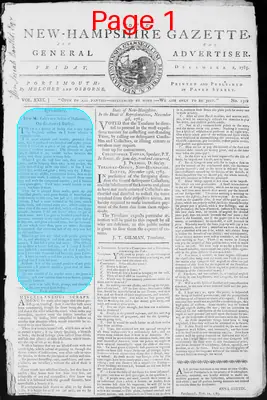
Story
December 2, 1785
Fowle's New Hampshire Gazette And General Advertiser
Portsmouth, Rockingham County, New Hampshire
What is this article about?
Mr. Varlo describes cultivating scarce six-rowed barley in England, achieving extraordinary yields despite mishaps like a mare eating the crop and pests, yielding enough to sow an acre.
Clipping
OCR Quality
98%
Excellent
Full Text
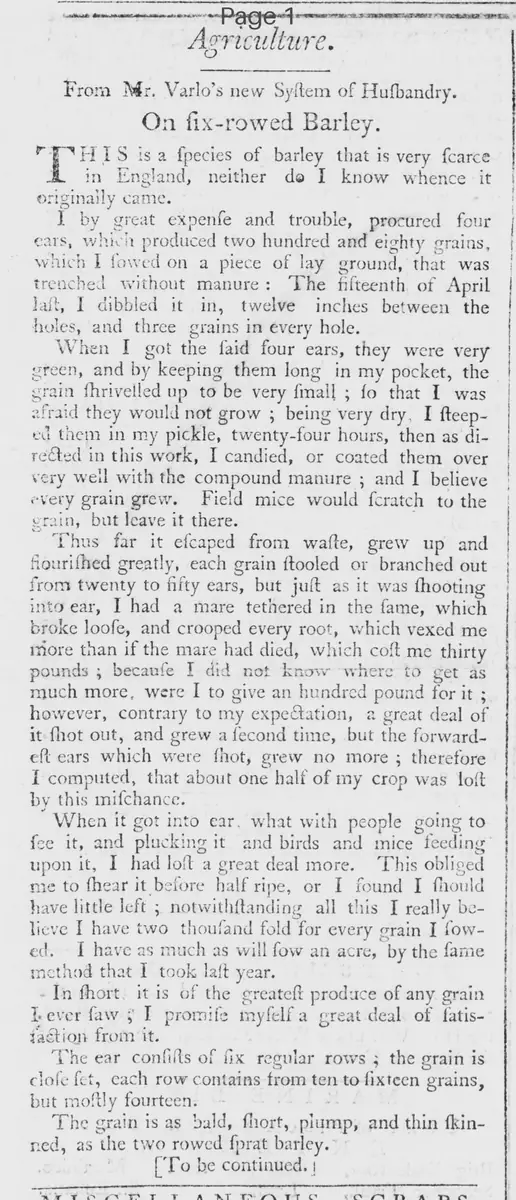
Agriculture.
From Mr. Varlo's new System of Husbandry.
On six-rowed Barley.
THIS is a species of barley that is very scarce in England, neither do I know whence it originally came.
I by great expense and trouble, procured four ears, which produced two hundred and eighty grains,
which I sowed on a piece of lay ground, that was trenched without manure : The fifteenth of April last, I dibbled it in, twelve inches between the holes, and three grains in every hole.
When I got the said four ears, they were very green, and by keeping them long in my pocket, the grain shrivelled up to be very small ; so that I was afraid they would not grow ; being very dry, I steeped them in my pickle, twenty-four hours, then as directed in this work, I candied, or coated them over very well with the compound manure ; and I believe every grain grew. Field mice would scratch to the grain, but leave it there.
Thus far it escaped from waste, grew up and flourished greatly, each grain tooled or branched out from twenty to fifty ears, but just as it was shooting into ear, I had a mare tethered in the same, which broke loose, and cropped every root, which vexed me more than if the mare had died, which cost me thirty pounds ; because I did not know where to get as much more, were I to give an hundred pound for it ;
however, contrary to my expectation, a great deal of it shot out, and grew a second time, but the forwardest ears which were shot, grew no more ; therefore I computed, that about one half of my crop was lost by this mischance.
When it got into ear. what with people going to see it, and plucking it and birds and mice feeding upon it, I had lost a great deal more. This obliged me to shear it before half ripe, or I found I should have little left ; notwithstanding all this I really believe I have two thousand fold for every grain I sowed. I have as much as will sow an acre, by the same method that I took last year.
- In short it is of the greatest produce of any grain I ever saw ; I promise myself a great deal of satisfaction from it.
The ear consists of six regular rows ; the grain is close set, each row contains from ten to sixteen grains, but mostly fourteen.
The grain is as bald, short, plump, and thin skinned, as the two rowed sprat barley.
[To be continued.]
From Mr. Varlo's new System of Husbandry.
On six-rowed Barley.
THIS is a species of barley that is very scarce in England, neither do I know whence it originally came.
I by great expense and trouble, procured four ears, which produced two hundred and eighty grains,
which I sowed on a piece of lay ground, that was trenched without manure : The fifteenth of April last, I dibbled it in, twelve inches between the holes, and three grains in every hole.
When I got the said four ears, they were very green, and by keeping them long in my pocket, the grain shrivelled up to be very small ; so that I was afraid they would not grow ; being very dry, I steeped them in my pickle, twenty-four hours, then as directed in this work, I candied, or coated them over very well with the compound manure ; and I believe every grain grew. Field mice would scratch to the grain, but leave it there.
Thus far it escaped from waste, grew up and flourished greatly, each grain tooled or branched out from twenty to fifty ears, but just as it was shooting into ear, I had a mare tethered in the same, which broke loose, and cropped every root, which vexed me more than if the mare had died, which cost me thirty pounds ; because I did not know where to get as much more, were I to give an hundred pound for it ;
however, contrary to my expectation, a great deal of it shot out, and grew a second time, but the forwardest ears which were shot, grew no more ; therefore I computed, that about one half of my crop was lost by this mischance.
When it got into ear. what with people going to see it, and plucking it and birds and mice feeding upon it, I had lost a great deal more. This obliged me to shear it before half ripe, or I found I should have little left ; notwithstanding all this I really believe I have two thousand fold for every grain I sowed. I have as much as will sow an acre, by the same method that I took last year.
- In short it is of the greatest produce of any grain I ever saw ; I promise myself a great deal of satisfaction from it.
The ear consists of six regular rows ; the grain is close set, each row contains from ten to sixteen grains, but mostly fourteen.
The grain is as bald, short, plump, and thin skinned, as the two rowed sprat barley.
[To be continued.]
What sub-type of article is it?
Curiosity
Personal Triumph
What themes does it cover?
Triumph
Misfortune
What keywords are associated?
Six Rowed Barley
Agriculture
High Yield
Crop Cultivation
Mishap
Manure Treatment
What entities or persons were involved?
Mr. Varlo
Where did it happen?
England
Story Details
Key Persons
Mr. Varlo
Location
England
Event Date
Fifteenth Of April Last
Story Details
Mr. Varlo obtains scarce six-rowed barley seeds, sows them using special methods, faces setbacks from a mare, pests, and visitors, but achieves a yield of two thousand fold, enough to sow an acre.