Thank you for visiting SNEWPapers!
Sign up free
Editorial
January 25, 1843
Republican Herald
Providence, Providence County, Rhode Island
What is this article about?
Extracts from Massachusetts Governor Morton's address to the legislature emphasize social equality, moral principles, democratic rights, suffrage purity, and the need for education to promote reform and prevent inequality.
Clipping
OCR Quality
95%
Excellent
Full Text
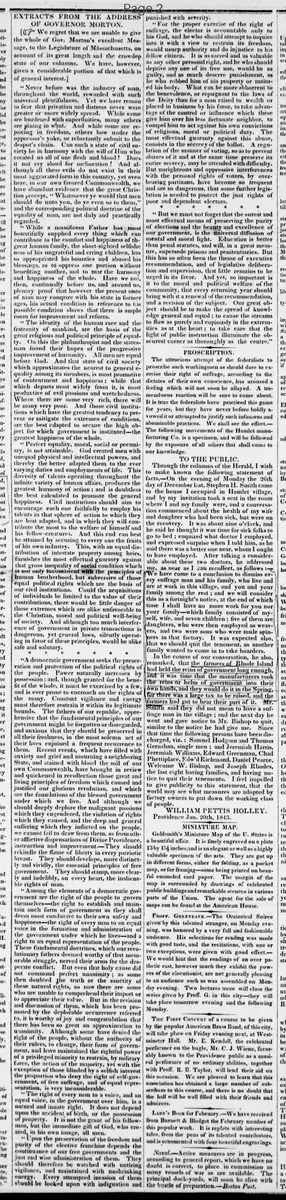
EXTRACTS FROM THE ADDRESS
OF GOVERNOR MORTON.
[ We regret that we are unable to give the whole of Gov. Morton's excellent Message, to the Legislature of Massachusetts, on account of its great length and the crowded state of our columns.
We have, however, given a considerable portion of that which is of general interest.]
" Never before was the industry of man, throughout the world, rewarded with such universal plentifulness, Yet we have reason to fear that privation and distress never were greater or more widely spread. While some are burdened with superfluities, many others are pining in want. And while some are rejoicing in freedom, others bow under the oppressor's yoke, or reluctantly submit to the despot's chain. Can such a state of civil society be in harmony with the will of Him who created us all of one flesh and blood? Does it not cry aloud for melioration? And although all these evils do not exist in their most aggravated form in this country, yet even here, in our own favored Commonwealth, we have abundant evidence that the great Christian precept, " Whatsoever ye would that men should do unto you, do ye even so to them," and the corresponding political doctrine of the equality of man, are not duly and practically regarded.
"While a munificent Father has most bountifully supplied every thing which can contribute to the comfort and happiness of the great human family, the short-sighted selfishness of his ungrateful and erring children, has so appropriated his bounties and abused his blessings, as to oppress one portion without benefiting another, and to mar the harmony and happiness of the whole. Have we not, then, continually before us, and around us, plenary proof that however the present state of man may compare with his state in former ages, his actual condition in reference to his possible condition shows that there is ample room for improvement and reform.
"The identity of the human race and the fraternity of mankind, are the basis of the great religious and political principle of equality. On this the philanthropist and the statesman found their hopes of the progressive improvement of humanity. All men are equal before God. And that state of civil society which approximates the nearest to general equality among its members, is most promotive of contentment and happiness; while that which departs most widely from it, is most productive of evil passions and wretchedness. Where there are some very rich, there will be many very poor. And those civil institutions which have the greatest tendency to prevent or mitigate the extremes of conditions, are the best adapted to secure the high object for which government is instituted—the greatest happiness of the whole.
"Perfect equality, moral, social or pecuniary, is not attainable. God created men with unequal physical and intellectual powers, and thereby the better adapted them to the ever varying duties and employments of life: This diversity of talents operating throughout the infinite variety of human affairs, produces the greatest harmony of action : and is doubtless the best calculated to promote the general happiness. Civil institutions should aim to encourage each one faithfully to employ his talents in that sphere of action to which they are best adapted, and in which they will contribute the most to the welfare of himself and his fellow-creatures. And this end can best be attained by securing to every one the fruits of his own industry. This, with an equal distribution of intestate property among heirs, furnishes the most effectual guaranty against that gross inequality of social condition which is not only inconsistent with the principles of human brotherhood, but subversive of those equal political rights which are the basis of our civil institutions. Could the acquisitions of individuals be limited to the value of their contributions, there would be little danger of those extremes which are alike unfavorable to the Christian, moral and political well-being of society. And although too much interference of government in private transactions is dangerous, yet general laws, silently operating in favor of these principles, would be alike safe and salutary.
"A democratic government seeks the preservation and protection of the political rights of the people. Power naturally increases by possession; and, though granted for the benefit of the whole, it must be exercised by a few, and is ever prone to encroach on the rights of the many. Constant vigilance and energy must therefore restrain it within its legitimate bounds. The fathers of our republic, apprehensive that the fundamental principles of our government might be forgotten or disregarded, and anxious that they should be preserved in all their freshness, in the most solemn act of their lives enjoined a frequent recurrence to them. Recent events, which have filled with anxiety and grief and mourning a neighboring State, and stained with blood the soil of our own Commonwealth, have brought in review and quickened in recollection those great and living principles of freedom which caused and justified our glorious revolution, and which are the foundations of the blessed government under which we live. And although we should deeply deplore the malignant passions which they engendered, the violation of rights which they caused, and the deep and general suffering which they inflicted on the people, we cannot fail to draw from them, as from other afflictive dispensations of Divine Providence, instruction and improvement.—They should rekindle the flame of liberty in every patriotic breast. They should develope, more distinctly and vividly, the essential principles of free government. They should stamp, more clearly and indelibly, on every heart, the inalienable rights of man.
"Among the elements of a democratic government are the right of the people to govern themselves—the right to establish and maintain such form of government as they shall deem most conducive to their own safety and happiness—the right of every man to an equal voice in the formation and administration of the government under which he lives—and a right to an equal representation of the people. These fundamental doctrines, which our revolutionary fathers deemed worthy of that memorable struggle, nerved their arms for the desperate conflict. But even that holy cause did not command perfect unanimity; as some then doubted the truth or the sanctity of these natural rights, so now there are some who are unable to comprehend their import or to appreciate their value. But in the revision and discussion of them, which has been promoted by the deplorable occurrence referred to, it is worthy of joy and congratulation that there has been so great an approximation to unanimity. Although some have denied the right of the people, without the authority of their rulers, to change, their form of government, and have maintained the rightful power of a privileged minority to restrain, by military force, the action of the majority, yet with the exception of those blinded by a selfish interest the proportion who deny the right of self-government, of free suffrage, and of equal representation,is very inconsiderable.
"The right of every man to a voice, and an equal voice, in the government over him, is a natural and innate right. It does not depend upon the accident of birth, or the possession of property. It is not the grant of his fellow-man, but the immediate gift of God, who created, in his own image, all men.
Upon the preservation of the freedom and purity of the elective franchise depends the continuance of our free governments and the just and wise administration of them. They should therefore be watched with untiring vigilance, and maintained with unshrinking energy. Every attempted invasion of them should be looked upon with indignation and punished with severity.
" For the proper exercise of the right of suffrage, the elector is accountable only to his God, and he who should attempt to inquire into it with a view to restrain its freedom, would usurp authority and do injustice to his fellow citizen. It is as sacred and as valuable as any other personal right, and he who should deprive any one of its free use, would be as guilty, and as much deserve punishment, as he who robbed him of his property or maimed his body. What can be more abhorrent to the benevolence, or repugnant to the laws of the Deity than for a man raised to wealth or placed in business by his favor, to take advantage of the control or influence which these give him over his less fortunate neighbor, to compel him to act against his own convictions of religious, moral or political duty. The most effectual guaranty against this abuse, consists in the secrecy of the ballot. A regulation of the manner of voting, so as to prevent abuses of it and at the same time preserve its entire secrecy, may be attended with difficulty. But unrighteous and oppressive interferences with the personal rights of voters, by over-bearing partisans, have become so frequent and are so dangerous, that some further legislation is needed to protect the just rights of poor and dependent electors.
" But we must not forget that the surest and most effectual means of preserving the purity of elections and the beauty and excellence of our government, is the universal diffusion of mental and moral light. Education is better than penal statutes, and will, in a great measure, supersede prisons and penitentiaries. But this has so often been the theme of executive recommendation, and of legislative deliberation and supervision, that little remains to be urged in its favor. And yet, so important is it to the moral and political welfare of the community, that every returning year should bring with it a renewal of the recommendation, and a revision of the subject. Our great object should be to make the spread of knowledge general and equal; to cause the streams to flow as purely and copiously in the extremities as at the heart: to take care that the light of public instruction illuminate the obscurest corner as thoroughly as the centre.'
OF GOVERNOR MORTON.
[ We regret that we are unable to give the whole of Gov. Morton's excellent Message, to the Legislature of Massachusetts, on account of its great length and the crowded state of our columns.
We have, however, given a considerable portion of that which is of general interest.]
" Never before was the industry of man, throughout the world, rewarded with such universal plentifulness, Yet we have reason to fear that privation and distress never were greater or more widely spread. While some are burdened with superfluities, many others are pining in want. And while some are rejoicing in freedom, others bow under the oppressor's yoke, or reluctantly submit to the despot's chain. Can such a state of civil society be in harmony with the will of Him who created us all of one flesh and blood? Does it not cry aloud for melioration? And although all these evils do not exist in their most aggravated form in this country, yet even here, in our own favored Commonwealth, we have abundant evidence that the great Christian precept, " Whatsoever ye would that men should do unto you, do ye even so to them," and the corresponding political doctrine of the equality of man, are not duly and practically regarded.
"While a munificent Father has most bountifully supplied every thing which can contribute to the comfort and happiness of the great human family, the short-sighted selfishness of his ungrateful and erring children, has so appropriated his bounties and abused his blessings, as to oppress one portion without benefiting another, and to mar the harmony and happiness of the whole. Have we not, then, continually before us, and around us, plenary proof that however the present state of man may compare with his state in former ages, his actual condition in reference to his possible condition shows that there is ample room for improvement and reform.
"The identity of the human race and the fraternity of mankind, are the basis of the great religious and political principle of equality. On this the philanthropist and the statesman found their hopes of the progressive improvement of humanity. All men are equal before God. And that state of civil society which approximates the nearest to general equality among its members, is most promotive of contentment and happiness; while that which departs most widely from it, is most productive of evil passions and wretchedness. Where there are some very rich, there will be many very poor. And those civil institutions which have the greatest tendency to prevent or mitigate the extremes of conditions, are the best adapted to secure the high object for which government is instituted—the greatest happiness of the whole.
"Perfect equality, moral, social or pecuniary, is not attainable. God created men with unequal physical and intellectual powers, and thereby the better adapted them to the ever varying duties and employments of life: This diversity of talents operating throughout the infinite variety of human affairs, produces the greatest harmony of action : and is doubtless the best calculated to promote the general happiness. Civil institutions should aim to encourage each one faithfully to employ his talents in that sphere of action to which they are best adapted, and in which they will contribute the most to the welfare of himself and his fellow-creatures. And this end can best be attained by securing to every one the fruits of his own industry. This, with an equal distribution of intestate property among heirs, furnishes the most effectual guaranty against that gross inequality of social condition which is not only inconsistent with the principles of human brotherhood, but subversive of those equal political rights which are the basis of our civil institutions. Could the acquisitions of individuals be limited to the value of their contributions, there would be little danger of those extremes which are alike unfavorable to the Christian, moral and political well-being of society. And although too much interference of government in private transactions is dangerous, yet general laws, silently operating in favor of these principles, would be alike safe and salutary.
"A democratic government seeks the preservation and protection of the political rights of the people. Power naturally increases by possession; and, though granted for the benefit of the whole, it must be exercised by a few, and is ever prone to encroach on the rights of the many. Constant vigilance and energy must therefore restrain it within its legitimate bounds. The fathers of our republic, apprehensive that the fundamental principles of our government might be forgotten or disregarded, and anxious that they should be preserved in all their freshness, in the most solemn act of their lives enjoined a frequent recurrence to them. Recent events, which have filled with anxiety and grief and mourning a neighboring State, and stained with blood the soil of our own Commonwealth, have brought in review and quickened in recollection those great and living principles of freedom which caused and justified our glorious revolution, and which are the foundations of the blessed government under which we live. And although we should deeply deplore the malignant passions which they engendered, the violation of rights which they caused, and the deep and general suffering which they inflicted on the people, we cannot fail to draw from them, as from other afflictive dispensations of Divine Providence, instruction and improvement.—They should rekindle the flame of liberty in every patriotic breast. They should develope, more distinctly and vividly, the essential principles of free government. They should stamp, more clearly and indelibly, on every heart, the inalienable rights of man.
"Among the elements of a democratic government are the right of the people to govern themselves—the right to establish and maintain such form of government as they shall deem most conducive to their own safety and happiness—the right of every man to an equal voice in the formation and administration of the government under which he lives—and a right to an equal representation of the people. These fundamental doctrines, which our revolutionary fathers deemed worthy of that memorable struggle, nerved their arms for the desperate conflict. But even that holy cause did not command perfect unanimity; as some then doubted the truth or the sanctity of these natural rights, so now there are some who are unable to comprehend their import or to appreciate their value. But in the revision and discussion of them, which has been promoted by the deplorable occurrence referred to, it is worthy of joy and congratulation that there has been so great an approximation to unanimity. Although some have denied the right of the people, without the authority of their rulers, to change, their form of government, and have maintained the rightful power of a privileged minority to restrain, by military force, the action of the majority, yet with the exception of those blinded by a selfish interest the proportion who deny the right of self-government, of free suffrage, and of equal representation,is very inconsiderable.
"The right of every man to a voice, and an equal voice, in the government over him, is a natural and innate right. It does not depend upon the accident of birth, or the possession of property. It is not the grant of his fellow-man, but the immediate gift of God, who created, in his own image, all men.
Upon the preservation of the freedom and purity of the elective franchise depends the continuance of our free governments and the just and wise administration of them. They should therefore be watched with untiring vigilance, and maintained with unshrinking energy. Every attempted invasion of them should be looked upon with indignation and punished with severity.
" For the proper exercise of the right of suffrage, the elector is accountable only to his God, and he who should attempt to inquire into it with a view to restrain its freedom, would usurp authority and do injustice to his fellow citizen. It is as sacred and as valuable as any other personal right, and he who should deprive any one of its free use, would be as guilty, and as much deserve punishment, as he who robbed him of his property or maimed his body. What can be more abhorrent to the benevolence, or repugnant to the laws of the Deity than for a man raised to wealth or placed in business by his favor, to take advantage of the control or influence which these give him over his less fortunate neighbor, to compel him to act against his own convictions of religious, moral or political duty. The most effectual guaranty against this abuse, consists in the secrecy of the ballot. A regulation of the manner of voting, so as to prevent abuses of it and at the same time preserve its entire secrecy, may be attended with difficulty. But unrighteous and oppressive interferences with the personal rights of voters, by over-bearing partisans, have become so frequent and are so dangerous, that some further legislation is needed to protect the just rights of poor and dependent electors.
" But we must not forget that the surest and most effectual means of preserving the purity of elections and the beauty and excellence of our government, is the universal diffusion of mental and moral light. Education is better than penal statutes, and will, in a great measure, supersede prisons and penitentiaries. But this has so often been the theme of executive recommendation, and of legislative deliberation and supervision, that little remains to be urged in its favor. And yet, so important is it to the moral and political welfare of the community, that every returning year should bring with it a renewal of the recommendation, and a revision of the subject. Our great object should be to make the spread of knowledge general and equal; to cause the streams to flow as purely and copiously in the extremities as at the heart: to take care that the light of public instruction illuminate the obscurest corner as thoroughly as the centre.'
What sub-type of article is it?
Social Reform
Suffrage
Moral Or Religious
What keywords are associated?
Social Equality
Democratic Rights
Suffrage Purity
Electoral Reform
Moral Improvement
Education Diffusion
Human Fraternity
What entities or persons were involved?
Governor Morton
Massachusetts Legislature
God
Editorial Details
Primary Topic
Advocacy For Social Equality, Democratic Rights, And Electoral Purity
Stance / Tone
Advocatory And Exhortative For Reform And Vigilance
Key Figures
Governor Morton
Massachusetts Legislature
God
Key Arguments
Global Plenty Contrasts With Widespread Privation, Calling For Melioration Based On Christian Equality.
Selfishness Misuses Bounties, Creating Inequality; Reform Is Needed For Human Improvement.
Equality Before God Promotes Happiness; Institutions Should Mitigate Extremes Of Wealth And Poverty.
Secure Fruits Of Industry And Equal Inheritance To Prevent Gross Inequality.
Democratic Government Requires Vigilance Against Power Encroachment; Recent Events Reaffirm Liberty Principles.
Right To Self Government, Equal Voice, And Representation Are Innate And God Given.
Preserve Suffrage Freedom And Purity Through Secrecy And Legislation Against Interference.
Universal Education Diffuses Moral Light, Essential For Government Excellence.