Thank you for visiting SNEWPapers!
Sign up free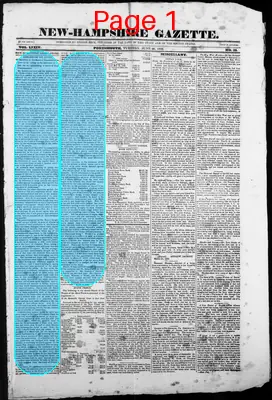
The New Hampshire Gazette
Portsmouth, Rockingham County, New Hampshire
What is this article about?
In the New Hampshire House of Representatives on June 12, Mr. Lovel of Meredith argued for repealing the act establishing a board of Road Commissioners, citing increased costs, inconvenience, and executive patronage. Opponents spoke against the resolution, which passed 131-74, instructing the Judiciary Committee to report a repeal bill.
Clipping
OCR Quality
Full Text
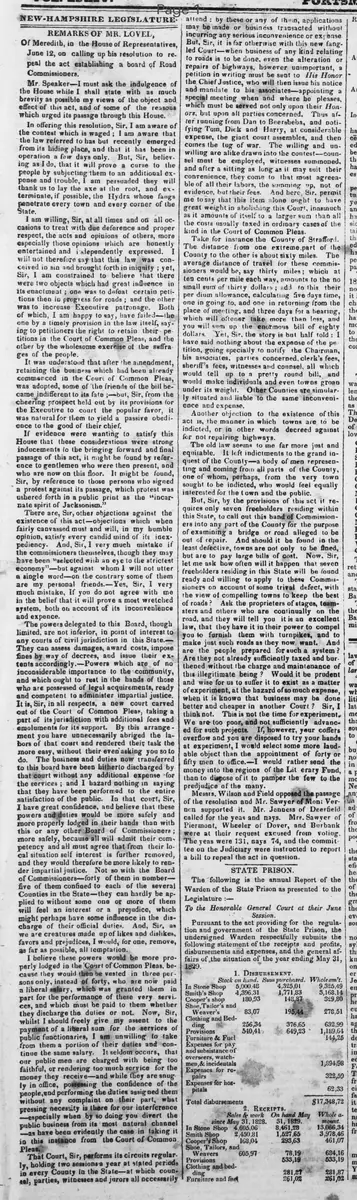
REMARKS OF MR. LOVEL,
Of Meredith, in the House of Representatives.
June 12, on calling up his resolution to repeal the act establishing a board of Road Commissioners.
Mr. Speaker--I must ask the indulgence of the House while I shall state with as much brevity as possible my views of the object and effect of this act, and of some of the reasons which urged its passage through this House.
In offering this resolution, Sir, I am aware of the contest which is waged; I am aware that the law referred to has but recently emerged from its hiding place, and that it has been in operation a few days only. But, Sir, believing as I do, that it will prove a curse to the people by subjecting them to an additional expense and trouble, I am persuaded they will thank us to lay the axe at the root, and exterminate, if possible, the Hydra whose fangs penetrate every town and every corner of the State.
I am willing, Sir, at all times and on all occasions to treat with due deference and proper respect, the acts and opinions of others, more especially those opinions which are honestly entertained and independently expressed. I will not therefore say that this law was conceived in sin and brought forth in iniquity; yet, Sir, I am constrained to believe that there were two objects which had great influence in its enactment; one was to defeat certain petitions then in progress for roads; and the other was to increase Executive patronage. Both of which, I am happy to say, have failed--the one by a timely provision in the law itself, saying to petitioners the right to retain their petitions in the Court of Common Pleas, and the other by the wholesome exercise of the suffrages of the people.
It was understood that after the amendment, retaining the business which had been already commenced in the Court of Common Pleas, was adopted, some of the friends of the bill became indifferent to its fate;--but, Sir, from the cheering prospect held out by its provisions for the Executive to court the popular favor, it was natural for them to yield a passive obedience to the good of their chief.
If evidence were wanting to satisfy this House that these considerations were strong inducements to the bringing forward and final passage of this act, it might be found by reference to gentlemen who were then present, and who are now on this floor. It might be found, Sir, by reference to those persons who signed a protest against its passage, which protest was ushered forth in a public print as the "incarnate spirit of Jacksonism."
There are, Sir, other objections against the existence of this act--objections which when fairly canvassed must and will, in my humble opinion, satisfy every candid mind of its inexpediency. And, Sir, I very much mistake it the commissioners themselves, though they may have been "selected with an eye to the strictest economy"--but against whom I will not utter a single word--on the contrary some of them are my personal friends.--Yes, Sir, I very much mistake, if you do not agree with me in the belief that it will prove a most wretched system, both on account of its inconvenience and expense.
The powers delegated to this Board, though limited, are not inferior, in point of interest to any courts of civil jurisdiction in this State.-- They can assess damages, award costs, impose fines by way of decrees, and issue their extents accordingly.--Powers which are of no inconsiderable importance to the community, and which ought to rest in the hands of those who are possessed of legal acquirements, ready and competent to administer impartial justice.
It is, Sir, in all respects, a new court carved out of the Court of Common Pleas, taking a part of its jurisdiction with additional fees and emoluments for its support. By this arrangement you have unnecessarily abridged the labors of that court and rendered their task the more easy, without their even asking you so to do. The business and duties now transferred to this board have been hitherto discharged by that court without any additional expense for the services; and I hazard nothing in saying that they have been performed to the entire satisfaction of the public. In that court, Sir, I have great confidence, and believe that these powers and duties would be more safely and more properly lodged in their hands than with this or any other Board of Commissioners; more safely, because all will admit their competency and all must agree that from their local situation self interest is further removed. and they would therefore be more likely to render impartial justice. Not so with the Board of Commissioners--forty of them in number-- five of them confined to each of the several Counties in the State--they can hardly be applied to without some one or more of them will feel an interest or a prejudice, which might perhaps have some influence in the discharge of their official duties. And, Sir, as we are creatures made up of likes and dislikes, favors and prejudices, I would, for one, remove, as far as possible, all temptation.
I believe these powers would be more properly lodged in the Court of Common Pleas. because they would then be vested in three persons only, instead of forty, who are now paid a liberal salary, which was granted them in part for the performance of these very services, and which must be paid to them whether they discharge the duties or not. Now, Sir, whilst I should freely give my assent to the payment of a liberal sum for the services of public functionaries, I am unwilling to take from them a portion of their duties and continue the same salary. It seldom occurs, that our public men are charged with being too faithful, or rendering too much service for the money they receive--and while they are snugly in office, possessing the confidence of the people, and performing the duties assigned them without any complaint on their part, what pressing necessity is there for our interference --especially when by so doing you divert the public business from its most natural channel --as have been evidently the case in taking it in this instance from the Court of Common Pleas.
That Court, Sir, performs its circuits regularly, holding two sessions a year at stated periods in every County in the State--at which counsel, parties, witnesses and jurors all necessarily attend: by these or any of them, applications may be made or business transacted without incurring any serious inconvenience or expense.
But, Sir, it is far otherwise with this new fangled Court--when business of any kind relating to roads is to be done, even the alteration or repairs of highways, however unimportant, a petition in writing must be sent to His Honor the Chief Justice, who will then issue his notice and mandate to his associates appointing a special meeting when and where he pleases, which must be served not only upon their Honors, but upon all parties concerned. Thus after running from Dan to Beersheba, and notifying Tom, Dick and Harry, at considerable expense, the giant court assembles, and then comes the tug of war. The willing and unwilling are alike drawn into the contest--counsel must be employed, witnesses summoned, and after a sitting as long as it may suit their convenience, they come to that most agreeable of all their labors, the summing up, not of evidence, but their fees. And here, Sir, permit me to say that this item alone ought to have great weight in abolishing this Court, inasmuch as it amounts of itself to a larger sum than all the costs usually taxed in ordinary cases of the kind in the Court of Common Pleas.
Take for instance the County of Strafford. The distance from one extreme part of the County to the other is about sixty miles. The average distance of travel for these commissioners would be, say thirty miles; which at ten cents per mile each way, amounts to the no small sum of thirty dollars; add to this their per diem allowance, calculating five days time, one in going to, and one in returning from the place of meeting, and three days for a hearing, which will oftener take more than less, and you will sum up the enormous bill of eighty dollars. Yet, Sir, the story is but half told: I have said nothing about the expense of the petition, going specially to notify the Chairman, his associates, parties concerned, clerk's fees, sheriff's fees, witnesses and counsel, all which would tell up to a pretty round bill, and would make individuals and even towns groan under its weight. Other Counties are similarly situated and liable to the same inconvenience and expense.
Another objection to the existence of this act is, the manner in which towns are to be indicted, or in other words decreed against for not repairing highways.
The old law seems to me far more just and equitable. It left indictments to the grand inquest of the County--a body of men representing and coming from all parts of the County, one of whom, perhaps, from the very town sought to be indicted, who would feel equally interested for the town and the public.
But, Sir, by the provisions of this act it requires only seven freeholders residing within this State, to call out this band of Commissioners into any part of the County for the purpose of examining a bridge or road alleged to be out of repair. And should it be found in the least defective, towns are not only to be fined, but are to pay large bills of cost. Now, Sir, let me ask how often will it happen that seven freeholders residing in this State will be found ready and willing to apply to these Commissioners on account of some trivial defect, with the view of compelling towns to keep the best of roads? Ask the proprietors of stages, teamsters and others who are continually on the road, and they will tell you it is an excellent law, that they have it in their power to compel you to furnish them with turnpikes, and to make just such roads as they now want. And are the people prepared for such a system? Are they not already sufficiently taxed and burdened without the charge and maintenance of this illegitimate being? Would it be prudent and wise for us to suffer it to exist as a matter of experiment, at the hazard of so much expense, when it is known that business may be done better and cheaper in another Court? Sir, I think not. This is not the time for experiment, We are too poor, and not sufficiently advanced for such projects. If, however, your coffers overflow and you are disposed to try your hands at experiment, I would select some more laudable object than the appointment of forty or fifty men to office.--I would rather send the money into the regions of the Literary Fund, than to dispose of it to pamper the few to the prejudice of the many.
Messrs. Wilson and Field opposed the passage of the resolution and Mr. Sawyer of Mont Vernon supported it. Mr. Jenness of Deerfield called for the yeas and nays. Messrs. Sawyer of Piermont, Wheeler of Dover, and Burbank were at their request excused from voting. The yeas were 131, nays 74, and the committee on the Judiciary were instructed to report a bill to repeal the act in question.
What sub-type of article is it?
What keywords are associated?
What entities or persons were involved?
Where did it happen?
Domestic News Details
Primary Location
New Hampshire
Event Date
June 12
Key Persons
Outcome
the resolution passed with yeas 131, nays 74; messrs. sawyer of piermont, wheeler of dover, and burbank excused from voting; judiciary committee instructed to report a bill to repeal the act.
Event Details
Mr. Lovel delivered remarks criticizing the recently enacted law establishing a board of Road Commissioners for increasing expenses, inconvenience, potential biases, and executive patronage, arguing it should be handled by the Court of Common Pleas. He highlighted costs in counties like Strafford and inequities in indicting towns for road repairs. Opponents Wilson and Field argued against repeal, while Sawyer supported it; Jenness called for yeas and nays.