Thank you for visiting SNEWPapers!
Sign up free
Poem
November 13, 1901
Freeland Tribune
Freeland, Luzerne County, Pennsylvania
What is this article about?
John Hay's poem 'LIBERTY' uses the sea as a metaphor for the unpredictable yet majestic nature of freedom, urging trust in liberty despite its storms of revolution and violence against tyrants.
Clipping
OCR Quality
98%
Excellent
Full Text
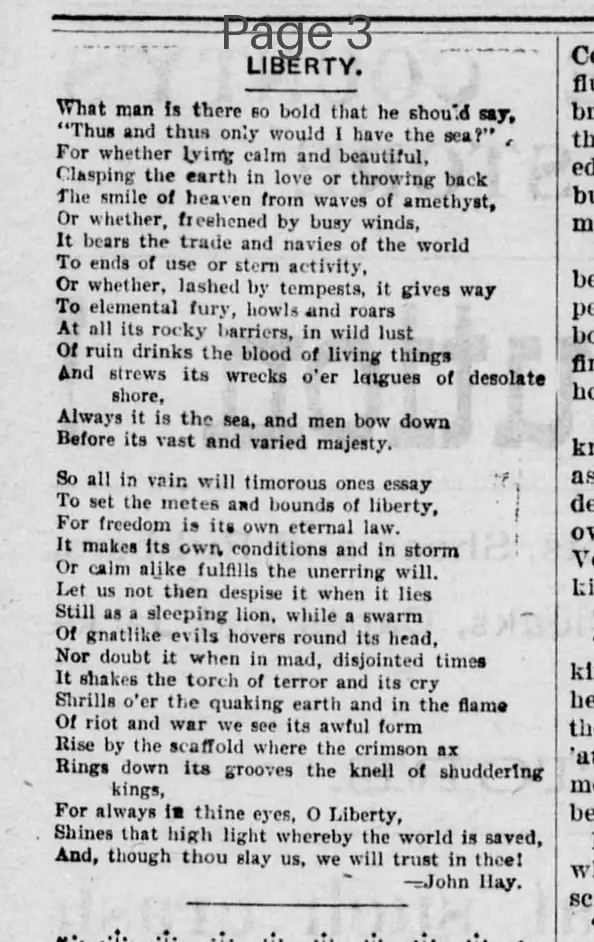
LIBERTY.
What man is there so bold that he should say
"Thus and thus only would I have the sea?"
For whether lying calm and beautiful,
Clasping the earth in love or throwing back
The smile of heaven from waves of amethyst,
Or whether, freshened by busy winds,
It bears the trade and navies of the world
To ends of use or stern activity,
Or whether, lashed by tempests, it gives way
To elemental fury, howls and roars
At all its rocky barriers, in wild lust
Of ruin drinks the blood of living things
And strews its wrecks o'er leagues of desolate
shore,
Always it is the sea, and men bow down
Before its vast and varied majesty.
So all in vain will timorous ones essay
To set the metes and bounds of liberty.
For freedom is its own eternal law.
It makes its own conditions and in storm
Or calm alike fulfills the unerring will.
Let us not then despise it when it lies
Still as a sleeping lion, while a swarm
Of gnatlike evils hovers round its head,
Nor doubt it when in mad, disjointed times
It shakes the torch of terror and its cry
Shrills o'er the quaking earth and in the flame
Of riot and war we see its awful form
Rise by the scaffold where the crimson ax
Rings down its grooves the knell of shuddering
kings,
For always in thine eyes, O Liberty,
Shines that high light whereby the world is saved,
And, though thou slay us, we will trust in thee!
-John Hay.
What man is there so bold that he should say
"Thus and thus only would I have the sea?"
For whether lying calm and beautiful,
Clasping the earth in love or throwing back
The smile of heaven from waves of amethyst,
Or whether, freshened by busy winds,
It bears the trade and navies of the world
To ends of use or stern activity,
Or whether, lashed by tempests, it gives way
To elemental fury, howls and roars
At all its rocky barriers, in wild lust
Of ruin drinks the blood of living things
And strews its wrecks o'er leagues of desolate
shore,
Always it is the sea, and men bow down
Before its vast and varied majesty.
So all in vain will timorous ones essay
To set the metes and bounds of liberty.
For freedom is its own eternal law.
It makes its own conditions and in storm
Or calm alike fulfills the unerring will.
Let us not then despise it when it lies
Still as a sleeping lion, while a swarm
Of gnatlike evils hovers round its head,
Nor doubt it when in mad, disjointed times
It shakes the torch of terror and its cry
Shrills o'er the quaking earth and in the flame
Of riot and war we see its awful form
Rise by the scaffold where the crimson ax
Rings down its grooves the knell of shuddering
kings,
For always in thine eyes, O Liberty,
Shines that high light whereby the world is saved,
And, though thou slay us, we will trust in thee!
-John Hay.
What sub-type of article is it?
Ode
What themes does it cover?
Liberty Independence
Political
What keywords are associated?
Liberty
Freedom
Sea Metaphor
Political Turmoil
John Hay
What entities or persons were involved?
John Hay
Poem Details
Title
Liberty.
Author
John Hay
Key Lines
What Man Is There So Bold That He Should Say
"Thus And Thus Only Would I Have The Sea?"
For Freedom Is Its Own Eternal Law.
It Makes Its Own Conditions And In Storm
Or Calm Alike Fulfills The Unerring Will.
For Always In Thine Eyes, O Liberty,
Shines That High Light Whereby The World Is Saved,
And, Though Thou Slay Us, We Will Trust In Thee!