Thank you for visiting SNEWPapers!
Sign up free
The Bismarck Tribune
Bismarck, Mandan, Burleigh County, Morton County, North Dakota
What is this article about?
O.W. Roberts, Bismarck meteorologist, delivers radio talk on U.S. Weather Bureau's history since 1870, daily observations, forecasting via pressure areas, instrument improvements, forecast distribution methods including radio and mail, rainfall stations, and cooperation with agricultural entities to aid North Dakota farmers.
Clipping
OCR Quality
Full Text
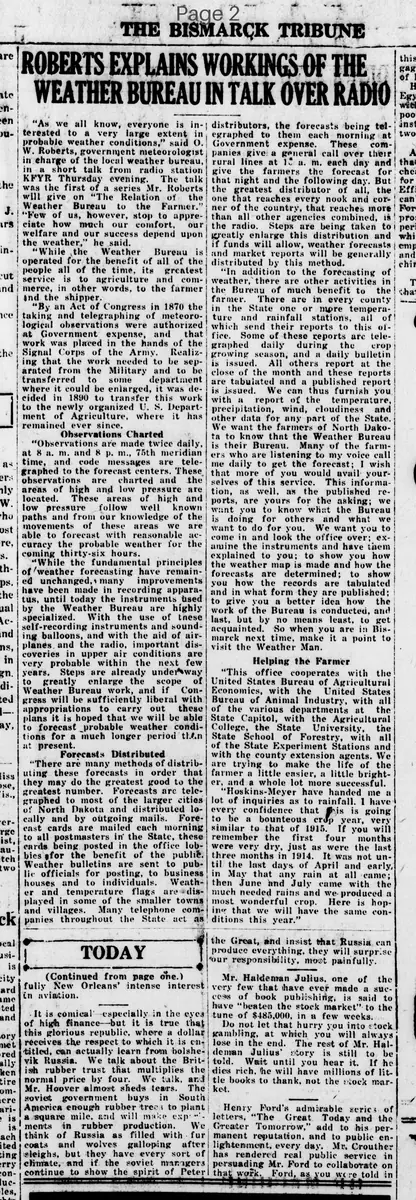
ROBERTS EXPLAINS WORKINGS OF THE
WEATHER BUREAU IN TALK OVER RADIO
"As we all know, everyone is interested to a very large extent in probable weather conditions," said O. W. Roberts, government meteorologist in charge of the local weather bureau, in a short talk from radio station KFYR Thursday evening. The talk was the first of a series Mr. Roberts will give on "The Relation of the Weather Bureau to the Farmer."
"Few of us, however, stop to appreciate how much our comfort, our welfare and our success depend upon the weather," he said.
"While the Weather Bureau is operated for the benefit of all of the people all of the time, its greatest service is to agriculture and commerce, in other words, to the farmer and the shipper.
"By an Act of Congress in 1870 the taking and telegraphing of meteorological observations were authorized at Government expense, and that work was placed in the hands of the Signal Corps of the Army. Realizing that the work needed to be separated from the Military and to be transferred to some department where it could be enlarged, it was decided in 1890 to transfer this work to the newly organized U. S. Department of Agriculture, where it has remained ever since.
Observations Charted
"Observations are made twice daily, at 8 a. m. and 8 p. m., 75th meridian time, and code messages are telegraphed to the forecast centers. These observations are charted and the areas of high and low pressure are located. These areas of high and low pressure follow well known paths and from our knowledge of the movements of these areas we are able to forecast with reasonable accuracy the probable weather for the coming thirty-six hours.
"While the fundamental principles of weather forecasting have remained unchanged, many improvements have been made in recording apparatus, until today the instruments used by the Weather Bureau are highly specialized. With the use of these self-recording instruments and sounding balloons, and with the aid of airplanes, and the radio, important discoveries in upper air conditions are very probable within the next few years. Steps are already underway to greatly enlarge the scope of Weather Bureau work, and if Congress will be sufficiently liberal with appropriations to carry out these plans it is hoped that we will be able to forecast probable weather conditions for a much longer period than at present.
Forecasts Distributed
"There are many methods of distributing these forecasts in order that they may do the greatest good to the greatest number. Forecasts are telegraphed to most of the larger cities of North Dakota and distributed locally and by outgoing mails. Forecast cards are mailed each morning to all postmasters in the State, these cards being posted in the office lobbies for the benefit of the public.
Weather bulletins are sent to public officials for posting, to business houses and to individuals. Weather and temperature flags are displayed in some of the smaller towns and villages. Many telephone companies throughout the State act as distributors, the forecasts being telegraphed to them each morning at Government expense. These companies give a general call over their rural lines at 8 a. m. each day and give the farmers the forecast for that night and the following day. But the greatest distributor of all, the one that reaches every nook and corner of the country, that reaches more than all other agencies combined, is the radio. Steps are being taken to greatly enlarge this distribution and if funds will allow, weather forecasts and market reports will be generally distributed by this method.
"In addition to the forecasting of weather, there are other activities in the Bureau of much benefit to the farmer. There are in every county in the State one or more temperature and rainfall stations, all of which send their reports to this office. Some of these reports are telegraphed daily during the crop growing season, and a daily bulletin is issued. All others report at the close of the month and these reports are tabulated and a published report is issued. We can thus furnish you with a report of the temperature, precipitation, wind, cloudiness and other data for any part of the State.
We want the farmers of North Dakota to know that the Weather Bureau is their Bureau. Many of the farmers who are listening to my voice call me daily to get the forecast; I wish that more of you would avail yourselves of this service. This information, as well as the published reports, are yours for the asking; we want you to know what the Bureau is doing for others and what we want to do for you. We want you to come in and look the office over; examine the instruments and have them explained to you; to show you how the weather map is made and how the forecasts are determined; to show you how the records are tabulated and in what form they are published; to give you a better idea how the work of the Bureau is conducted, and last, but by no means least, to get acquainted. So when you are in Bismarck next time, make it a point to visit the Weather Man.
Helping the Farmer
"This office cooperates with the United States Bureau of Agricultural Economics, with the United States Bureau of Animal Industry, with all of the various departments at the State Capitol, with the Agricultural College, the State University, the State School of Forestry, with all of the State Experiment Stations and with the county extension agents. We are trying to make the life of the farmer a little easier, a little brighter, and a whole lot more successful.
"Hoskins-Meyer have handed me a lot of inquiries as to rainfall. I have every confidence that this is going to be a bounteous crop year, very similar to that of 1915. If you will remember the first four months were very dry, just as were the last three months in 1914. It was not until the last days of April and early in May that any rain at all came; then June and July came with the much needed rains and we produced a most wonderful crop. Here is hoping that we will have the same conditions this year."
What sub-type of article is it?
What keywords are associated?
What entities or persons were involved?
Where did it happen?
Story Details
Key Persons
Location
Bismarck, North Dakota
Event Date
Thursday Evening
Story Details
O. W. Roberts explains the history, operations, forecasting methods, distribution of forecasts, and benefits of the U.S. Weather Bureau to farmers via radio talk from station KFYR, emphasizing its service to agriculture and commerce.