Thank you for visiting SNEWPapers!
Sign up free
Alexandria Gazette
Alexandria, Alexandria County, District Of Columbia
What is this article about?
Prof. Richard A. Wise defends William and Mary College in a letter to the Alexandria Gazette, refuting 'Chasseur's' claims of it being 'practically dead' and a mere day school. He details the faculty, curriculum, student achievements, independence from state aid, Williamsburg's refining social environment, low mortality rates, and historical prestige, urging support for the institution.
Clipping
OCR Quality
Full Text
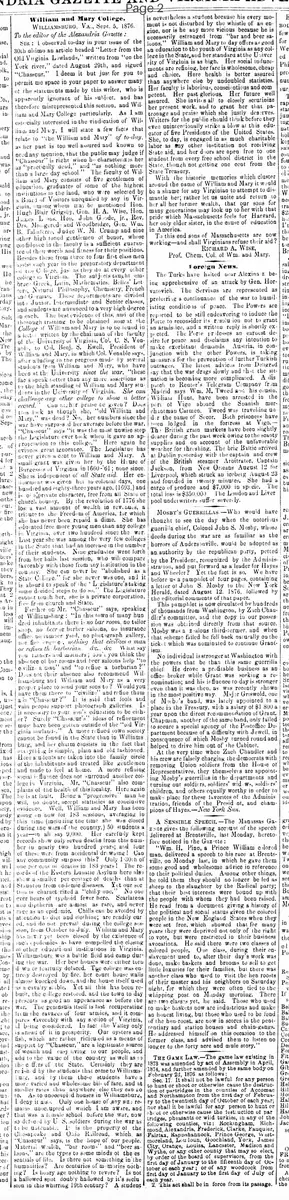
WILLIAMSBURG, VA., Sept. 5, 1876.
To the editor of the Alexandria Gazette:
SIR: I observed to-day in your issue of the 30th ultimo an article headed "Letter from the Old Virginia Lowlands," written from "on the York river," dated August 29th, and signed "Chasseur." I deem it but just for you to permit me space in your paper to answer many of the statements made by this writer, who is apparently ignorant of his subject, and has therefore misrepresented this section, and William and Mary College particularly. As I am especially interested in the vindication of William and Mary, I will state a few facts that relate to "the William and Mary" of to-day, as her past is too well assured and known to need any mention, that the public may judge if "Chasseur" is right when he characterizes her as "practically dead," and "as nothing more than a large day school." The faculty of William and Mary consists of five gentlemen of education, graduates of some of the highest institutions in the land, who were selected by a Board of Visitors unequaled by any in Virginia, among whom may be mentioned Hon. Hugh Blair Grigsby, Gen. H. A. Wise, Hon. James Lyons, Hon. John Goode, jr., Rev. Drs. Minnegerode and Woodbridge, Gen. Wm. B. Taliaferro, Judge B. M. Crump and nine other high toned gentlemen of honor, whose confidence in the faculty is a sufficient guarantee of their worth and fitness for their positions. Besides these from three to four first class men assist each year in the preparatory department the College, just as they do at every other college in Virginia. The subjects taught embrace Greek, Latin, Mathematics, Belles Lettres, Natural Philosophy, Chemistry, French and German. Those departments are divided into Junior, Intermediate and Senior classes, and students are advanced to a very high degree in each. The best evidence of this, and of the thorough training to be obtained now at the College of William and Mary is to be found in a letter written by the chairman of the faculty of the University of Virginia, Col. C. S. Venable, to Col. Benj. S. Ewell, President of William and Mary, in which Col. Venable says, after alluding to the progress made by several students from William and Mary, who have been at the University since the war, "these facts speak better than any mere assertions as to the high standing of William and Mary students in the University of Virginia. She can challenge any other college to show a better record." Can higher praise be given? Does this look as though she, "old William and Mary," was dead? No, her numbers since the war have surpassed her average before the war. "Chasseur" says "it was the most unwise step the Legislature ever took when it gave no appropriation to this college." Here again he evinces great ignorance. The Legislature has never given a cent to William and Mary. A small grant was given her by the House of Burgesses of Virginia in 1660-'61; none since. She is independent of all State aid. Her endowment was given her in colonial days, one hundred and eighty-three years ago, (1693,) and is of a private character, free from all State or church bounty. By the revolution of 1776 she lost a vast amount of wealth in revenues, a tribute to the Freedom of America, for which she has never been repaid a dime. She has educated free more young men than any college in Virginia, over two hundred since the war. Last year she was among the very few colleges in the State that had an increase in the number of their students. Nine graduates went forth from her halls last session, who will compare favorably with those from any institution in the country. She can never be "abolished as a State College," for she never was one, and it is absurd to speak of the Legislature's taking some decided steps to do so. The Legislature cannot touch her, she is a private corporation, free from church and State.
Further on Mr. "Chasseur" says, speaking of Williamsburg: "In this town of many hundred inhabitants there is no bar room, no tailor shop, no beer or barber saloons, no insurance office, no lumber yard, no photograph gallery, nor fire engine, nothing that civilizes a man or refines the barbarian etc., &c." What say you parents and mothers; don't you think the absence of bar rooms and beer saloons help "to civilize a man" and "to refine a barbarian?" Does not their absence also recommend Williamsburg and William and Mary as a very proper place to send your sons to? Would you have them there to "civilize" and refine them in "Chasseur's" way? It is said that fools and vain people support photograph galleries. Is it necessary to your son's education to be either? Surely "Chasseur's" ideas of refinement must have been gotten outside of the "old Virginia lowlands." A more refined town society cannot be found in the State than in Williamsburg, and her charm consists in the fact that everything is simple, plain and old fashioned. Here students are taken into the family circle of the inhabitants and treated like gentlemen and made to feel at home. A more refining social influence does not surround another college in Virginia. Mr. "Chasseur" also complains of the health of this locality. Here again he is at fault. Being a "progressive" man he will, no doubt, accept statistics as conclusive evidence. Well, William and Mary has been going on now for 183 sessions, averaging in this time (including the time she was closed during the wars of the country) 50 students a year—in all say 9,000. Her carefully kept records show only seven deaths from this number in nearly two hundred years; and four of these were from accidental drowning! Can any community surpass this? Only 1-30th of one per cent of deaths in 183 years! The records of the Eastern Lunatic Asylum here also show a smaller percentage of death than at Staunton from endemic diseases. Yet our section is characterized a "chilly one." No one ever hears of typhoid fever here. Scarlatina and diphtheria are almost as rare, and never rage as an epidemic. Chills can be avoided by attention to diet and clothing; are readily cured, and do not prevail during the college session, from October to July. William and Mary has never yet been closed by the existence of such epidemics as have compelled the closing of other educational institutions in Virginia. Williamsburg was a battle field and camp during the war. Her best houses were either torn down or fearfully damaged. The college was entirely destroyed by fire, her court house walls almost knocked down, and the house itself used as a cavalry stable. Yet all this has been rebuilt, the college restored, and the town to-day presents as good an appearance as before the war. The peninsula itself is fast recuperating from the ravages of four armies, and it compares favorably with any section of Virginia, all things considered. In fact the Valley only is ahead of it in prosperity. Our oysters and fish, which are rather ridiculed as a means of support by "Chasseur," are a legitimate source of wealth and easy living to our people, and add to the value of the country as well as the coffers of the State. Certainly they are relished by the students that come to Williamsburg, and by them these students have a more varied and wholesome bill of fare, and at smaller rates than anywhere else they can go to. As to unoccupied houses in Williamsburg, I deny it also. Only one house of any size remains unoccupied of which I am aware, and that was a male school before the war, but so defaced by U. S. soldiers during the war as to be untenable. It is the property of the Chesapeake and Ohio Railroad, which, as "Chasseur" says, is the hope of our people.
Material wealth, "bar rooms" and "beer saloons," are the types to some minds of the essentials of life. Is there not something in the humanities? Are centuries of memories nothing? Is hoary age nothing to revere? Is not a hallowed spot doubly hallowed by its seclusion to his study. A 19th century student is nevertheless a student because his every moment is not disturbed by the whistle of an engine, nor is he any more vicious because he is necessarily estranged from "bar and beer saloons." William and Mary to-day offers as good an education to the youth of Virginia as any college in the State and her standard at the University of Virginia is as high. Her social inducements are refining, her fare is wholesome, cheap and choice. Here health is better assured than anywhere else by undoubted statistics. Her faculty is laborious, conscientious and competent. Her past glorious. Her future well assured. She invites all to closely scrutinize her present work, and to grant her that patronage and praise which she justly deserves. Writers for the public should think before they even unintentionally strike a blow at this educator of five Presidents of the United States. She, to-day, is engaged in as much charitable labor as any other institution not receiving State aid, and her doors are open free to one student from every free school district in the State, though not getting one cent from the State Treasury.
With the historic memories which cluster around the name of William and Mary it would be a shame for any Virginian to attempt to dismantle her; rather let us unite and return to her all her former wealth, that our sons for many generations may look up to her with that pride which Massachusetts feels for Harvard, her only elder sister, in the cause of education in America.
To this end sons of Massachusetts are now working—and shall Virginians refuse their aid?
RICHARD A. WISE,
Prof. Chem. Col. of Wm. and Mary.
What sub-type of article is it?
What themes does it cover?
What keywords are associated?
What entities or persons were involved?
Letter to Editor Details
Author
Richard A. Wise, Prof. Chem. Col. Of Wm. And Mary.
Recipient
To The Editor Of The Alexandria Gazette
Main Argument
william and mary college is thriving with a qualified faculty, rigorous curriculum, successful students, independence from state aid, a healthy and refining environment in williamsburg, and a glorious history, refuting 'chasseur's' misrepresentations that it is 'practically dead' and merely a day school.
Notable Details