Thank you for visiting SNEWPapers!
Sign up free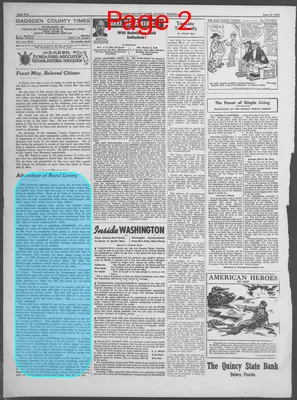
Editorial
June 22, 1944
Gadsden County Times
Quincy, Gadsden County, Florida
What is this article about?
Editorial praises rural and small-town living, citing post-war plans of city families to stay rural, historical population shifts from rural to urban, benefits for children, and farming as a satisfying way of life despite challenges.
Clipping
OCR Quality
100%
Excellent
Full Text
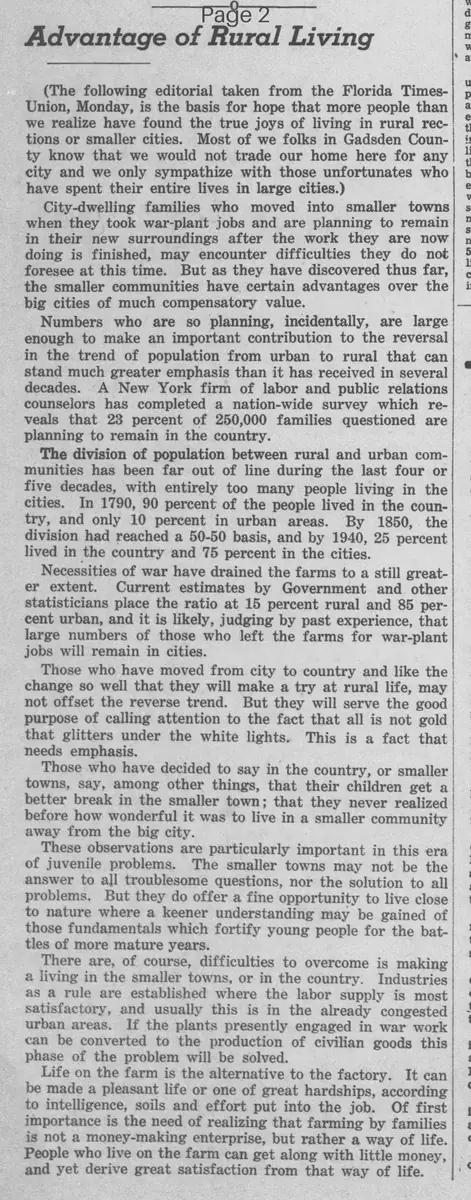
Advantage of Rural Living
(The following editorial taken from the Florida Times-Union, Monday, is the basis for hope that more people than we realize have found the true joys of living in rural sections or smaller cities. Most of we folks in Gadsden County know that we would not trade our home here for any city and we only sympathize with those unfortunates who have spent their entire lives in large cities.)
City-dwelling families who moved into smaller towns when they took war-plant jobs and are planning to remain in their new surroundings after the work they are now doing is finished, may encounter difficulties they do not foresee at this time. But as they have discovered thus far, the smaller communities have certain advantages over the big cities of much compensatory value.
Numbers who are so planning, incidentally, are large enough to make an important contribution to the reversal in the trend of population from urban to rural that can stand much greater emphasis than it has received in several decades. A New York firm of labor and public relations counselors has completed a nation-wide survey which reveals that 23 percent of 250,000 families questioned are planning to remain in the country.
The division of population between rural and urban communities has been far out of line during the last four or five decades, with entirely too many people living in the cities. In 1790, 90 percent of the people lived in the country, and only 10 percent in urban areas. By 1850, the division had reached a 50-50 basis, and by 1940, 25 percent lived in the country and 75 percent in the cities.
Necessities of war have drained the farms to a still greater extent. Current estimates by Government and other statisticians place the ratio at 15 percent rural and 85 percent urban, and it is likely, judging by past experience, that large numbers of those who left the farms for war-plant jobs will remain in cities.
Those who have moved from city to country and like the change so well that they will make a try at rural life, may not offset the reverse trend. But they will serve the good purpose of calling attention to the fact that all is not gold that glitters under the white lights. This is a fact that needs emphasis.
Those who have decided to stay in the country, or smaller towns, say, among other things, that their children get a better break in the smaller town; that they never realized before how wonderful it was to live in a smaller community away from the big city.
These observations are particularly important in this era of juvenile problems. The smaller towns may not be the answer to all troublesome questions, nor the solution to all problems. But they do offer a fine opportunity to live close to nature where a keener understanding may be gained of those fundamentals which fortify young people for the battles of more mature years.
There are, of course, difficulties to overcome in making a living in the smaller towns, or in the country. Industries as a rule are established where the labor supply is most satisfactory, and usually this is in the already congested urban areas. If the plants presently engaged in war work can be converted to the production of civilian goods this phase of the problem will be solved.
Life on the farm is the alternative to the factory. It can be made a pleasant life or one of great hardships, according to intelligence, soils and effort put into the job. Of first importance is the need of realizing that farming by families is not a money-making enterprise, but rather a way of life.
People who live on the farm can get along with little money, and yet derive great satisfaction from that way of life.
(The following editorial taken from the Florida Times-Union, Monday, is the basis for hope that more people than we realize have found the true joys of living in rural sections or smaller cities. Most of we folks in Gadsden County know that we would not trade our home here for any city and we only sympathize with those unfortunates who have spent their entire lives in large cities.)
City-dwelling families who moved into smaller towns when they took war-plant jobs and are planning to remain in their new surroundings after the work they are now doing is finished, may encounter difficulties they do not foresee at this time. But as they have discovered thus far, the smaller communities have certain advantages over the big cities of much compensatory value.
Numbers who are so planning, incidentally, are large enough to make an important contribution to the reversal in the trend of population from urban to rural that can stand much greater emphasis than it has received in several decades. A New York firm of labor and public relations counselors has completed a nation-wide survey which reveals that 23 percent of 250,000 families questioned are planning to remain in the country.
The division of population between rural and urban communities has been far out of line during the last four or five decades, with entirely too many people living in the cities. In 1790, 90 percent of the people lived in the country, and only 10 percent in urban areas. By 1850, the division had reached a 50-50 basis, and by 1940, 25 percent lived in the country and 75 percent in the cities.
Necessities of war have drained the farms to a still greater extent. Current estimates by Government and other statisticians place the ratio at 15 percent rural and 85 percent urban, and it is likely, judging by past experience, that large numbers of those who left the farms for war-plant jobs will remain in cities.
Those who have moved from city to country and like the change so well that they will make a try at rural life, may not offset the reverse trend. But they will serve the good purpose of calling attention to the fact that all is not gold that glitters under the white lights. This is a fact that needs emphasis.
Those who have decided to stay in the country, or smaller towns, say, among other things, that their children get a better break in the smaller town; that they never realized before how wonderful it was to live in a smaller community away from the big city.
These observations are particularly important in this era of juvenile problems. The smaller towns may not be the answer to all troublesome questions, nor the solution to all problems. But they do offer a fine opportunity to live close to nature where a keener understanding may be gained of those fundamentals which fortify young people for the battles of more mature years.
There are, of course, difficulties to overcome in making a living in the smaller towns, or in the country. Industries as a rule are established where the labor supply is most satisfactory, and usually this is in the already congested urban areas. If the plants presently engaged in war work can be converted to the production of civilian goods this phase of the problem will be solved.
Life on the farm is the alternative to the factory. It can be made a pleasant life or one of great hardships, according to intelligence, soils and effort put into the job. Of first importance is the need of realizing that farming by families is not a money-making enterprise, but rather a way of life.
People who live on the farm can get along with little money, and yet derive great satisfaction from that way of life.
What sub-type of article is it?
Agriculture
Social Reform
What keywords are associated?
Rural Living
Urban Trends
War Plant Jobs
Population Shift
Small Towns
Juvenile Problems
Farming Lifestyle
What entities or persons were involved?
Florida Times Union
Gadsden County
New York Firm Of Labor And Public Relations Counselors
Government Statisticians
Editorial Details
Primary Topic
Advantages Of Rural Living And Reversal Of Urban Population Trend
Stance / Tone
Supportive Of Rural And Small Town Life Over Urban Living
Key Figures
Florida Times Union
Gadsden County
New York Firm Of Labor And Public Relations Counselors
Government Statisticians
Key Arguments
Smaller Communities Offer Compensatory Advantages Over Big Cities
23 Percent Of Surveyed Families Plan To Remain In Rural Areas After War Jobs
Population Has Shifted From 90% Rural In 1790 To 85% Urban Currently
Rural Life Provides Better Opportunities For Children And Understanding Of Fundamentals
Smaller Towns Help Address Juvenile Problems
Farming Is A Way Of Life Rather Than A Money Making Enterprise
Rural Living Allows Satisfaction With Little Money