Thank you for visiting SNEWPapers!
Sign up free
Story
December 28, 1808
Alexandria Daily Gazette, Commercial & Political
Alexandria, Virginia
What is this article about?
Continuation of Mr. Giles's speech in the U.S. Senate on November 24, debating repeal of the embargo. He argues using Liverpool market reports that U.S. breadstuffs and cotton shortages would raise prices in Britain, pressuring her interests without starving her, countering Mr. Hillhouse's views.
Clipping
OCR Quality
98%
Excellent
Full Text
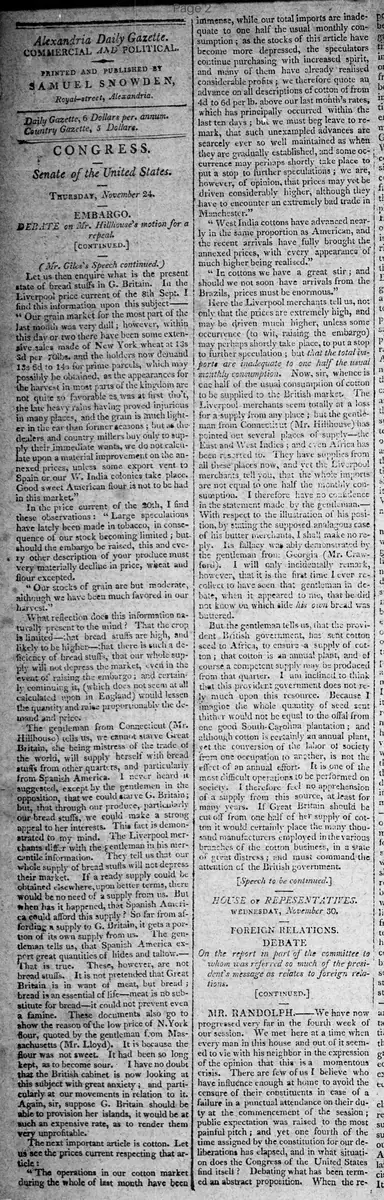
CONGRESS.
Senate of the United States.
Thursday, November 24.
EMBARGO.
DEBATE on Mr. Hillhouse's motion for a repeal.
[CONTINUED.]
(Mr. Giles's Speech continued.)
Let us then enquire what is the present state of bread stuffs in G. Britain. In the Liverpool price current of the 8th Sept. I find this information upon this subject--
"Our grain market for the most part of the last month was very dull; however, within this day or two there have been some extensive sales made of New York wheat at 11s 6d per 70lbs. and the holders now demand 13s 6d to 14s for prime parcels, which may possibly be obtained, as the appearances for the harvest in most parts of the kingdom are not quite so favorable as was at first thought, the late heavy rains having proved injurious in many places, and the grain is much lighter in the ear than former seasons; but as the dealers and country millers buy only to supply their immediate wants, we do not calculate upon a material improvement on the annexed prices, unless some export vent to Spain or our W. India colonies take place."
Good sweet American flour is not to be had in this market."
In the price current of the 20th, I find these observations: "Large speculations have lately been made in tobacco, in consequence of our stock becoming limited; but should the embargo be raised, this and every other description of your produce must very materially decline in price, wheat and flour excepted."
"Our stocks of grain are but moderate, although we have been much favored in our harvest."
What reflection does this information naturally present to the mind? That the crop is limited--that bread stuffs are high, and likely to be higher--that there is such a deficiency of bread stuffs; that our whole supply will not depress the market, even in the event of raising the embargo; and certainly continuing it, (which does not seem at all calculated upon in England) would lessen the quantity and raise proportionably the demand and price.
The gentleman from Connecticut (Mr. Hillhouse) tells us, we cannot starve Great Britain, she being mistress of the trade of the world, will supply herself with bread stuffs from other quarters, and particularly from Spanish America. I never heard it suggested, except by the gentlemen in the opposition, that we could starve G. Britain; but, that through our produce, particularly our bread stuffs, we could make a strong appeal to her interests. This fact is demonstrated to my mind. The Liverpool merchants differ with the gentleman in his mercantile information. They tell us that our whole supply of bread stuffs will not depress their market. If a ready supply could be obtained elsewhere, upon better terms, there would be no need of a supply from us. But when has it happened, that Spanish America could afford this supply? So far from affording a supply to G. Britain, it gets a portion of its own supply from us. The gentleman tells us, that Spanish America exports great quantities of hides and tallow.-- That is true. These, however, are not bread stuffs. It is not pretended that Great Britain is in want of meat, but bread; bread is an essential of life--meat is no substitute for bread--it could not prevent even a famine. These documents also go to show the reason of the low price of N. York flour, quoted by the gentleman from Massachusetts (Mr. Lloyd). It is because the flour was not sweet. It had been so long kept, as to become sour. I have no doubt that the British cabinet is now looking at this subject with great anxiety; and particularly at our movements in relation to it.
Again, sir, suppose G. Britain should be able to provision her islands, it would be at such an expensive rate, as to render them very unprofitable.
The next important article is cotton. Let us see the prices current respecting that article:
"The operations in our cotton market during the whole of last month have been immense, while our total imports are inadequate to one half the usual monthly consumption; as the stocks of this article have become more depressed, the speculators continue purchasing with increased spirit, and many of them have already realised considerable profits; we therefore quote an advance on all descriptions of cotton of from 4d to 6d per lb. above our last month's rates; which has principally occurred within the last ten days; but we must beg leave to remark, that such unexampled advances are scarcely ever so well maintained as when they are gradually established, and some occurrence may perhaps shortly take place to put a stop to further speculations; we are, however, of opinion, that prices may yet be driven considerably higher, although they have to encounter an extremely bad trade in Manchester."
"West India cottons have advanced nearly in the same proportion as American, and the recent arrivals have fully brought the annexed prices, with every appearance of much higher being realised."
"In cottons we have a great stir; and should we not soon have arrivals from the Brazils, prices must be enormous."
Here the Liverpool merchants tell us, not only that the prices are extremely high, and may be driven much higher, unless some occurrence (to wit, raising the embargo) may perhaps shortly take place, to put a stop to further speculation; but that the total imports are inadequate to one half the usual monthly consumption. Now, sir, whence is one half of the usual consumption of cotton to be supplied to the British market. The Liverpool merchants seem totally at a loss for a supply from any place; but the gentleman from Connecticut (Mr. Hillhouse) has pointed out several places of supply--the East and West Indies; and even Africa has been resorted to. They have supplies from all these places now, and yet the Liverpool merchants tell you, that the whole imports are not equal to one half the monthly consumption. I therefore have no confidence in the statement made by the gentleman.--
With respect to the illustration of his position, by stating the supposed analogous case of his butter merchants. I shall make no reply. Its fallacy was ably demonstrated by the gentleman from Georgia (Mr. Crawford). I will only incidentally remark, however, that it is the first time I ever recollect to have seen, that gentleman in debate, when it appeared to me, that he did not know on which side his own bread was buttered.
But the gentleman tells us, that the provident British government, has sent cotton seed to Africa, to ensure a supply of cotton; that cotton is an annual plant, and of course a competent supply may be produced from that quarter. I am inclined to think that this provident government does not rely much upon this resource. Because I imagine the whole quantity of seed sent thither would not be equal to the offal from one good South-Carolina plantation; and although cotton is certainly an annual plant, yet the conversion of the labor of society from one occupation to another, is not the effect of an annual effort. It is one of the most difficult operations to be performed on society. I therefore feel no apprehension of a supply from this source, at least for many years. If Great Britain should be cut off from one half of her supply of cotton it would certainly place the many thousand manufacturers employed in the various branches of the cotton business, in a state of great distress; and must command the attention of the British government.
[Speech to be continued.]
Senate of the United States.
Thursday, November 24.
EMBARGO.
DEBATE on Mr. Hillhouse's motion for a repeal.
[CONTINUED.]
(Mr. Giles's Speech continued.)
Let us then enquire what is the present state of bread stuffs in G. Britain. In the Liverpool price current of the 8th Sept. I find this information upon this subject--
"Our grain market for the most part of the last month was very dull; however, within this day or two there have been some extensive sales made of New York wheat at 11s 6d per 70lbs. and the holders now demand 13s 6d to 14s for prime parcels, which may possibly be obtained, as the appearances for the harvest in most parts of the kingdom are not quite so favorable as was at first thought, the late heavy rains having proved injurious in many places, and the grain is much lighter in the ear than former seasons; but as the dealers and country millers buy only to supply their immediate wants, we do not calculate upon a material improvement on the annexed prices, unless some export vent to Spain or our W. India colonies take place."
Good sweet American flour is not to be had in this market."
In the price current of the 20th, I find these observations: "Large speculations have lately been made in tobacco, in consequence of our stock becoming limited; but should the embargo be raised, this and every other description of your produce must very materially decline in price, wheat and flour excepted."
"Our stocks of grain are but moderate, although we have been much favored in our harvest."
What reflection does this information naturally present to the mind? That the crop is limited--that bread stuffs are high, and likely to be higher--that there is such a deficiency of bread stuffs; that our whole supply will not depress the market, even in the event of raising the embargo; and certainly continuing it, (which does not seem at all calculated upon in England) would lessen the quantity and raise proportionably the demand and price.
The gentleman from Connecticut (Mr. Hillhouse) tells us, we cannot starve Great Britain, she being mistress of the trade of the world, will supply herself with bread stuffs from other quarters, and particularly from Spanish America. I never heard it suggested, except by the gentlemen in the opposition, that we could starve G. Britain; but, that through our produce, particularly our bread stuffs, we could make a strong appeal to her interests. This fact is demonstrated to my mind. The Liverpool merchants differ with the gentleman in his mercantile information. They tell us that our whole supply of bread stuffs will not depress their market. If a ready supply could be obtained elsewhere, upon better terms, there would be no need of a supply from us. But when has it happened, that Spanish America could afford this supply? So far from affording a supply to G. Britain, it gets a portion of its own supply from us. The gentleman tells us, that Spanish America exports great quantities of hides and tallow.-- That is true. These, however, are not bread stuffs. It is not pretended that Great Britain is in want of meat, but bread; bread is an essential of life--meat is no substitute for bread--it could not prevent even a famine. These documents also go to show the reason of the low price of N. York flour, quoted by the gentleman from Massachusetts (Mr. Lloyd). It is because the flour was not sweet. It had been so long kept, as to become sour. I have no doubt that the British cabinet is now looking at this subject with great anxiety; and particularly at our movements in relation to it.
Again, sir, suppose G. Britain should be able to provision her islands, it would be at such an expensive rate, as to render them very unprofitable.
The next important article is cotton. Let us see the prices current respecting that article:
"The operations in our cotton market during the whole of last month have been immense, while our total imports are inadequate to one half the usual monthly consumption; as the stocks of this article have become more depressed, the speculators continue purchasing with increased spirit, and many of them have already realised considerable profits; we therefore quote an advance on all descriptions of cotton of from 4d to 6d per lb. above our last month's rates; which has principally occurred within the last ten days; but we must beg leave to remark, that such unexampled advances are scarcely ever so well maintained as when they are gradually established, and some occurrence may perhaps shortly take place to put a stop to further speculations; we are, however, of opinion, that prices may yet be driven considerably higher, although they have to encounter an extremely bad trade in Manchester."
"West India cottons have advanced nearly in the same proportion as American, and the recent arrivals have fully brought the annexed prices, with every appearance of much higher being realised."
"In cottons we have a great stir; and should we not soon have arrivals from the Brazils, prices must be enormous."
Here the Liverpool merchants tell us, not only that the prices are extremely high, and may be driven much higher, unless some occurrence (to wit, raising the embargo) may perhaps shortly take place, to put a stop to further speculation; but that the total imports are inadequate to one half the usual monthly consumption. Now, sir, whence is one half of the usual consumption of cotton to be supplied to the British market. The Liverpool merchants seem totally at a loss for a supply from any place; but the gentleman from Connecticut (Mr. Hillhouse) has pointed out several places of supply--the East and West Indies; and even Africa has been resorted to. They have supplies from all these places now, and yet the Liverpool merchants tell you, that the whole imports are not equal to one half the monthly consumption. I therefore have no confidence in the statement made by the gentleman.--
With respect to the illustration of his position, by stating the supposed analogous case of his butter merchants. I shall make no reply. Its fallacy was ably demonstrated by the gentleman from Georgia (Mr. Crawford). I will only incidentally remark, however, that it is the first time I ever recollect to have seen, that gentleman in debate, when it appeared to me, that he did not know on which side his own bread was buttered.
But the gentleman tells us, that the provident British government, has sent cotton seed to Africa, to ensure a supply of cotton; that cotton is an annual plant, and of course a competent supply may be produced from that quarter. I am inclined to think that this provident government does not rely much upon this resource. Because I imagine the whole quantity of seed sent thither would not be equal to the offal from one good South-Carolina plantation; and although cotton is certainly an annual plant, yet the conversion of the labor of society from one occupation to another, is not the effect of an annual effort. It is one of the most difficult operations to be performed on society. I therefore feel no apprehension of a supply from this source, at least for many years. If Great Britain should be cut off from one half of her supply of cotton it would certainly place the many thousand manufacturers employed in the various branches of the cotton business, in a state of great distress; and must command the attention of the British government.
[Speech to be continued.]
What sub-type of article is it?
Historical Event
What themes does it cover?
Triumph
Misfortune
What keywords are associated?
Embargo Debate
Senate Speech
Liverpool Market
Bread Stuffs
Cotton Prices
Great Britain
American Exports
What entities or persons were involved?
Mr. Giles
Mr. Hillhouse
Mr. Lloyd
Mr. Crawford
Where did it happen?
Senate Of The United States
Story Details
Key Persons
Mr. Giles
Mr. Hillhouse
Mr. Lloyd
Mr. Crawford
Location
Senate Of The United States
Event Date
Thursday, November 24
Story Details
Mr. Giles continues his speech supporting the embargo, citing Liverpool price currents to argue that U.S. exports of breadstuffs and cotton are crucial to Britain, causing high prices and potential distress if embargo persists, countering opponents' claims of alternative supplies.