Thank you for visiting SNEWPapers!
Sign up free
United Automobile Worker
Detroit, Wayne County, Michigan
What is this article about?
At the UAW-CIO education conference in Detroit, President R.J. Thomas praises Treasury Secretary Henry Morgenthau Jr. as a labor ally and pledges union support for war production and $50M in defense bonds. Morgenthau's speech emphasizes labor's frontline role in WWII victory through factory output and bond purchases.
Merged-components note: Merged continuation of Secretary of the Treasury Henry Morgenthau's speech on labor's stake in the war and defense bonds across pages 5 and 6.
Clippings
1 of 2
OCR Quality
Full Text
Workers Fight for War Production
Bringing to a close the first annual Michigan conference of the UAW-CIO education department, R. J. Thomas, UAW-CIO president, welcomed Secretary of the Treasury Henry Morgenthau, Jr., "as a foremost friend of labor" and said auto workers would fight as hard for factory production as for their union.
Thomas was anchor-man in a three-hour program of speeches and community singing that climaxed the two-day conference, which all day Saturday and Sunday morning revolved about panel sessions and educational seminars in the Hotel Fort Shelby.
His speech was made to 6,000 UAW-CIO members in the Coliseum of the State Fair Grounds, and followed an earlier address at the Chrysler Tank Arsenal, when he shared the platform with Mrs. Morgenthau in a defense sales program.
LUND, KRZYCKI
Other speakers at the Coliseum rally were Wendel E. Lund, director of the Michigan Unemployment Compensation department, and Leo Krzycki, vice president of the Amalgamated Clothing Workers-CIO.
"Secretary Morgenthau is a friend of labor—we know that to be a fact," Thomas opened. "He is one man we can contact in Washington when we want to. He is a foremost friend of labor and of the union men in the Capitol."
PLEDGES UAW-CIO
Lauding progress of the defense bond sales campaign, Thomas pledged UAW-CIO to make good his promise of replacing the battleship Arizona by the purchase of $50,000,000 worth of defense bonds.
"Our union members will fight as hard in their factories for production as for their union," he said.
He hit at the attitude of employers who not only failed to appreciate seriousness of the war effort in the production realm but opposed efforts of employees to buy defense bonds by voluntary pay check deductions.
NEWS CASE
"We have such managements in this city," he declared. "That of the Detroit News, which has opposed efforts of the Newspaper Guild to let workers buy bonds by payroll deductions, is the same management which all along encouraged auto manufacturers in their 'business-as-usual' policies."
Mentioning his appointment by President Roosevelt to the Labor Victory Board, Thomas stated as an aim of AF of L and CIO leaders "peace for the good of America." He praised the international executive board of UAW-CIO for its unanimous vote of confidence in CIO President Philip Murray.
ACCOUPLEMENT
"I, personally, am not interested in the AF of L. I am not interested in sitting down with a bunch of racketeers,
"We had another prominent leader in the CIO, however, who asked for an 'accouplement' with the AF of L," he added.
"I want the world to know that I am going to fight as hard as I can to further the policies of our president, Philip Murray. I have in that particular sentiment the unanimous support, I think, of the UAW-CIO."
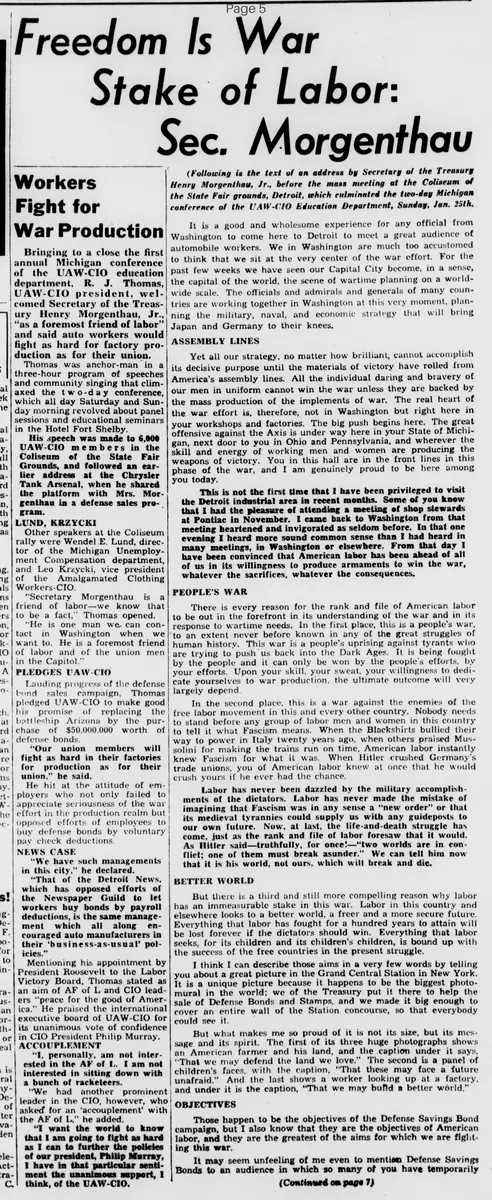
(Following is the text of an address by Secretary of the Treasury Henry Morgenthau, Jr., before the mass meeting at the Coliseum of the State Fair grounds, Detroit, which culminated the two-day Michigan conference of the UAW-CIO Education Department, Sunday, Jan. 25th.)
It is a good and wholesome experience for any official from Washington to come here to Detroit to meet a great audience of automobile workers. We in Washington are much too accustomed to think that we sit at the very center of the war effort. For the past few weeks we have seen our Capital City become, in a sense, the capital of the world, the scene of wartime planning on a world-wide scale. The officials and admirals and generals of many countries are working together in Washington at this very moment, planning the military, naval, and economic strategy that will bring Japan and Germany to their knees.
ASSEMBLY LINES
Yet all our strategy, no matter how brilliant, cannot accomplish its decisive purpose until the materials of victory have rolled from America's assembly lines. All the individual daring and bravery of our men in uniform cannot win the war unless they are backed by the mass production of the implements of war. The real heart of the war effort is, therefore, not in Washington but right here in your workshops and factories. The big push begins here. The great offensive against the Axis is under way here in your State of Michigan, next door to you in Ohio and Pennsylvania, and wherever the skill and energy of working men and women are producing the weapons of victory. You in this hall are in the front lines in this phase of the war, and I am genuinely proud to be here among you today.
This is not the first time that I have been privileged to visit the Detroit industrial area in recent months. Some of you know that I had the pleasure of attending a meeting of shop stewards at Pontiac in November. I came back to Washington from that meeting heartened and invigorated as seldom before. In that one evening I heard more sound common sense than I had heard in many meetings, in Washington or elsewhere. From that day I have been convinced that American labor has been ahead of all of us in its willingness to produce armaments to win the war, whatever the sacrifices, whatever the consequences.
PEOPLE'S WAR
There is every reason for the rank and file of American labor to be out in the forefront in its understanding of the war and in its response to wartime needs. In the first place, this is a people's war, to an extent never before known in any of the great struggles of human history. This war is a people's uprising against tyrants who are trying to push us back into the Dark Ages. It is being fought by the people and it can only be won by the people's efforts, by your efforts. Upon your skill, your sweat, your willingness to dedicate yourselves to war production, the ultimate outcome will very largely depend.
In the second place, this is a war against the enemies of the free labor movement in this and every other country. Nobody needs to stand before any group of labor men and women in this country to tell it what Fascism means. When the Blackshirts bullied their way to power in Italy twenty years ago, when others praised Mussolini for making the trains run on time, American labor instantly knew Fascism for what it was. When Hitler crushed Germany's trade unions, you of American labor knew at once that he would crush yours if he ever had the chance.
Labor has never been dazzled by the military accomplishments of the dictators. Labor has never made the mistake of imagining that Fascism was in any sense a "new order" or that its medieval tyrannies could supply us with any guideposts to our own future. Now, at last, the life-and-death struggle has come, just as the rank and file of labor foresaw that it would.
As Hitler said—truthfully, for once—"two worlds are in conflict; one of them must break asunder." We can tell him now that it is his world, not ours, which will break and die.
BETTER WORLD
But there is a third and still more compelling reason why labor has an immeasurable stake in this war. Labor in this country and elsewhere looks to a better world, a freer and a more secure future. Everything that labor has fought for a hundred years to attain will be lost forever if the dictators should win. Everything that labor seeks, for its children and its children's children, is bound up with the success of the free countries in the present struggle.
I think I can describe those aims in a very few words by telling you about a great picture in the Grand Central Station in New York. It is a unique picture because it happens to be the biggest photo-mural in the world; we of the Treasury put it there to help the sale of Defense Bonds and Stamps, and we made it big enough to cover an entire wall of the Station concourse, so that everybody could see it.
But what makes me so proud of it is not its size, but its message and its spirit. The first of its three huge photographs shows an American farmer and his land, and the caption under it says, "That we may defend the land we love." The second is a panel of children's faces, with the caption, "That these may face a future unafraid." And the last shows a worker looking up at a factory, and under it is the caption, "That we may build a better world."
OBJECTIVES
Those happen to be the objectives of the Defense Savings Bond campaign, but I also know that they are the objectives of American labor, and they are the greatest of the aims for which we are fighting this war.
It may seem unfeeling of me even to mention Defense Savings Bonds to an audience in which so many of you have temporarily (Continued on page 7)
Sec. Morgenthau
(Continued from page 6)
lost your jobs, suddenly and through no fault of your own, because of the change-over to war production in the automobile industry.
I know what you in the Detroit area have been suffering in temporary unemployment, and I wish as fervently as you do for the day when your plants will be back in full production again, and when those of you who are walking the streets will be back at your benches once more. Certainly I would never ask or expect any of you who are out of a job to buy Defense Bonds or Stamps. We have a slogan at the Treasury: "Let's make every payday Bond Day." That does not apply to those who have no payday and no regular income. The Treasury will never ask anyone to buy Defense Bonds if it means taking food from his children or clothing and shelter from his family.
NO INTIMIDATION
The other day a Chicago advertising agency sent us an elaborate sales promotion plan based, frankly enough (and these were its words) upon "the traditional dread among the American people of being held up to public ridicule and scorn." The idea of this misguided plan was to label as a slacker everyone who did not buy a bond.
We replied that we disapproved and did not countenance anything of the sort. We replied that we did not believe in the effectiveness of intimidating Americans, and that if any such tactics were proposed, we would avoid them like the plague.
But for those who do receive regular pay, those who have good jobs at good wages, there is a greater need than ever to make every payday Bond Day. You who are working in the Detroit area have just seen with your own eyes what a great economic dislocation can bring. You have seen friends and neighbors hard at work one day and thrown onto their unemployment insurance the next, as part of the price of preparing this country's factories for war. You know that those who have built up a reserve of savings are better able to meet an unforeseen shock than those who have not guarded themselves against it. Isn't it better to be prepared in time? Isn't it better to safeguard your future by setting aside a part of your earnings now, every week and every payday? Your country needs the money, and you need the security that these double-purpose bonds will bring.
THREE QUESTIONS
I am often asked three questions about Defense Bonds which must, I am sure, be in your minds. The first is, "Can I get my money out if I need it?" The answer is yes—any time after sixty days from the date you bought your bond. The second is, "What happens if I lose my bond? The answer is that we at the Treasury have a record of every bond and its owner; we can supply you with another if you identify yourself, and we will be glad to keep your bond for you at the Treasury if you wish us to keep it in the safe for you. The third question is, "Will I lose money on these bonds the way so many people lost on the Liberty Bonds?" The answer is that you can't lose. These bonds, unlike the old Liberty Bonds, are registered in your name. You cannot trade them on the market or offer them in payment of a debt. You will always get back from the Government your one hundred cents on every dollar, and the longer you hold them, the more they will grow in value.
Moreover, Defense Bonds not only help to pay for the guns and tanks and planes that will win the war; they also pay for labor, your labor. Every time you buy a $75 bond you pay for the services of a skilled worker for an entire week; every time you buy a Bond or even a Defense Stamp you are enabling the United States Government to pay you for your work, and you are hastening the day when our fighting men will be able to carry the war to Tokyo and Berlin.
About a month ago two of your brothers in the Dodge Local, Mr. Rubin and Mr. Swetz, came to see me in Washington, to discuss ways and means of hastening the conversion of their plants to war production. Together we accomplished something, because those two men had the initiative to come to my office, and also because of the fine cooperation of Mr. Patterson, the Undersecretary of War, Mr. Stettinius, the Lend-Lease Administrator, and Mr. K. T. Keller, of the Chrysler Corporation.
IMMEDIATE STOPPAGE
But what I shall always remember about that meeting is the spirit that your representatives showed. I argued then, and I have said it for months to everyone who would listen, that the only way to arm this country in time was to order the complete and immediate stoppage of all automobile production, and the quickest possible conversion of the plants. Your representatives knew that that would mean immediate unemployment for great numbers of men; yet when I asked them how they felt about it they answered, without a moment's hesitation, "We can take it; we want it done."
That was just a sample of the spirit I have found among American labor ever since we at the Treasury started the Defense Savings program. It is a sample of the spirit that the whole country has discovered in the weeks since Pearl Harbor. It is the spirit that is going to win the war.
I said in Cleveland yesterday that the pioneers who settled this Middle Western country did not let danger or hardship frighten them. They regarded every danger as a challenge, every hardship as an adventure. That is the spirit with which you are meeting this crisis, the greatest that free men have ever undergone.
You workers of Detroit are in the forefront of the fight, and I am confident that you will see it through until the fight is won.
What sub-type of article is it?
What themes does it cover?
What keywords are associated?
What entities or persons were involved?
Where did it happen?
Story Details
Key Persons
Location
Detroit, Michigan
Event Date
Sunday, Jan. 25th
Story Details
UAW-CIO conference concludes with speeches by Thomas pledging union support for war production and bonds, and Morgenthau urging labor to buy bonds and emphasizing their role in defeating fascism for a better world.