Thank you for visiting SNEWPapers!
Sign up free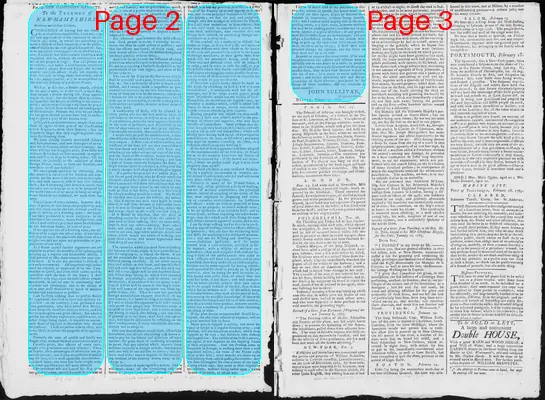
Fowle's New Hampshire Gazette And General Advertiser
Portsmouth, Rockingham County, New Hampshire
What is this article about?
Major General John Sullivan urges New Hampshire freemen to support militia reform, including appointing experienced officers, uniform arms and locally manufactured dress, and regular training to ensure defense, economic benefits, and preservation of liberties without a standing army. Dated January 27, 1785, from Durham.
Merged-components note: Merged across pages as this is a single continuous letter to the freemen of New-Hampshire on militia organization and importance, signed by John Sullivan; changed label from 'editorial' on the second part to 'letter_to_editor' to match the overall content and signature.
Clippings
1 of 2
OCR Quality
Full Text
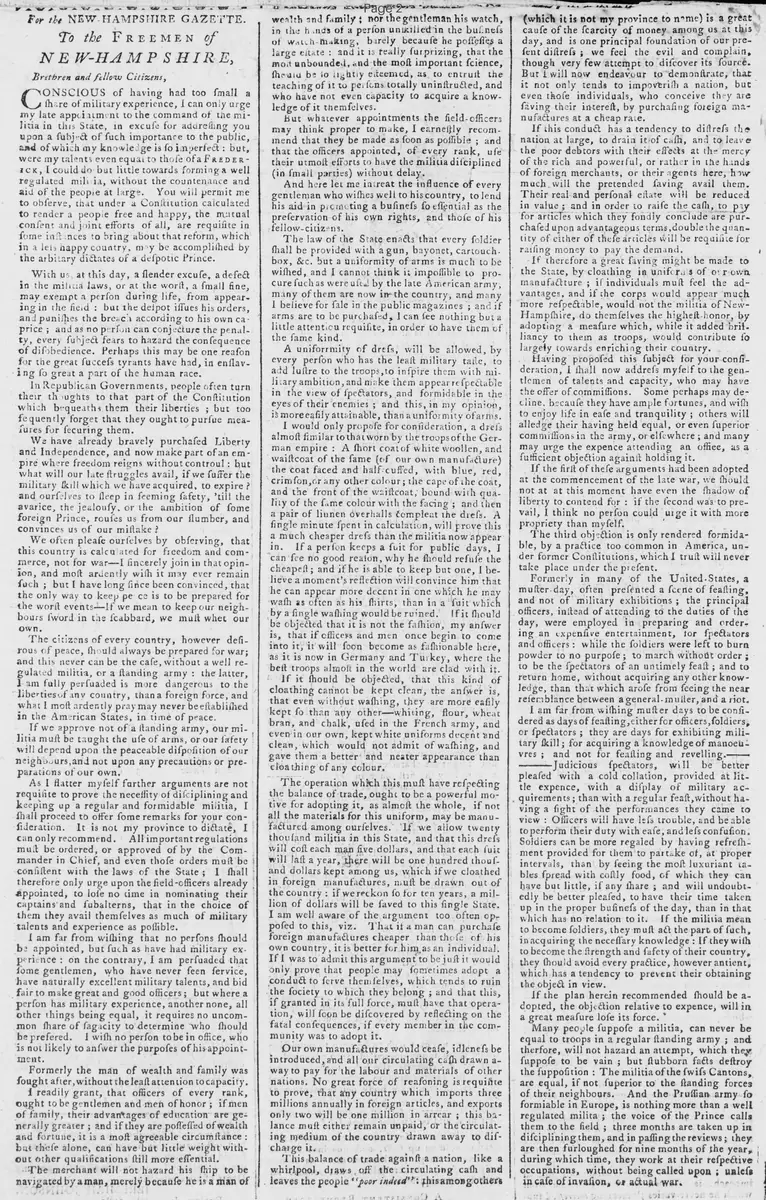
To the FREEMEN of
NEW-HAMPSHIRE,
Brethren and fellow Citizens,
CONSCIOUS of having had too small a
share of military experience, I can only urge
my late appointment to the command of the mi-
litia in this State, in excuse for addressing you
upon a subject of such importance to the public,
and of which my knowledge is so imperfect: but,
were my talents even equal to those of a Fred er-
ick, I could do but little towards forming a well
regulated militia, without the countenance and
aid of the people at large. You will permit me
to observe, that under a Constitution calculated
to render a people free and happy, the mutual
consent and joint efforts of all, are requisite in
some instances to bring about that reform, which
in a less happy country, may be accomplished by
the arbitrary dictates of a despotic Prince.
With us, at this day, a slender excuse, a defect
in the militia laws, or at the worst, a small fine,
may exempt a person during life, from appear-
ing in the field: but the despot issues his orders,
and punishes the breach according to his own ca-
price; and as no person can conjecture the penal-
ty, every subject fears to hazard the consequence
of disobedience. Perhaps this may be one reason
for the great success tyrants have had, in enslav-
ing so great a part of the human race.
In Republican Governments, people often turn
their thoughts to that part of the Constitution
which bequeaths them their liberties; but too
frequently forget that they ought to pursue mea-
sures for securing them.
We have already bravely purchased Liberty
and Independence, and now make part of an em-
pire where freedom reigns without controul: but
what will our late struggles avail, if we suffer the
military skill which we have acquired, to expire?
and ourselves to sleep in seeming safety, 'till the
avarice, the jealousy, or the ambition of some
foreign Prince, rouses us from our slumber, and
convinces us of our mistake?
We often please ourselves by observing, that
this country is calculated for freedom and com-
merce, not for war--I sincerely join in that opin-
ion, and most ardently wish it may ever remain
such: but I have long since been convinced, that
the only way to keep peace is to be prepared for
the worst events--if we mean to keep our neigh-
bours sword in the scabbard, we must whet our
own.
The citizens of every country, however desi-
rous of peace, should always be prepared for war;
and this never can be the case, without a well re-
gulated militia, or a standing army: the latter,
I am fully persuaded is more dangerous to the
liberties of any country, than a foreign force, and
what I most ardently pray may never be established
in the American States, in time of peace.
If we approve not of a standing army, our mi-
litia must be taught the use of arms, or our safety
will depend upon the peaceable disposition of our
neighbours, and not upon any precautions or pre-
parations of our own.
As I flatter myself further arguments are not
requisite to prove the necessity of disciplining and
keeping up a regular and formidable militia, I
shall proceed to offer some remarks for your con-
sideration. It is not my province to dictate, I
can only recommend. All important regulations
must be ordered, or approved of by the Com-
mander in Chief, and even those orders must be
consistent with the laws of the State: I shall
therefore only urge upon the field-officers already
appointed, to lose no time in nominating their
captains and subalterns, that in the choice of
them they avail themselves as much of military
talents and experience as possible.
I am far from wishing that no persons should
be appointed, but such as have had military ex-
perience: on the contrary, I am persuaded that
some gentlemen, who have never seen service,
have naturally excellent military talents, and bid
fair to make great and good officers; but where a
person has military experience, another none, all
other things being equal, it requires no uncom-
mon share of sagacity to determine who should
be preferred. I wish no person to be in office, who
is not likely to answer the purposes of his appointment.
Formerly the man of wealth and family was
sought after, without the least attention to capacity.
I readily grant, that officers of every rank,
ought to be gentlemen and men of honor; if men
of family, their advantages of education are ge-
nerally greater; and if they are possessed of wealth
and fortune, it is a most agreeable circumstance:
but these alone, can have but little weight with-
out other qualifications still more essential.
The merchant will not hazard his ship to be
navigated by a man, merely because he is a man of
wealth and family: nor the gentleman his watch.
in the hands of a person unskilled in the business
of watch-making, barely because he possesses a
large estate: and it is really surprising, that the
most unbounded, and the most important science,
should be so lightly esteemed, as to entrust the
teaching of it to persons totally uninstructed, and
who have not even capacity to acquire a know-
ledge of it themselves.
But whatever appointments the field-officers
may think proper to make, I earnestly recom-
mend that they be made as soon as possible; and
that the officers appointed, of every rank, use
their utmost efforts to have the militia disciplined
(in small parties) without delay.
And here let me intreat the influence of every
gentleman who wishes well to his country, to lend
his aid in promoting a business so essential as the
preservation of his own rights, and those of his
fellow-citizens.
The law of the State enacts that every soldier
shall be provided with a gun, bayonet, cartouch.
box, &c. but a uniformity of arms is much to be
wished, and I cannot think it impossible to pro-
cure such as were used by the late American army,
many of them are now in the country, and many
I believe for sale in the public magazines; and if
arms are to be purchased, I can see nothing but a
little attention requisite, in order to have them of
the same kind.
A uniformity of dress, will be allowed, by
every person who has the least military taste, to
add lustre to the troops, to inspire them with mi-
litary ambition, and make them appear respectable
in the view of spectators, and formidable in the
eyes of their enemies; and this, in my opinion,
is more easily attainable, than a uniformity of arms.
I would only propose for consideration, a dress
almost similar to that worn by the troops of the Ger-
man empire: A short coat of white woollen, and
waistcoat of the same (of our own manufacture)
the coat faced and half-cuffed, with blue, red,
crimson, or any other colour; the cape of the coat,
and the front of the waistcoat, bound with qua-
lity of the same colour with the facing; and then
a pair of linen overalls complete the dress. A
single minute spent in calculation, will prove this
a much cheaper dress than the militia now appear
in. If a person keeps a suit for public days, I
can see no good reason, why he should refuse the
cheapest: and if he is able to keep but one, I be-
lieve a moment's reflection will convince him that
he can appear more decent in one which he may
wash as often as his shirts, than in a suit which
by a single washing would be ruined. If it should
be objected that it is not the fashion, my answer
is, that if officers and men once begin to come
into it, it will soon become as fashionable here,
as it is now in Germany and Turkey, where the
best troops almost in the world are clad with it.
If it should be objected, that this kind of
cloathing cannot be kept clean, the answer is,
that even without washing, they are more easily
kept so than any other--whiting, flour, wheat
bran, and chalk, used in the French army, and
even in our own, kept white uniforms decent and
clean, which would not admit of washing, and
gave them a better and neater appearance than
cloathing of any colour.
The operation which this must have respecting
the balance of trade, ought to be a powerful mo-
tive for adopting it, as almost the whole, if not
all the materials for this uniform, may be manu-
factured among ourselves. If we allow twenty
thousand militia in this State, and that this dress
will cost each man five dollars, and that each suit
will last a year, there will be one hundred thouf-
and dollars kept among us, which if we cloathed
in foreign manufactures, must be drawn out of
the country: if we reckon so for ten years, a mil-
lion of dollars will be saved to this single State.
I am well aware of the argument too often op-
posed to this, viz. That if a man can purchase
foreign manufactures cheaper than those of his
own country, it is better for him as an individual.
If I was to admit this argument to be just it would
only prove that people may sometimes adopt a
conduct to serve themselves, which tends to ruin
the society to which they belong; and that this,
if granted in its full force, must have that opera-
tion, will soon be discovered by reflecting on the
fatal consequences, if every member in the com-
munity was to adopt it.
Our own manufactures would cease, idleness be
introduced, and all our circulating cash drawn a-
way to pay for the labour and materials of other
nations. No great force of reasoning is requisite
to prove, that any country which imports three
millions annually in foreign articles, and exports
only two will be one million in arrear; this ba-
lance must either remain unpaid, or the circulating
medium of the country drawn away to dis-
charge it.
This balance of trade against a nation, like a
whirlpool, draws off the circulating cash and
leaves the people poor indeed: this among other
(which it is not my province to name) is a great
cause of the scarcity of money among us at this
day, and is one principal foundation of our pre-
sent distresses: we feel the evil and complain,
though very few attempt to discover its source.
But I will now endeavour to demonstrate, that
it not only tends to impoverish a nation, but
even those individuals, who conceive they are
saving their interest, by purchasing foreign ma-
nufactures at a cheap rate.
If this conduct has a tendency to distress the
nation at large, to drain it of cash, and to leave
the poor debtors with their effects at the mercy
of the rich and powerful, or rather in the hands
of foreign merchants, or their agents here; how
much will the pretended saving avail them.
Their real and personal estate will be reduced
in value; and in order to raise the cash, to pay
for articles which they fondly conclude are pur-
chased upon advantageous terms, double the quan-
tity of either of these articles will be requisite for
raising money to pay the demand.
If therefore a great saving might be made to
the State, by cloathing in uniforms of our own
manufacture; if individuals must feel the ad-
vantages, and if the corps would appear much
more respectable, would not the militia of New-
Hampshire, do themselves the highest honor, by
adopting a measure which, while it added bril-
liancy to them as troops, would contribute so
largely towards enriching their country.
Having proposed this subject for your consi-
deration, I shall now address myself to the gen-
tlemen of talents and capacity, who may have
the offer of commissions. Some perhaps may de-
cline, because they have ample fortunes, and wish
to enjoy life in ease and tranquility; others will
allege their having held equal, or even superior
commissions in the army, or elsewhere; and many
may urge the expense attending an office, as a
sufficient objection against holding it.
If the first of these arguments had been adopted
at the commencement of the late war, we should
not at this moment have even the shadow of
liberty to contend for: if the second was to pre-
vail, I think no person could urge it with more
propriety than myself.
The third objection is only rendered formida-
ble, by a practice too common in America, un-
der former Constitutions, which I trust will never
take place under the present.
Formerly in many of the United States, a
muster-day, often presented a scene of feasting,
and not of military exhibitions; the principal
officers, instead of attending to the duties of the
day, were employed in preparing and order.
ing an expensive entertainment, for spectators
and officers: while the soldiers were left to burn
powder to no purpose; to march without order;
to be the spectators of an untimely feast: and to
return home, without acquiring any other know-
ledge, than that which arose from seeing the near
resemblance between a general muster, and a riot.
I am far from wishing muster days to be consi-
dered as days of feasting, either for officers, soldiers,
or spectators; they are days for exhibiting mili-
tary skill; for acquiring a knowledge of manoeu-
vres; and not for feasting and revelling.
Judicious spectators, will be better
pleased with a cold collation, provided at lit-
tle expense, with a display of military ac-
quirements; than with a regular feast, without ha-
ving a sight of the performances they came to
view: Officers will have less trouble, and be able
to perform their duty with ease, and less confusion.
Soldiers can be more regaled by having refresh-
ment provided for them to partake of, at proper
intervals, than by seeing the most luxuriant ta-
bles spread with costly food, of which they can
have but little, if any share; and will undoubt-
edly be better pleased, to have their time taken
up in the proper business of the day, than in that
which has no relation to it. If the militia mean
to become soldiers, they must act the part of such,
in acquiring the necessary knowledge: If they wish
to become the strength and safety of their country,
they should avoid every practice, however ancient,
which has a tendency to prevent their obtaining
the object in view.
If the plan herein recommended should be a-
dopted, the objection relative to expense, will in
a great measure lose its force.
Many people suppose a militia, can never be
equal to troops in a regular standing army; and
therefore, will not hazard an attempt, which they
suppose to be vain; but stubborn facts destroy
the supposition: The militia of the Swiss Cantons,
are equal, if not superior to the standing forces
of their neighbours. And the Prussian army so
formidable in Europe, is nothing more than a well
regulated militia; the voice of the Prince calls
them to the field; three months are taken up in
disciplining them, and in passing the reviews; they
are then furloughed for nine months of the year,
during which time, they work at their respective
occupations, without being called upon: unless
in case of invasion, or actual war.
I know so much time of the yeomanry in this country, cannot be spared; but much more than has ever yet been spent, might be devoted to a business so important, without being sensibly felt; and I cannot avoid urging this in the most pressing terms, at a time, when, however desirous we may be of a lasting peace; war does not in my view, appear at a great distance; If any gentleman should differ from me in sentiment, and can assign a satisfactory reason, for the British refusing to give up the important posts on our frontiers, ceded to us by treaty; I shall then with pleasure change my opinion, and my fears on that head will be at an end.
In order to prepare for every event, if in each neighbourhood the officers and soldiers were to assemble one or two hours in a week- to practice the use of arms, and regularly attend on the proper muster-days, they would soon become expert in the art of war; be a terror to every ambitious power; and render themselves able and skillful guardians of those liberties, purchased by the blood of their brethren, and the treasures of their country.
JOHN SULLIVAN,
Major-General.
Durham, January 27, 1785.
What sub-type of article is it?
What themes does it cover?
What keywords are associated?
What entities or persons were involved?
Letter to Editor Details
Author
John Sullivan, Major General
Recipient
To The Freemen Of New Hampshire
Main Argument
new hampshire must establish a well-regulated militia through experienced officer appointments, uniform arms and locally manufactured dress, and regular training to secure liberties, promote economic self-sufficiency, and prepare for potential war without relying on a standing army.
Notable Details