Thank you for visiting SNEWPapers!
Sign up free
Gazette Of The United States And Daily Evening Advertiser
Philadelphia, Philadelphia County, Pennsylvania
What is this article about?
Earl Fitzwilliam's letter to the Earl of Carlisle outlines his January-February correspondence with the British Cabinet on Irish Catholic petitions for repeal of disqualifications, warning of potential unrest and his readiness to concede without opposition instructions.
Clipping
OCR Quality
Full Text
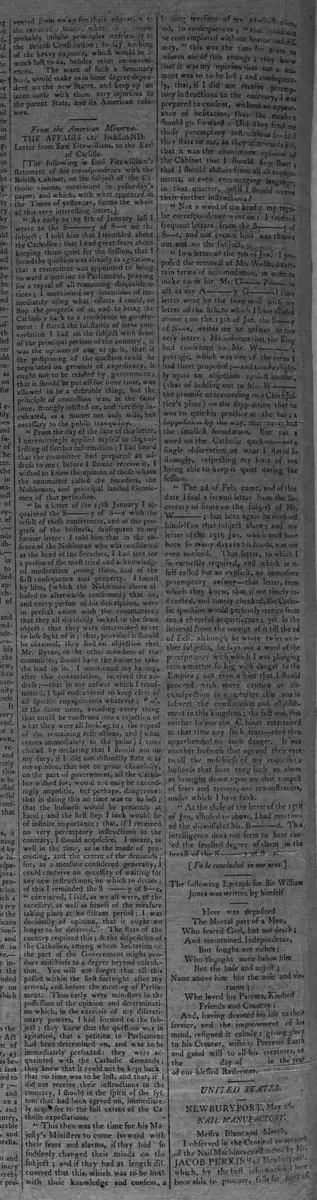
THE AFFAIRS OF IRELAND.
Letter from Earl Fitzwilliam, to the Earl of Carlisle.
The following is Earl Fitzwilliam's statement of his correspondence with the British Cabinet, on the subject of the Catholic claims, mentioned in yesterday's paper, and which, with what appeared in the Times of yesterday, forms the whole of this very interesting letter.
"As early as the 8th of January last I wrote to the Secy of S--e on the subject; I told him that I trembled about the Catholics; that I had great fears about keeping them quiet for the Session, that I found the question was already in agitation, that a committee was appointed to bring forward a petition to Parliament, praying for a repeal of all remaining disqualifications; I mentioned my intentions of immediately using what efforts I could, to stop the progress of it, and to bring the Catholics back to a confidence in government: I stated the substance of some conversation I had on the subject with some of the principal persons of the country; it was the opinion of one of these, that if the postponing of the question could be negotiated on grounds of expediency, it ought not to be resisted by government; that it should be put off for some time, was allowed to be a desirable thing, but the principle of concession was, at the same time, strongly insisted on, and forcibly inculcated, as a matter not only wise, but necessary to the public tranquility.
"From the day of the date of this letter, I unremittingly applied myself to the collecting of further information: I had heard that the committee had prepared an address to me: before I should receive it, I wished to know the opinion of those whom the committee called the Seceders, the Noblemen, and principal landed Gentlemen of that persuasion.
"In a letter of the 15th January I acquainted the S--y of Se with the result of these conferences, and of the progress of the business, subsequent to my former letter: I told him that in the absence of the Nobleman who was considered as the head of the Seceders, I had sent for a person of the most tried and acknowledged moderation among them, and of the first consequence and property. I found by him, (which the Nobleman above alluded to afterwards confirmed) that he, and every person of his description, were in perfect union with the committees; that they all decidedly looked to the same object: that they were determined never to lose sight of it; that, provided it should be obtained, they had no objection that Mr. Byrne, or the other members of the committee, should have the honor to take the lead in it. I mentioned my having, after this conversation, received the address; that in my answer which I transmitted, I had endeavored to keep clear of all specific engagements whatever; or, at the same time, avoiding every thing that could be construed into a rejection of what they were all looking to; the repeal of the remaining restrictions, and (what comes immediately to the point) I concluded by declaring that I should not do my duty, if I did not distinctly state it as my opinion, that not to grant cheerfully, on the part of government, all the Catholics wished for, would not only be exceedingly impolitic, but perhaps, dangerous: that in doing this no time was to be lost; that the business would be presently at hand; and the first step I took would be of infinite importance; that, if I received no very peremptory instructions to the contrary, I should acquiesce. I meant, as well in the time, as in the mode of proceeding, and the extent of the demands; for, as a measure considered generally, I could conceive no necessity of waiting for any new instructions, on which to decide; of this I reminded the S--y of Se, convinced, I said, as we all were, of the necessity, as well as fitness of the measure taking place at no distant period; I was decidedly of opinion, that it ought no longer to be deferred." The state of the country required this; & the disposition of the Catholics, among whom hesitation on the part of the Government might produce mischiefs to a degree beyond calculation. You will not forget that all this passed within the first fortnight after my arrival, and before the meeting of Parliament. Thus early were ministers in the possession of the opinion and determination which, in the exercise of my discretionary powers, I had formed on the subject; they knew that the question was in agitation, that a petition to Parliament had been determined on, and was to be immediately presented: they were acquainted with the Catholic demands; they knew that it could not be kept back: that no time was to be lost, and that, if I did not receive their instructions to the contrary, I should in the spirit of the system that had been agreed on, immediately acquiesce to the full extent of the Catholic expectations.
"This then was the time for his Majesty's Ministers to come forward with their fears and alarms, if they had suddenly changed their minds on the subject; and if they had at length discovered that this, which was to be both with their knowledge and consent,
binding measure of my administration, led to consequences "that could not be contemplated without horror and dismay," this was the time for them to inform me of this change; they knew that it was my opinion that not a moment was to be lost; and consequently, that, if I did not receive peremptory instructions to the contrary, I was prepared to consent, without an appearance of hesitation, that the measure should go forward: Did they send me those peremptory instructions? Did they state to me, as they afterwards did, that it was the unanimous opinion of the Cabinet that I should oppose short; that I should abstain from all engagements, or even encouraging language, in that quarter, until I should receive their further instructions?
"Not a word of the kind: my regular correspondence went on: I received frequent letters from the S--y of S-e, and not even a hint was thrown out on the subject.
"In a letter of the 7th of Jan. I proposed the removal of Mr. Wolfe, on certain terms of accommodation, in order to make room for Mr. G P- to act as my A-v-y G-l: this letter went by the same mail with my letter of the 8th, to which I have alluded above: on the 13th of Jan. the S--y of S-e, writes me an answer to this very letter; He informs that the King had consented to Mr. W--'s peerage, which was one of the terms I had there proposed; and touches lightly upon an objection against another, (that of holding out to Mr. W-- the promise of succeeding to a Chief Justice's place) on the supposition that he was to quit his practice at the bar; a supposition by the way, that never had the smallest foundation. But not a word on the Catholic question-not a single observation on what I stated so strongly, respecting my fears of not being able to keep it quiet during the Session.
"The 2d of Feb. came, and of that date I find a second letter from the Secretary of State on the subject of Mr. W--; but here again he confined himself to that subject alone; and my letter of the 15th Jan. which must have been so many days in his hands, was not even noticed. That letter, to which I so earnestly required, and which in itself called for an explicit, an immediate peremptory answer-that letter, from which they knew, that if not timely instructed, and timely checked, the Catholic question would presently receive from me a cheerful acquiescence; yet in the interval from the receipt of it till the 2d of Feb. although he wrote twice on other subjects, he says not a word of the precipitancy with which I was plunging into a matter so big with danger to the Empire; not even a hint that I should proceed with more caution or circumspection in a measure that was to subvert the constitution and establishment in this kingdom: the fact was, that neither he nor the Cabinet entertained at that time any such fears-they then apprehended no such danger. It was another business that opened their eyes to all the mischiefs of my councils; a business that soon rung such an alarm as brought down upon me that tempest of fears and terrors, and remonstrances, under which I have sunk.
"At the close of the letter of the 15th of Jan. alluded to above, I had mentioned the dismissal of Mr. B-d. This intelligence does not seem to have caused the smallest degree of alarm in the breast of the S--y of S
[To be concluded in our next.]
What sub-type of article is it?
What keywords are associated?
What entities or persons were involved?
Where did it happen?
Foreign News Details
Primary Location
Ireland
Event Date
8th Of January Last To 2d Of February
Key Persons
Outcome
potential mischiefs and unrest among catholics if government hesitates on concessions; no peremptory instructions received from cabinet to oppose the catholic demands.
Event Details
Earl Fitzwilliam reports his efforts to gauge and manage Irish Catholic agitation for repeal of disqualifications via correspondence with the Secretary of State, conferences with Catholic leaders, and receipt of an address; he warns of dangers of delay and intends to acquiesce without contrary orders, but receives no such instructions initially.