Thank you for visiting SNEWPapers!
Sign up free
Douglas Daily Dispatch
Douglas, Cochise County, Arizona
What is this article about?
Thomas A. Edison viewed a pioneering talking film of his radio interview at his West Orange, N.J., laboratory on Nov. 25, produced by General Electric with synchronized audio and video recorded separately.
Merged-components note: Continuation of Edison talking film story.
Clippings
1 of 2
OCR Quality
Full Text
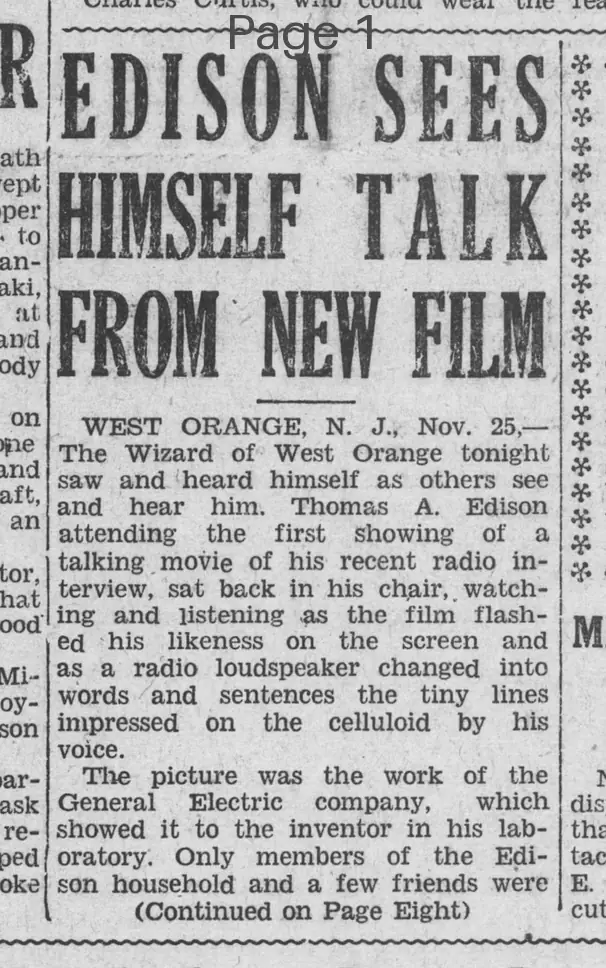
HIMSELF
TALK
FROM NEW FILM
WEST ORANGE, N. J., NOV. 25,- The Wizard of West Orange tonight saw and heard himself as others see and hear him. Thomas A. Edison attending the first showing of a talking movie of his recent radio interview, sat back in his chair, watching and listening as the film flashed his likeness on the screen and as a radio loudspeaker changed into words and sentences the tiny lines impressed on the celluloid by his voice.
The picture was the work of the General Electric company, which showed it to the inventor in his laboratory. Only members of the Edison household and a few friends were
(Continued on Page Eight)
(Continued from Page One)
present.
A dextrous synchronization of two electric motors made possible this realistic appearance of Mr. Edison on the screen. Picture and voice were recorded nearly 200 miles apart, the former in the Edison library, where the interview was held, and the latter in the General Electric research laboratory at Schenectady.
The inventor's replies to the questions of his interrogator were carried as electric impulses over a telephone wire to the upstate city, where they were recorded on a film at exactly the same rate of speed of the camera that was taking the pictures here. Two negative films, after development, were transposed on a single positive, which was used this evening.
So delicate were the adjustments that a variance of one sixty-fourth of a second in the speed of either the motor running the camera or the other, operating the voice film would have made the talking movie impossible. A tie-in of power between the lines of the two utility companies furnishing the current for the motors avoided a variation in the frequency, for a difference of one quarter of motor revolution in a thousand would have upset the plans.
The talking film is of standard size. Along a narrow margin in one side the voice is recorded in tiny zig-zag lines. As a beam of light passes through these lines, the broken ray falls upon a photo-electric cell which changes the light rays into electric impulses, similar to radio impulses. These in turn are changed into sound by a radio receiver and amplified by loud speaker. The projector is of standard type.
What sub-type of article is it?
What keywords are associated?
What entities or persons were involved?
Where did it happen?
Domestic News Details
Primary Location
West Orange, N. J.
Event Date
Nov. 25
Key Persons
Event Details
Thomas A. Edison attended the first showing of a talking movie of his recent radio interview in his laboratory, produced by the General Electric company, with only members of the Edison household and a few friends present. The film synchronized picture and voice recorded 200 miles apart using two electric motors, telephone wires, and precise adjustments to avoid speed variances.