Thank you for visiting SNEWPapers!
Sign up free
Winchester Republican
Winchester, Virginia
What is this article about?
A letter advocating the vital role of science, literature, and arts in civilized society to establish an intellectual aristocracy against moneyed elites. It critiques the U.S. Constitution for deviating from natural human principles, fostering commerce-driven ills like luxury and usury that burden agriculturalists.
Clipping
OCR Quality
Full Text
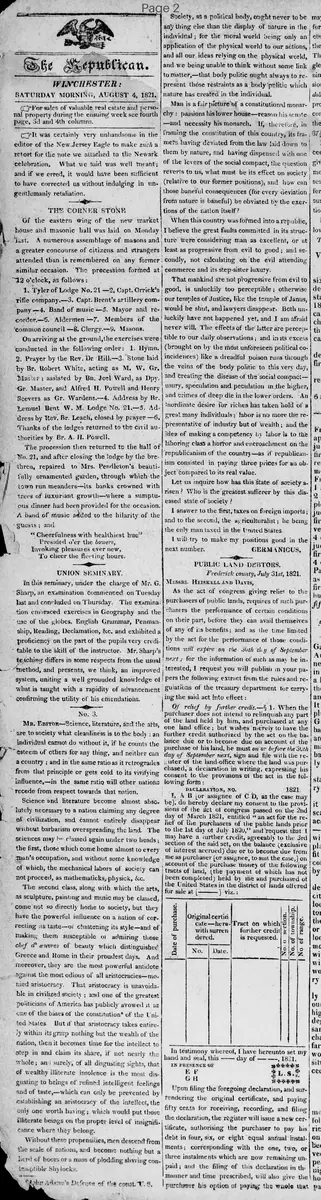
Mr. Egerton—Science, literature, and the arts, are to society what cleanliness is to the body: an individual cannot do without it, if he counts the esteem of others for any thing, and neither can a country; and in the same ratio as it retrogrades from that principle or gets cold to its vivifying influence,—in the same ratio will other nations recede from respect towards that nation. Science and literature become almost absolutely necessary to a nation claiming any degree of civilization, and cannot entirely disappear without barbarism overspreading the land. The sciences may be classed again under two heads; the first, those which come home almost to every man's occupation, and without some knowledge of which, the mechanical labors of society can not proceed, as mathematicks, physick, &c. The second class, along with which the arts, as sculpture, painting and music may be classed, come not so directly home to society, but they have the powerful influence on a nation of correcting its taste—of chastening its style—and of making them susceptible of admiring those chef d'oeuvres of beauty which distinguished Greece and Rome in their proudest days. And moreover, they are the most powerful antidote against the most odious of all aristocracies—moneyed aristocracy. That aristocracy is unavoidable in civilized society; and one of the greatest politicians of America has publicly avowed it as one of the bases of the constitution of the United States. But if that aristocracy takes entirely within its grasp nothing but the wealth of the nation, then it becomes time for the intellect to step in and claim its share, if not nearly the whole; and surely, of all disgusting sights, that of wealthy illiterate insolence is the most disgusting to beings of refined intelligent feelings and of taste,—which can only be prevented by establishing an aristocracy of the intellect, the only one worth having; which would put those illiterate beings on the proper level of insignificance where they belong. Without these propensities, men descend from the scale of nations, and become nothing but a herd of boors or a mass of plodding shaving contemptible Shylocks.
"John Adams's Defence of the const. U. S.
Society, as a political body, ought never to be any thing else than the display of nature in the individual; for the moral world being only an application of the physical world to our actions, and all our ideas relying on the physical world, and we being unable to think without some link to matter,—that body politic ought always to represent those restraints as a body politic which nature has created in the individual. Man is a fair picture of a constitutional monarchy: passions his lower house—reason his senate—and necessity his monarch. If, therefore, in framing the constitution of this country, its framers having deviated from the law laid down to them by nature, and having dispensed with one of the levers of the social compact, the question reverts to us, what must be its effect on society (relative to our former positions), and how can those baneful consequences (for every deviation from nature is baneful) be obviated by the exertions of the nation itself? When this country was formed into a republic, I believe the great faults committed in its structure were considering man as excellent, or at least as progressive from evil to good; and secondly, not calculating on the evil attending commerce and its step-sister luxury. That mankind are not progressive from evil to good, is unluckily too perceptible; otherwise our temples of Justice, like the temple of Janus, would be shut, and lawyers disappear. Both unluckily have not happened yet, and I am afraid never will. The effects of the latter are perceptible to our daily observations; and in its excess (brought on by the most unforeseen political coincidences) like a dreadful poison runs through the veins of the body politic to this very day. And treating the disease of the social compact—usury, speculation and peculation in the higher, and crimes of deep dye in the lower orders. An inordinate desire of riches has taken hold of a great many individuals; labor is no more the representative of industry but of wealth; and the idea of making a competency by labor is to the laboring class a horror and encroachment on the republicanism of the country—as if republicanism consisted in paying three prices for an object compared to its real value. Let us inquire how has this state of society arisen? Who is the greatest sufferer by this diseased state of society? I answer to the first, taxes on foreign imports; and to the second, the agriculturalist; he being the only man taxed in the United States. I will try to make my positions good in the next number.
GERMANICUS.
What sub-type of article is it?
What themes does it cover?
What keywords are associated?
What entities or persons were involved?
Letter to Editor Details
Author
Germanicus.
Recipient
Mr. Egerton
Main Argument
science, literature, and arts are essential to civilization, serving as an antidote to moneyed aristocracy by promoting an intellectual elite. the u.s. constitution deviates from natural law by ignoring human passions and the corrupting influences of commerce and luxury, leading to societal diseases like usury and speculation that particularly afflict agriculturalists.
Notable Details