Thank you for visiting SNEWPapers!
Sign up free
Poem
November 4, 1826
The Ladies' Garland
Harpers Ferry, Jefferson County, West Virginia
What is this article about?
Excerpt from Lord Byron's Childe Harold's Pilgrimage Canto IV, stanzas 30-34, describing Petrarch's simple tomb and mansion in the village of Arqua, Italy. It reflects on his genius, fame through love for Laura, the solace of rural solitude, mortality, and spiritual struggle.
Clipping
OCR Quality
98%
Excellent
Full Text
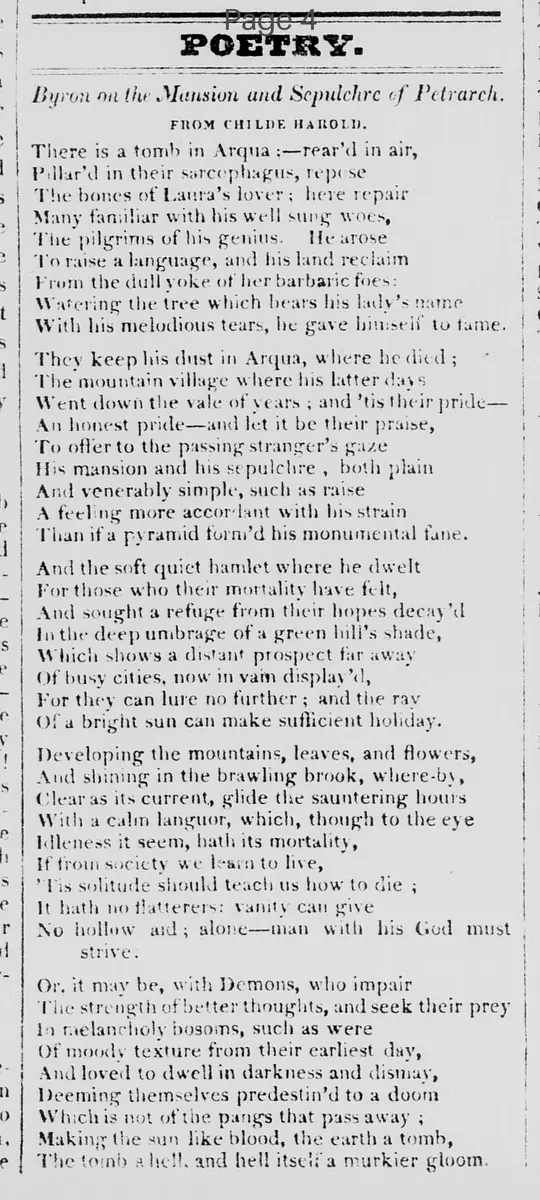
POETRY.
Byron on the Mansion and Sepulchre of Petrarch.
FROM CHILDE HAROLD.
There is a tomb in Arqua :—rear'd in air,
Pillar'd in their sarcophagus, repose
The bones of Laura's lover; here repair
Many familiar with his well sung woes,
The pilgrims of his genius. He arose
To raise a language, and his land reclaim
From the dull yoke of her barbaric foes:
Watering the tree which bears his lady's name
With his melodious tears, he gave himself to fame.
They keep his dust in Arqua, where he died;
The mountain village where his latter days
Went down the vale of years; and 'tis their pride—
An honest pride—and let it be their praise,
To offer to the passing stranger's gaze
His mansion and his sepulchre, both plain
And venerably simple, such as raise
A feeling more accordant with his strain
Than if a pyramid form'd his monumental fane.
And the soft quiet hamlet where he dwelt
For those who their mortality have felt,
And sought a refuge from their hopes decay'd
In the deep umbrage of a green hill's shade,
Which shows a distant prospect far away
Of busy cities, now in vain display'd,
For they can lure no further; and the ray
Of a bright sun can make sufficient holiday.
Developing the mountains, leaves, and flowers,
And shining in the brawling brook, where-by
Clear as its current, glide the sauntering hours
With a calm languor, which, though to the eye
Idleness it seem, hath its morality,
If from society we learn to live,
'Tis solitude should teach us how to die;
It hath no flatterers: vanity can give
No hollow aid; alone—man with his God must strive.
Or, it may be, with Demons, who impair
The strength of better thoughts, and seek their prey
In melancholy bosoms, such as were
Of moody texture from their earliest day,
And loved to dwell in darkness and dismay,
Deeming themselves predestin'd to a doom
Which is not of the pangs that pass away;
Making the sun like blood, the earth a tomb,
The tomb a hell, and hell itself a murkier gloom.
Byron on the Mansion and Sepulchre of Petrarch.
FROM CHILDE HAROLD.
There is a tomb in Arqua :—rear'd in air,
Pillar'd in their sarcophagus, repose
The bones of Laura's lover; here repair
Many familiar with his well sung woes,
The pilgrims of his genius. He arose
To raise a language, and his land reclaim
From the dull yoke of her barbaric foes:
Watering the tree which bears his lady's name
With his melodious tears, he gave himself to fame.
They keep his dust in Arqua, where he died;
The mountain village where his latter days
Went down the vale of years; and 'tis their pride—
An honest pride—and let it be their praise,
To offer to the passing stranger's gaze
His mansion and his sepulchre, both plain
And venerably simple, such as raise
A feeling more accordant with his strain
Than if a pyramid form'd his monumental fane.
And the soft quiet hamlet where he dwelt
For those who their mortality have felt,
And sought a refuge from their hopes decay'd
In the deep umbrage of a green hill's shade,
Which shows a distant prospect far away
Of busy cities, now in vain display'd,
For they can lure no further; and the ray
Of a bright sun can make sufficient holiday.
Developing the mountains, leaves, and flowers,
And shining in the brawling brook, where-by
Clear as its current, glide the sauntering hours
With a calm languor, which, though to the eye
Idleness it seem, hath its morality,
If from society we learn to live,
'Tis solitude should teach us how to die;
It hath no flatterers: vanity can give
No hollow aid; alone—man with his God must strive.
Or, it may be, with Demons, who impair
The strength of better thoughts, and seek their prey
In melancholy bosoms, such as were
Of moody texture from their earliest day,
And loved to dwell in darkness and dismay,
Deeming themselves predestin'd to a doom
Which is not of the pangs that pass away;
Making the sun like blood, the earth a tomb,
The tomb a hell, and hell itself a murkier gloom.
What sub-type of article is it?
Ode
What themes does it cover?
Death Mourning
Nature Seasons
Moral Virtue
What keywords are associated?
Byron
Petrarch
Arqua
Sepulchre
Laura
Solitude
Mortality
Fame
What entities or persons were involved?
Byron
Poem Details
Title
Byron On The Mansion And Sepulchre Of Petrarch.
Author
Byron
Subject
On The Mansion And Sepulchre Of Petrarch In Arqua
Form / Style
Ottava Rima Stanzas
Key Lines
There Is A Tomb In Arqua :—Rear'd In Air,
'Tis Solitude Should Teach Us How To Die;
Alone—Man With His God Must Strive.
Making The Sun Like Blood, The Earth A Tomb,