Thank you for visiting SNEWPapers!
Sign up free
Sunbury American
Sunbury, Northumberland County, Pennsylvania
What is this article about?
A meteorite (aerolite) fell in Tennessee, creating a hot impact site. Locals excavated a 5-6 ton, wedge-shaped mass from 20 feet deep in limestone and clay near Cheatham's Cross Roads. They contacted the Smithsonian for transport but hope to keep it in the state.
Clipping
OCR Quality
Full Text
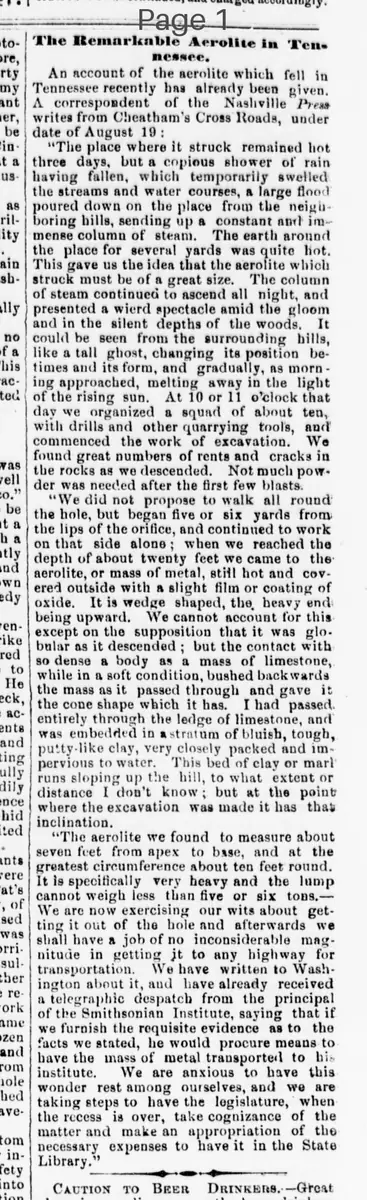
An account of the aerolite which fell in Tennessee recently has already been given. A correspondent of the Nashville "Press and Times" writes from Cheatham's Cross Roads, under date of August 19 :
"The place where it struck remained hot three days, but a copious shower of rain having fallen, which temporarily swelled the streams and water courses, a large flood poured down on the place from the neighboring hills, sending up a constant and immense column of steam. The earth around the place for several yards was quite hot. This gave us the idea that the aerolite which struck must be of a great size. The column of steam continued to ascend all night, and presented a weird spectacle amid the gloom and in the silent depths of the woods. It could be seen from the surrounding hills, like a tall ghost, changing its position sometimes and its form, and gradually, as morning approached, melting away in the light of the rising sun. At 10 or 11 o'clock that day we organized a squad of about ten, with drills and other quarrying tools, and commenced the work of excavation. We found great numbers of rents and cracks in the rocks as we descended. Not much powder was needed after the first few blasts. "We did not propose to walk all round the hole, but began five or six yards from the lips of the orifice, and continued to work on that side alone: when we reached the depth of about twenty feet we came to the aerolite, or mass of metal, still hot and covered outside with a slight film or coating of oxide. It is wedge shaped, the heavy end being upward. We cannot account for this except on the supposition that it was globular as it descended : but the contact with so dense a body as a mass of limestone, while in a soft condition, pushed backwards the mass as it passed through and gave it the cone shape which it has. It had passed entirely through the ledge of limestone, and was embedded in a stratum of bluish, tough, putty-like clay, very closely packed and impervious to water. This bed of clay or marl runs sloping up the hill, to what extent or distance I don't know; but at the point where the excavation was made it has that inclination.
"The aerolite we found to measure about seven feet from apex to base, and at the greatest circumference about ten feet round. It is specifically very heavy and the lump cannot weigh less than five or six tons.- We are now exercising our wits about getting it out of the hole and afterwards we shall have a job of no inconsiderable magnitude in getting it to any highway for transportation. We have written to Washington about it, and have already received a telegraphic dispatch from the principal of the Smithsonian Institute, saying that if we furnish the requisite evidence as to the facts we stated, he would procure means to have the mass of metal transported to his institute. We are anxious to have this wonder rest among ourselves, and we are taking steps to have the legislature, when the recess is over, take cognizance of the matter and make an appropriation of the necessary expenses to have it in the State Library."
What sub-type of article is it?
What themes does it cover?
What keywords are associated?
Where did it happen?
Story Details
Location
Cheatham's Cross Roads, Tennessee
Event Date
August 19
Story Details
An aerolite fell recently, striking hot ground that steamed after rain. A group excavated it from 20 feet deep in limestone and clay, finding a hot, oxide-coated, wedge-shaped mass about 7 feet long, 10 feet circumference, weighing 5-6 tons. They contacted the Smithsonian but seek state appropriation to keep it locally.