Thank you for visiting SNEWPapers!
Sign up free
Story
April 2, 1926
Union Labor Bulletin
Little Rock, Pulaski County, Arkansas
What is this article about?
Malcolm H. Stewart testifies in Washington that New York financiers oppose U.S. merchant marine and La Follette seamen's law due to investments in foreign ships, allowing exploitation via high rates. Seamen's union echoes claims of hidden foreign interests among U.S. owners.
Clipping
OCR Quality
98%
Excellent
Full Text
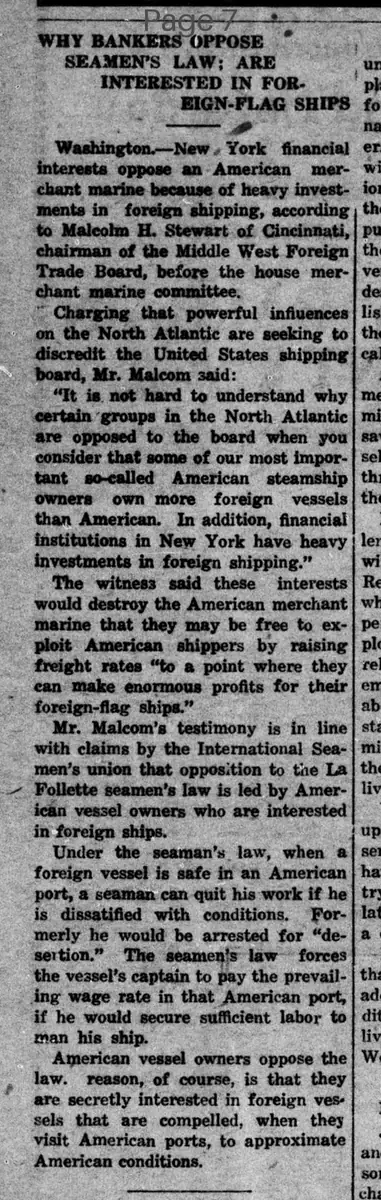
WHY BANKERS OPPOSE
SEAMEN'S LAW: ARE
INTERESTED IN FOR-
EIGN-FLAG SHIPS
Washington.—New York financial interests oppose an American merchant marine because of heavy investments in foreign shipping, according to Malcolm H. Stewart of Cincinnati, chairman of the Middle West Foreign Trade Board, before the house merchant marine committee.
Charging that powerful influences on the North Atlantic are seeking to discredit the United States shipping board, Mr. Malcolm said:
"It is not hard to understand why certain groups in the North Atlantic are opposed to the board when you consider that some of our most important so-called American steamship owners own more foreign vessels than American. In addition, financial institutions in New York have heavy investments in foreign shipping."
The witness said these interests would destroy the American merchant marine that they may be free to exploit American shippers by raising freight rates "to a point where they can make enormous profits for their foreign-flag ships."
Mr. Malcolm's testimony is in line with claims by the International Seamen's union that opposition to the La Follette seamen's law is led by American vessel owners who are interested in foreign ships.
Under the seamen's law, when a foreign vessel is safe in an American port, a seaman can quit his work if he is dissatisfied with conditions. Formerly he would be arrested for "desertion." The seamen's law forces the vessel's captain to pay the prevailing wage rate in that American port, if he would secure sufficient labor to man his ship.
American vessel owners oppose the law. The reason, of course, is that they are secretly interested in foreign vessels that are compelled, when they visit American ports, to approximate American conditions.
SEAMEN'S LAW: ARE
INTERESTED IN FOR-
EIGN-FLAG SHIPS
Washington.—New York financial interests oppose an American merchant marine because of heavy investments in foreign shipping, according to Malcolm H. Stewart of Cincinnati, chairman of the Middle West Foreign Trade Board, before the house merchant marine committee.
Charging that powerful influences on the North Atlantic are seeking to discredit the United States shipping board, Mr. Malcolm said:
"It is not hard to understand why certain groups in the North Atlantic are opposed to the board when you consider that some of our most important so-called American steamship owners own more foreign vessels than American. In addition, financial institutions in New York have heavy investments in foreign shipping."
The witness said these interests would destroy the American merchant marine that they may be free to exploit American shippers by raising freight rates "to a point where they can make enormous profits for their foreign-flag ships."
Mr. Malcolm's testimony is in line with claims by the International Seamen's union that opposition to the La Follette seamen's law is led by American vessel owners who are interested in foreign ships.
Under the seamen's law, when a foreign vessel is safe in an American port, a seaman can quit his work if he is dissatisfied with conditions. Formerly he would be arrested for "desertion." The seamen's law forces the vessel's captain to pay the prevailing wage rate in that American port, if he would secure sufficient labor to man his ship.
American vessel owners oppose the law. The reason, of course, is that they are secretly interested in foreign vessels that are compelled, when they visit American ports, to approximate American conditions.
What sub-type of article is it?
Historical Event
Deception Fraud
What themes does it cover?
Deception
Justice
What keywords are associated?
Bankers Opposition
Seamens Law
Foreign Flag Ships
Merchant Marine
La Follette Law
What entities or persons were involved?
Malcolm H. Stewart
International Seamen's Union
Where did it happen?
Washington
Story Details
Key Persons
Malcolm H. Stewart
International Seamen's Union
Location
Washington
Story Details
Malcolm H. Stewart testifies that New York financial interests oppose the American merchant marine and La Follette seamen's law due to heavy investments in foreign shipping, aiming to exploit American shippers with high freight rates. This aligns with seamen's union claims that American vessel owners with foreign interests lead the opposition.