Thank you for visiting SNEWPapers!
Sign up free
Letter to Editor
August 1, 1807
Virginia Argus
Richmond, Virginia
What is this article about?
A letter to the Argus defending President Jefferson's decision to pardon Erick Bollman and use his testimony against Aaron Burr in a treason trial, arguing that Bollman's communications justified the action to expose and convict traitors despite promises of confidentiality.
Clipping
OCR Quality
98%
Excellent
Full Text
FOR THE ARGUS.
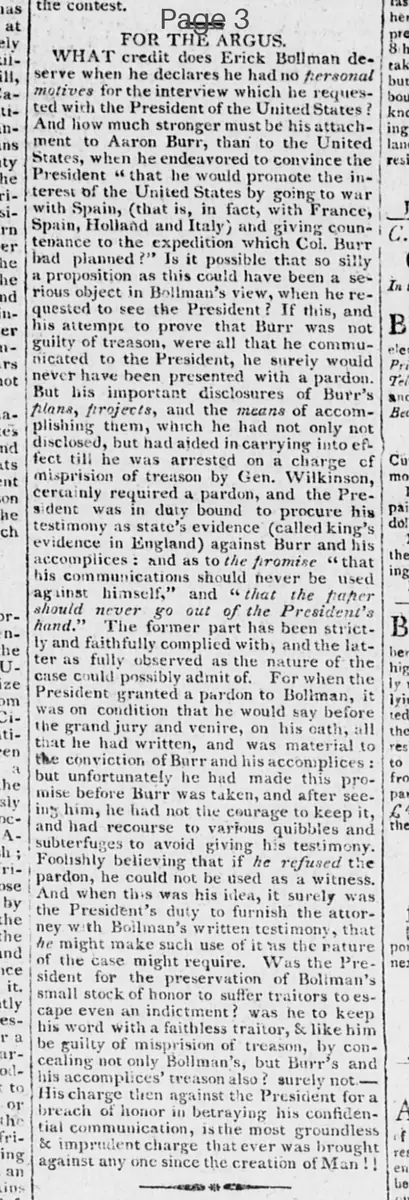
WHAT credit does Erick Bollman deserve when he declares he had no personal motives for the interview which he requested with the President of the United States? And how much stronger must be his attachment to Aaron Burr, than to the United States, when he endeavored to convince the President " that he would promote the interest of the United States by going to war with Spain, (that is, in fact, with France, Spain, Holland and Italy) and giving countenance to the expedition which Col. Burr had planned?" Is it possible that so silly a proposition as this could have been a serious object in Bollman's view, when he requested to see the President? If this, and his attempt to prove that Burr was not guilty of treason, were all that he communicated to the President, he surely would never have been presented with a pardon. But his important disclosures of Burr's plans, projects, and the means of accomplishing them, which he had not only not disclosed, but had aided in carrying into effect till he was arrested on a charge of misprision of treason by Gen. Wilkinson, certainly required a pardon, and the President was in duty bound to procure his testimony as state's evidence (called king's evidence in England) against Burr and his accomplices: and as to the promise "that his communications should never be used against himself," and "that the paper should never go out of the President's hand.?"
The former part has been strictly and faithfully complied with, and the latter as fully observed as the nature of the case could possibly admit of. For when the President granted a pardon to Bollman, it was on condition that he would say before the grand jury and venire, on his oath, all that he had written, and was material to the conviction of Burr and his accomplices : but unfortunately he had made this promise before Burr was taken, and after seeing him, he had not the courage to keep it, and had recourse to various quibbles and subterfuges to avoid giving his testimony. Foolishly believing that if he refused the pardon, he could not be used as a witness. And when this was his idea, it surely was the President's duty to furnish the attorney with Bollman's written testimony, that he might make such use of it as the nature of the case might require. Was the President for the preservation of Bollman's small stock of honor to suffer traitors to escape even an indictment? was he to keep his word with a faithless traitor, & like him be guilty of misprision of treason, by concealing not only Bollman's, but Burr's and his accomplices' treason also? surely not- His charge then against the President for a breach of honor in betraying his confidential communication, is the most groundless & imprudent charge that ever was brought against any one since the creation of Man!!
WHAT credit does Erick Bollman deserve when he declares he had no personal motives for the interview which he requested with the President of the United States? And how much stronger must be his attachment to Aaron Burr, than to the United States, when he endeavored to convince the President " that he would promote the interest of the United States by going to war with Spain, (that is, in fact, with France, Spain, Holland and Italy) and giving countenance to the expedition which Col. Burr had planned?" Is it possible that so silly a proposition as this could have been a serious object in Bollman's view, when he requested to see the President? If this, and his attempt to prove that Burr was not guilty of treason, were all that he communicated to the President, he surely would never have been presented with a pardon. But his important disclosures of Burr's plans, projects, and the means of accomplishing them, which he had not only not disclosed, but had aided in carrying into effect till he was arrested on a charge of misprision of treason by Gen. Wilkinson, certainly required a pardon, and the President was in duty bound to procure his testimony as state's evidence (called king's evidence in England) against Burr and his accomplices: and as to the promise "that his communications should never be used against himself," and "that the paper should never go out of the President's hand.?"
The former part has been strictly and faithfully complied with, and the latter as fully observed as the nature of the case could possibly admit of. For when the President granted a pardon to Bollman, it was on condition that he would say before the grand jury and venire, on his oath, all that he had written, and was material to the conviction of Burr and his accomplices : but unfortunately he had made this promise before Burr was taken, and after seeing him, he had not the courage to keep it, and had recourse to various quibbles and subterfuges to avoid giving his testimony. Foolishly believing that if he refused the pardon, he could not be used as a witness. And when this was his idea, it surely was the President's duty to furnish the attorney with Bollman's written testimony, that he might make such use of it as the nature of the case might require. Was the President for the preservation of Bollman's small stock of honor to suffer traitors to escape even an indictment? was he to keep his word with a faithless traitor, & like him be guilty of misprision of treason, by concealing not only Bollman's, but Burr's and his accomplices' treason also? surely not- His charge then against the President for a breach of honor in betraying his confidential communication, is the most groundless & imprudent charge that ever was brought against any one since the creation of Man!!
What sub-type of article is it?
Persuasive
Political
Provocative
What themes does it cover?
Politics
Crime Punishment
What keywords are associated?
Aaron Burr
Erick Bollman
President Jefferson
Treason Trial
Pardon
Burr Conspiracy
State Evidence
What entities or persons were involved?
For The Argus
Letter to Editor Details
Recipient
For The Argus
Main Argument
president jefferson was justified in pardoning erick bollman and using his testimony against aaron burr, as it was necessary to expose treason and prevent traitors from escaping justice, despite confidentiality promises.
Notable Details
Bollman's Proposal For War With Spain To Support Burr's Expedition
Pardon Conditioned On Testimony Before Grand Jury
Bollman's Refusal To Testify After Seeing Burr
Reference To Misprision Of Treason By Gen. Wilkinson