Thank you for visiting SNEWPapers!
Sign up free
Concord Register
Concord, Merrimack County, New Hampshire
What is this article about?
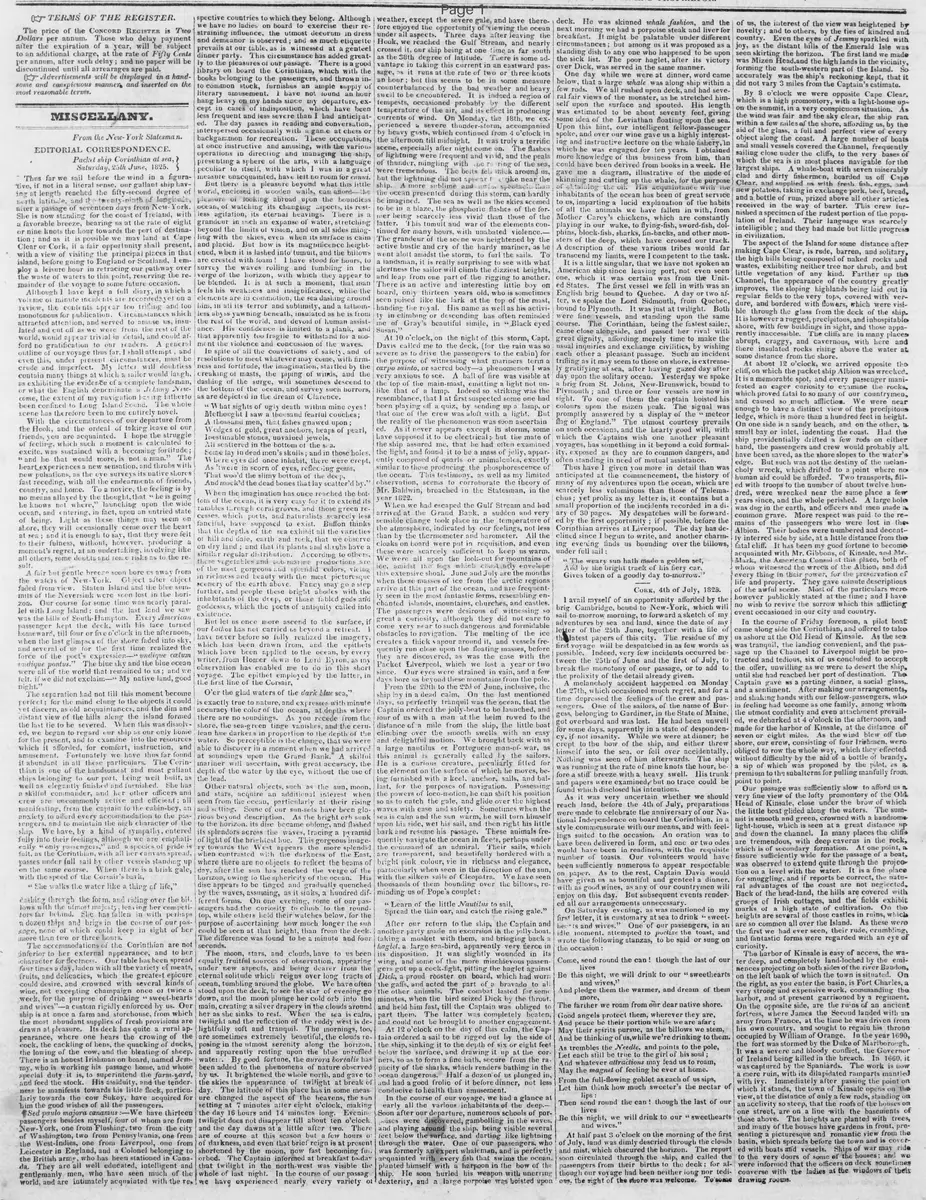
Editorial correspondence recounting a 17-day Atlantic voyage from New York to Ireland on the packet ship Corinthian in June-July 1825, describing ship life, natural phenomena, storms, wildlife encounters, a sailor's suicide, and arrival at Kinsale.
Clipping
OCR Quality
Full Text
From the New-York Statesman.
EDITORIAL CORRESPONDENCE.
Packet ship Corinthian at sea, Saturday, 25th June, 1825.
Thus far we sail before the wind in a figurative, if not in a literal sense, our gallant ship having at length reached the fifty-second degree of north latitude, and the twenty-ninth of longitude, after a passage of seventeen days from New-York. She is now standing for the coast of Ireland, with a favorable breeze, bearing us at the rate of eight or nine knots the hour towards the port of destination; and as it is possible we may land at Cape Clear or Cork, if a fair opportunity shall present, with a view of visiting the principal places in that island, before going to England or Scotland, I employ a leisure hour in retracing our pathway over the waste of waters to this point, reserving the remainder of the voyage to some future occasion.
Although I have kept a full diary, in which a volume of minute incidents are recorded, yet on a review, the contents appear too trifling and too monotonous for publication. Circumstances which attracted attention, and served to amuse us, insulated and cut off as we were from the rest of the world, would appear trivial in detail, and could afford no gratification to our readers. A general outline of our voyage thus far, I shall attempt; and even this, under present circumstances, must be crude and imperfect. My letter will doubtless contain many things at which a sailor would laugh, as exhibiting the evidence of a complete landsman, or what the English denominate a Johnny New-come, the extent of my navigation having hitherto been confined to Long Island Sound. The whole scene has therefore been to me entirely novel.
With the circumstances of our departure from the Hook, and the ordeal of taking leave of our friends, you are acquainted. I hope the struggle of feeling, which such a moment is calculated to excite, was sustained with a becoming fortitude; "and he that would more, is not a man." The heart experiences a new sensation, and throbs with new pulsations, as the eye surveys its native shores fast receding, with all the endearments of friends, country, and home. To a novice, the feeling is by no means allayed by the thought, that "he is going he knows not where," launching upon the wide ocean, and entering, in fact, upon an untried state of being. Light as these things may seem on shore, they will occasionally come over the heart at sea; and it is enough to say, that they were felt to their fulness, without, however, producing a moment's regret, at an undertaking, involving like all others, some doubts and some risks as to the result.
A fair but gentle breeze soon bore us away from the waters of New-York. Object after object faded from view. Staten Island and the blue summits of the Neversink were soon lost in the horizon. Our course for some time was nearly parallel with Long Island: and the last land we saw was the hills of South-Hampton. Every American passenger kept the deck, with his face turned homeward, till four or five o'clock in the afternoon, when the last glimpses of the shore faded into sky, and several of us for the first time realized the force of the poet's expression "undique caelum undique pontus." The blue sky and the blue ocean were all of the world that remained to us; and we felt, if we did not exclaim—"My native land, good night."
The separation had not till this moment become perfect; for the mind clung to the objects it could not discern, as old acquaintances, and the dim and distant view of the hills along the island formed the last tie to be severed. When this was dissolved, we began to regard our ship as our only home for the present, and to examine into the resources which it afforded, for comfort, instruction, and amusement. Fortunately we have thus far found it abundant in all these particulars. The Corinthian is one of the handsomest and most gallant ships belonging to our port, being well built, as well as elegantly finished and furnished. She has a skilful commander, and her other officers and crew are uncommonly active and efficient; all manifesting, from the captain to the cabin-boy, an anxiety to afford every accommodation to the passengers, and to maintain the high character of the ship. We have, by a kind of sympathy, entered fully into their feelings, although we are emphatically "only passengers," and a species of pride is felt, as the Corinthian, with all her canvass spread, passes under full sail by other vessels standing up on the same course. When there is a brisk gale, with the speed of the Corsair's bark,
"She walks the water like a thing of life,"
lashing through the foam, and riding over the billows with the utmost majesty, leaving her competitors far behind. She has fallen in with perhaps a dozen ships and brigs in the course of our passage, none of which could keep in sight of her more than two or three hours.
The accommodations of the Corinthian are not inferior to her external appearance, and to her character for fleetness. Our table has been spread four times a day, laden with all the variety of meats, fruits, and delicacies, which the greatest epicure could desire, and crowned with several kinds of wine, not excepting champagne once or twice a week, for the purpose of drinking "sweet-hearts and wives"—a custom rigidly enforced by us. Our ship is at once a farm and storehouse, from which the most abundant supplies of fresh provisions are drawn at pleasure. Its deck has quite a rural appearance, where one hears the crowing of the cock, the cackling of hens, the quacking of ducks, the lowing of the cow, and the bleating of sheep. There is an honest Irishman on board, named Jimmy, who is working his passage home, and whose special duty it is, to superintend the farm-yard, and feed the stock. His assiduity, and the tenderness he manifests towards his little flock, particularly towards the cow Sukey, have acquired for him the good wishes of all the passengers.
Sed paulo majora canamus:—We have thirteen passengers besides myself, four of whom are from New-York, one from Flushing, two from the city of Washington, two from Pennsylvania, one from the West-Indies, one from Liverpool, one from Leicester in England, and a Colonel belonging to the British army, who has been stationed in Canada. They are all well educated, intelligent and gentlemanly men, who have seen much of the world, and are intimately acquainted with the respective countries to which they belong. Although we have no ladies on board to exercise their restraining influence, the utmost decorum in dress and demeanor is observed; and as much etiquette prevails at our table, as is witnessed at a genteel dinner party. This circumstance has added greatly to the pleasures of our passage. There is a good library on board the Corinthian, which with the books belonging to the passengers, and thrown into common stock, furnishes an ample supply of literary amusement. I have not found an hour hang heavy on my hands since my departure, except in cases of indisposition, which have been less frequent and less severe than I had anticipated. The day passes in reading and conversation, interspersed occasionally with a game at chess or backgammon for recreation. These occupations, at once instructive and amusing, with the various operations in directing and managing the ship, presenting a sphere of the arts, with a language peculiar to itself, with which I was in a great measure unacquainted, have left no room for ennui.
But there is a pleasure beyond what this little world, enclosed in wooden walls, can afford—the pleasure of looking abroad upon the boundless ocean, of watching its changing aspects, its restless agitation, its eternal heavings. There is a grandeur in such an expanse of water, stretching beyond the limits of vision, and on all sides mingling with the skies, even when its surface is calm and placid. But how is its magnificence heightened, when it is lashed into tumult, and the billows are crested with foam! I have stood for hours, to survey the waves rolling and tumbling in the verge of the horizon, with which they appear to be blended. It is at such a moment, that man feels his weakness and insignificance, while the elements are in commotion, the sea dashing around him in all its terror and sublimity, and a fathomless abyss yawning beneath, insulated as he is from the rest of the world, and devoid of human assistance. His confidence is limited to a plank, and that apparently too fragile to withstand for a moment the violence and concussion of the waves.
In spite of all the convictions of safety, and of resolutions to meet whatever may come, with firmness and fortitude, the imagination, startled by the creaking of masts, the piping of winds, and the dashing of the surge, will sometimes descend to the bottom of the ocean, and survey such horrors, as are depicted in the dream of Clarence.
"What sights of ugly death within mine eyes! Methought I saw a thousand fearful couches; A thousand men, that fishes gnawed upon; Wedges of gold, great anchors, heaps of pearl, Inestimable stones, unvalued jewels, All scattered in the bottom of the sea. Some lay in dead men's skulls; and in those holes Where eyes did once inhabit, there were crept, As 'twere in scorn of eyes, reflecting gems, That woo'd the slimy bottom of the deep, And mock'd the dead bones that lay scatter'd by."
When the imagination has once reached the bottom of the ocean, it is very easy for it to extend its rambles through coral groves, and those green recesses, which poets, and naturalists scarcely less fanciful, have supposed to exist. Buffon thinks that the depths of the sea exhibit all the varieties of hill and dale, earth and rock, that we observe on dry land: and that its plants and shrubs have a similar regular distribution. According to others, these vegetables and sub-marine productions are of the most gorgeous and splendid colors, vying in richness and beauty with the most picturesque scenery of the earth above. Fancy may go a step further, and people these bright abodes with the inhabitants of the deep, or those fabled gods and goddesses, which the poets of antiquity called into existence.
But let us once more ascend to the surface, if our lathos has not carried us beyond a retreat. I have never before so fully realized the imagery, which has been drawn from, and the epithets which have been applied to the ocean, by every writer, from Homer down to Lord Byron, as my observation has enabled me to do in this short voyage. The epithet employed by the latter, in the first line of the Corsair,
"O'er the glad waters of the dark blue sea,"
is exactly true to nature, and expresses with minute accuracy the color of the ocean, at depths where there are no soundings. As you recede from the shore, the sea-green tinge vanishes, and the cerulean hue darkens in proportion to the depth of the water. So perceptible is the change, that we were able to discover in a moment when we had arrived at soundings upon the Grand Bank. A skilful mariner will ascertain, with great accuracy, the depth of the water by the eye, without the use of the lead.
Other natural objects, such as the sun, moon, and stars, acquire an additional interest when seen from the ocean, particularly at their rising and setting. Some of our sun-sets have been glorious beyond description. As the bright orb sunk to the horizon, its disc became oblong, and flashed its splendors across the waves, tracing a pyramid of light of the brightest hue. This gorgeous imagery towards the West appears the more splendid when contrasted with the darkness of the East, where there are no objects to reflect the beams of day, after the sun has reached the verge of the horizon, owing to the sphericity of the ocean. His disc appears to be tinged and gradually quenched by the waves, assuming, as it sinks, a hundred different forms. On one evening, some of our passengers had the curiosity to climb to the round-top, while others held their watches below, for the purpose of ascertaining how much longer the sun could be seen at that height, than from the deck. The difference was found to be a minute and four seconds.
The moon, stars, and clouds, have to us been equally fruitful sources of observation, appearing under new aspects, and being dearer from the eternal solitude which reigns over long tracts of ocean, tumbling around the globe. We have often stood upon the deck, to see the star of evening go down, and the moon plunge her cold orb into the main, creating a silver drapery in the clouds around her as she sinks to rest. When the sea is calm, twilight and the reflection of the ruddy west is delightfully soft and tranquil. The mornings, too, are sometimes extremely beautiful, the clouds reposing in the utmost serenity along the horizon, and apparently resting upon the blue unruffled waters. By good fortune, the aurora borealis has been added to the phenomena of nature observed by us. It brightened the whole north, and gave to the skies the appearance of twilight at break of day. The latitude of this place has in some measure changed the aspect of the heavens, the sun setting at 7 minutes after eight o'clock, making the day 16 hours and 14 minutes long. Evening twilight does not disappear till about ten o'clock, and the day dawns at a little after two. There are of course at this season but a few hours of darkness, and even that brief reign is at present shortened by the moon, now fast becoming full-orbed. The Captain informed at breakfast to-day that twilight in the north-west was visible the whole of last night. In the course of our passage we have experienced nearly every variety of weather, except the severe gale, and have therefore enjoyed the opportunity of viewing the ocean under all aspects. Three days after leaving the Hook, we reached the Gulf Stream, and nearly crossed it, our ship being at one time as far south as the 38th degree of latitude. There is some advantage in taking this current in an eastward passage, as it runs at the rate of two or three knots an hour; but this seems to be in some measure counterbalanced by the bad weather and heavy swell to be encountered. It is indeed a region of tempests, occasioned probably by the different temperature of the air, and its effect in producing currents of wind. On Monday, the 18th, we experienced a severe thunder-storm, accompanied by heavy gusts, which continued from 4 o'clock in the afternoon till midnight. It was truly a terrific scene, especially after night come on. The flashes of lightning were frequent and vivid, and the peals of thunder, mingling with the roaring of the sea, were tremendous. The bolts fell thick around us, but the lightning did not appear to strike near the ship. A more sublime and awful spectacle than the ocean presented during this storm, can hardly be imagined. The sea as well as the skies seemed to be in a blaze, the phosphoric flashes of the former being scarcely less vivid than those of the latter. This tumult and war of the elements continued for many hours, with unabated violence.—The grandeur of the scene was heightened by the active bustle and cry of the hardy mariner, as he went aloft amidst the storm, to furl the sails. To a landsman, it is really surprising to see with what alertness the sailor will climb the dizziest heights, and leap from one part of the rigging to another. There is an active and interesting little boy on board, only thirteen years old, who is sometimes seen poised like the lark at the top of the mast, handing the royal. His name as well as his activity in climbing or descending has often reminded me of Gray's beautiful simile, in "Black eyed Susan."
At 10 o'clock, on the night of this storm, Capt. Davis called me to the deck, (for the rain was so severe as to drive the passengers to the cabin) for the purpose of witnessing what mariners term a corpo santo, or sacred body—a phenomenon I was very anxious to see. A ball of fire was visible at the top of the main-mast, emitting a light not unlike that of a lamp. Indeed so striking was the resemblance, that I at first suspected some one had been playing off a quiz, by sending up a lamp, or that one of the crew was aloft with a light. But the reality of the phenomenon was soon ascertained. As it never appears except in storms, some have supposed it to be electrical; but the mate of the ship assured me, that he had often examined the light, and found it to be a mass of jelly, apparently composed of quartzes or animalcules, exactly similar to those producing the phosphorescence of the ocean. This testimony, as well as my limited observation, seems to corroborate the theory of Mr. Baldwin, broached in the Statesman, in the year 1822.
When we had escaped the Gulf Stream and had arrived at the Grand Bank, a sudden and very sensible change took place in the temperature of the atmosphere, indicated by our feelings, not less than by the thermometer and barometer. All the cloaks on board were put in requisition, and even these were scarcely sufficient to keep us warm. We were all upon the look-out for mountains of ice, amidst the fogs which chiefly envelope this extensive shoal. June and July are the months when these masses of ice from the arctic regions arrive at this part of the ocean, and are frequently seen in the most fantastic forms, resembling enchanted islands, mountains, churches, and castles. The passengers were desirous of witnessing so great a curiosity, although they did not care to come very near to such dangerous and formidable obstacles to navigation. The melting of the ice creates a thick vapour around it, and vessels frequently run close upon the floating masses, before they are discovered, as was the case with the Packet Liverpool, which we lost a year or two since. Our eyes were strained in vain, and a few days bore us beyond these mountains from the pole.
From the 20th to the 22d of June, inclusive, the ship lay in a dead calm. On the last mentioned days, so perfectly tranquil was the ocean, that the Captain ordered the jolly-boat to be launched, and four of us with a man at the helm rowed to the distance of a mile from the ship, the little boat climbing over the smooth swells with an easy and delightful motion. We brought back with us a large nautilus or, Portuguese man-of-war, as this animal is generally called by the sailors. He is a curious creature, peculiarly fitted for the element on the surface of which he moves, being furnished with a keel, anchor, sails, and ballast, for the purposes of navigation. Possessing the powers of loco-motion, he can shift his position so as to catch the gale, and glide over the highest waves with ease and safety. Sometimes when the sea is calm and the sun warm, he will turn himself upon his side, wet his sail, and then right his little bark and resume his passage. These animals frequently navigate the ocean in fleets, perhaps under the command of an admiral. Their sails, which are transparent, and beautifully bordered with a bright pink colour, vie in richness and elegance, particularly when seen in the direction of the sun, with the silken sails of Cleopatra. We have seen thousands of them bounding over the billows, reminding us of Pope's couplet:
"Learn of the little Nautilus to sail,
Spread the thin oar, and catch the rising gale."
After our return to the ship, the Captain and another party made an excursion in the jolly-boat, taking a musket with them, and bringing back a haglet, a large sea-bird, apparently very fierce in its disposition. It was slightly wounded in its wing, and some of the more mischievous passengers got up a cock-fight, pitting the haglet against Dick, a proud rooster on board, which had worn the gaffs, and acted the part of a bravado to all the other animals. The combat lasted for some minutes, when the bird seized Dick by the throat, and held him fast, till the Captain was obliged to part them. The latter was completely beaten, and could not be brought to another engagement.
At 12 o'clock on the day of this calm, the Captain ordered a sail to be rigged out by the side of the ship, sinking it to the depth of six or eight feet below the surface, and drawing it up at the corners, so as to form a fine bath, secure from the rapacity of the sharks, which renders bathing in the ocean dangerous. Half a dozen of us plunged in, and had a good frolic of it before dinner, not less conducive to health than amusement.
In the course of our voyage, we had a glance at nearly all the various inhabitants of the deep.—Soon after our departure, numerous schools of porpoises were discovered, gambolling in the waves, and playing around the ship, being visible several feet below the surface, and darting like lightning through the water. One of our passengers, who was formerly an expert whaleman, and is perfectly acquainted with every fish that swims the ocean, planted himself with a harpoon in the bow of the ship. He soon hurled his weapon with unerring dexterity, and a large porpoise was hoisted upon deck. He was skinned whale fashion, and the next morning we had a porpoise steak and liver for breakfast. It might be palatable under different circumstances; but among us it was proposed as a standing dish to any one who happened to be upon the sick list. The poor haglet, after its victory over Dick, was served in the same manner.
One day while we were at dinner, word came below, that a large whale was along ship within a few rods. We all rushed upon deck, and had several fair views of the monster, as he stretched himself upon the surface and spouted. His length was estimated to be about seventy feet, giving some idea of the Leviathan floating upon the sea. Upon this hint, our intelligent fellow-passenger spoke, and over our wine gave us a highly interesting and instructive lecture on the whale fishery, in which he was engaged for ten years. I obtained more knowledge of this business from him, than could have been derived from books in a week. He gave me a diagram, illustrative of the mode of skinning and cutting up the whale, for the purpose of extracting the oil. His acquaintance with the inhabitants of the ocean has been of great service to us, imparting a lucid explanation of the habits of all the animals we have fallen in with, from Mother Carey's chickens, which are constantly playing in our wake, to flying-fish, sword-fish, dolphins, block-fish, sharks, fin-backs, and other monsters of the deep, which have crossed our track. A description of these various tribes would far transcend my limits, were I competent to the task.
It is a little singular, that we have not spoken an American ship since leaving port, not even seen one, which it was certain was from the United States. The first vessel we fell in with was an English brig bound to Quebec. A day or two after, we spoke the Lord Sidmouth, from Quebec, bound to Plymouth. It was just at twilight. Both were fine vessels, and standing upon the same course. The Corinthian, being the fastest sailer, came close alongside, and passed her rival with great dignity, affording merely time to make the usual inquiries and exchange civilities, by wishing each other a pleasant passage. Such an incident trifling as it may seem to those on shore, is extremely gratifying at sea, after having gazed day after day upon the solitary ocean. Yesterday we spoke a brig from St. Johns, New-Brunswick, bound to Plymouth; and three or four vessels are now in sight. To one of them the captain hoisted his colours upon the mizen peak. The signal was promptly answered by a display of the "meteor flag of England." The utmost courtesy prevails on such occasions, and the hearty good will, with which the Captains wish one another pleasant voyages, has something in it beyond a cold formality, exposed as they are to common dangers, and often standing in need of mutual assistance.
Thus have I given you more in detail than was anticipated at the commencement, the history of many of my adventures upon the ocean, which are scarcely less voluminous than those of Telemachus; yet prolix as my letter is, it contains but a small proportion of the incidents recorded in a diary of 30 pages. My despatches will be forwarded by the first opportunity; if possible, before the Corinthian arrives at Liverpool. The day has declined since I begun to write, and another charming evening finds us bounding over the billows, under full sail:
"The weary sun hath made a golden set,
And by the bright track of his fiery car,
Gives token of a goodly day to-morrow."
CORK, 4th of July, 1825.
I avail myself of an opportunity afforded by the brig Cambridge, bound to New-York, which will sail to-morrow morning, to forward a sketch of my adventures by sea and land, since the date of my letter of the 25th June, together with a file of the latest papers of this city. The residue of my first voyage will be despatched in as few words as possible. Indeed, very few incidents occurred between the 25th of June and the first of July, to break the monotony of our passage, or to add to the prolixity of the detail already given.
A melancholy accident happened on Monday the 27th, which occasioned much regret, and for a time depressed the feelings of the crew and passengers. One of the sailors, of the name of Burgess, belonging to Gardiner, in the State of Maine, got overboard and was lost. He had been unwell for some days, apparently in a state of despondency, if not insanity. While we were at dinner; he crept to the bow of the ship, and either threw himself into the sea, or fell over accidentally. Nothing was seen of him afterwards. The ship was running at the rate of nine knots the hour, before a stiff breeze with a heavy swell. His trunk and papers were examined, but no trace could be found which disclosed his intentions.
As it was very uncertain whether we should reach land, before the 4th of July, preparations were made to celebrate the anniversary of our National Independence on board the Corinthian, in a style commensurate with our means, and with feelings suited to the occasion. An oration was to have been delivered in form, and one or two odes would have been in readiness, with the requisite number of toasts. Our volunteers would have been sufficiently numerous to appear respectable on paper. As to the rest, Captain Davis would have given us as bountiful and genteel a dinner, with as good wines, as any of our countrymen will enjoy on this day. But subsequent events rendered all our arrangements unnecessary.
On Saturday evening, as was mentioned in my first letter, it is customary at sea to drink "sweet-hearts and wives." One of our passengers, in an idle moment, attempted to poetize the toast, and wrote the following stanzas, to be said or sung on the occasion:
Come, send round the can! though the last of our lives
Be this night, we will drink to our "sweethearts and wives,"
And pledge them the warmer, and dream of them more,
The farther we roam from our dear native shore.
Good angels protect them, wherever they are.
And peace be their portion while we are afar;
May their spirits pursue, as the billows we stem,
And be thinking of us, while we're drinking to them.
As trembles the Needle, and points to the pole,
Let each still be true to the girl of his soul;
And whatever attractions may lead us to roam,
May the magnet of feeling be ever at home.
From the full-flowing goblet as each of us sips,
Let him think how much sweeter's the nectar of lips:
Then send round the can! though the last of our lives
Be this night, we will drink to our "sweethearts and wives."
At half past 3 o'clock on the morning of the first of July, land was dimly descried through the clouds and mist, which obscured the horizon. The report soon circulated through the ship, and called the passengers from their births to the deck; for although our voyage had been neither long nor tedious, the sight of the shore was welcome. To some of us, the interest of the view was heightened by novelty; and to others, by the ties of kindred and country. Even the eyes of Jemmy sparkled with joy, as the distant hills of the Emerald Isle was seen skirting the horizon. The first land we made was Mizen Head, and the high lands in the vicinity, forming the south-western part of the Island. So accurately was the ship's reckoning kept, that it did not vary 3 miles from the Captain's estimate.
By 8 o'clock we were opposite Cape Clear, which is a high promontory, with a light-house upon the summit, in a very conspicuous situation. As the wind was fair and the sky clear, the ship ran within a few miles of the shore, affording us, by the aid of the glass, a full and perfect view of every object along the coast. A large number of boats and small vessels covered the Channel, frequently sailing close under the cliffs, to the very bases of which the sea is in most places navigable for the largest ships. A whale-boat with seven miserably clad and dirty fishermen, boarded us off Cape Clear, and supplied us with fresh fish, eggs, and new potatoes, taking in exchange pork, beef, bread, and a bottle of rum, prized above all other articles received in the way of barter. This crew furnished a specimen of the rudest portion of the population of Ireland. Their language was scarcely intelligible; and they had made but little progress in civilization.
The aspect of the Island for some distance after making Cape Clear, is rude, barren, and solitary, the high hills being composed of naked rocks and wastes, exhibiting neither tree nor shrub, and but little vegetation of any kind. Farther up the Channel, the appearance of the country greatly improves, the sloping highlands being laid out in regular fields to the very tops, covered with verdure, and bordered with flowers, which were visible through the glass from the deck of the ship. It is however a rugged, precipitous, and inhospitable shore, with few buildings in sight, and those apparently inaccessible. The cliffs are in many places abrupt, craggy, and cavernous, with here and there insulated rocks rising above the water at some distance from the shore.
At about 12 o'clock, we arrived opposite the cliff, on which the packet ship Albion was wrecked. It is a memorable spot, and every passenger manifested an eager curiosity to examine the rocks, which proved fatal to so many of our countrymen, and caused so much affliction. We were near enough to have a distinct view of the precipitous ledge, which is more than a hundred feet in height. On one side is a sandy beach, and on the other, a small bay or inlet, indenting the coast. Had the ship providentially drifted a few rods on either hand, the passengers and crew would probably all have been saved, as the shore slopes to the water's edge. But such was not the destiny of the melancholy wreck, which drifted to a point where no human aid could be afforded. Two transports, filled with troops to the number of about twelve hundred, were wrecked near the same place a few years since, and the whole perished. A large hole was dug in the earth, and officers and men made a common grave. More respect was paid to the remains of the passengers who were lost in the Albion. Their bodies were numbered and decently interred side by side, at a little distance from the fatal cliff. It has been my good fortune to become acquainted with Mr. Gibbons, of Kinsale, and Mr. Mark, the American Consul at this place, both of whom witnessed the wreck of the Albion, and did every thing in their power, for the preservation of life and property. They gave minute descriptions of the awful scene. Most of the particulars were however publicly stated at the time; and I have no wish to revive the sorrow which this afflicting event occasioned in our city and country.
In the course of Friday forenoon, a pilot boat came along side the Corinthian, and offered to take us ashore at the Old Head of Kinsale. As the sea was tranquil, the landing convenient, and the passage up the Channel to Liverpool might be protracted and tedious, six of us concluded to accept the offer, unwilling as we were to desert the ship, until she had reached her port of destination. The Captain gave us a parting dinner, a social glass, and a sentiment. After making our arrangements, and shaking hands with our fellow-passengers, who in feeling had become as one family, among whom the utmost cordiality and even attachment prevailed, we debarked at 4 o'clock in the afternoon, and made for the harbor of Kinsale, at the distance of seven or eight miles. As the wind blew off the shore, our crew, consisting of four Irishmen, were obliged to row the whole way, which they effected without difficulty by the aid of a bottle of brandy, a sip of which was proposed by the pilot, as a premium to the subalterns for pulling manfully from point to point.
Our passage was sufficiently slow to afford us a very fine view of the lofty promontory of the Old Head of Kinsale, close under the brow of which the little boat glided along the waters. The summit is smooth and green, crowned with a handsome light-house, which is seen at a great distance up and down the channel. In many places the cliffs are tremendous, with deep caverns in the rock, which is of secondary formation. At one point, a fissure sufficiently wide for the passage of a boat, was observed to extend quite through the projection on a level with the water. It is a fine place for smuggling, and if reports be correct, the natural advantages of the coast are not neglected. Back of the head-land, the hills are covered with groups of Irish cottages, and the fields exhibit marks of a high state of cultivation. On the heights are several of those castles in ruins, which are so common all over the Island. As these were the first we had ever seen, their rude, crumbling, and fantastic forms were regarded with an eye of curiosity.
The harbor of Kinsale is easy of access, the water deep, and completely land-locked by the eminences projecting on both sides of the river Bandon, on the left bank of which the town is situated. On the right, as you enter the basin, is Fort Charles, a very strong and expensive work, commanding the harbor, and at present garrisoned by a regiment. On the opposite side, are the ruins of an ancient fortress, where James the Second landed with an army from France, at the time he was driven from his own country, and sought to regain his throne occupied by William of Orange. In the year 1690, the fort was stormed by the Duke of Marlborough. It was a severe and bloody conflict, the Governor of Ireland being killed in the breach. In 1580, it was captured by the Spaniards. The work is now a mere ruin, with its dilapidated ramparts mantled with ivy. Immediately after passing the point on which it stands, the town of Kinsale opens on the view, at the distance of only a few rods, standing on an acclivity so steep, that the roofs of the houses on one street, are on a line with the basements of those above. The heights are planted with trees, and many of the houses have gardens in front, presenting a picturesque and romantic view from the basin, which spreads before the town and is covered with boats and vessels. Ships of war may ride to the very doors of some of the houses; and we were informed that the officers on deck sometimes converse with the ladies at the windows of their drawing rooms.
What sub-type of article is it?
What themes does it cover?
What keywords are associated?
What entities or persons were involved?
Where did it happen?
Story Details
Key Persons
Location
Atlantic Ocean, Approaching Coast Of Ireland (Cape Clear, Cork, Kinsale)
Event Date
June 25 To July 4, 1825
Story Details
Detailed account of a sea voyage from New York to Ireland aboard the packet ship Corinthian, including departure emotions, ship accommodations and life, natural observations (storms, sunsets, aurora), wildlife encounters (porpoises, whale, nautilus), incidents (thunderstorm, calm with boat excursions, sailor's suicide), vessel sightings, and arrival with views of Irish coast and Kinsale harbor.