Thank you for visiting SNEWPapers!
Sign up free
The Daily Worker
Chicago, Cook County, Illinois
What is this article about?
Reports from Tokyo detail arrests of 825 communists in Japan amid war preparations against the Soviet Union, linked to assaults on the Soviet frontier in Manchuria. Historical context includes the 1928 assassination of Chang Tso-lin and Japanese influence over Manchurian warlords, with provocative statements at the Kyoto Pacific Relations Institute.
Clipping
OCR Quality
Full Text
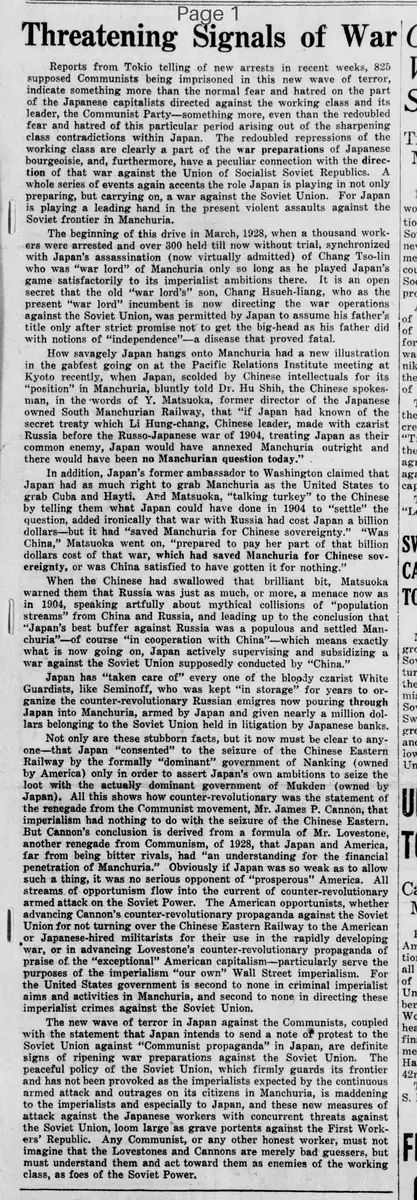
Reports from Tokyo telling of new arrests in recent weeks, 825 supposed Communists being imprisoned in this new wave of terror, indicate something more than the normal fear and hatred on the part of the Japanese capitalists directed against the working class and its leader, the Communist Party—something more, even than the redoubled fear and hatred of this particular period arising out of the sharpening class contradictions within Japan. The redoubled repressions of the working class are clearly a part of the war preparations of Japanese bourgeoisie, and, furthermore, have a peculiar connection with the direction of that war against the Union of Socialist Soviet Republics. A whole series of events again accents the role Japan is playing in not only preparing, but carrying on, a war against the Soviet Union. For Japan is playing a leading hand in the present violent assaults against the Soviet frontier in Manchuria.
The beginning of this drive in March, 1928, when a thousand workers were arrested and over 300 held till now without trial, synchronized with Japan's assassination (now virtually admitted) of Chang Tso-lin who was "war lord" of Manchuria only so long as he played Japan's game satisfactorily to its imperialist ambitions there. It is an open secret that the old "war lord's" son, Chang Hsueh-liang, who as the present "war lord" incumbent is now directing the war operations against the Soviet Union, was permitted by Japan to assume his father's title only after strict promise not to get the big-head as his father did with notions of "independence"-a disease that proved fatal.
How savagely Japan hangs onto Manchuria had a new illustration in the gabfest going on at the Pacific Relations Institute meeting at Kyoto recently, when Japan, scolded by Chinese intellectuals for its "position" in Manchuria, bluntly told Dr. Hu Shih, the Chinese spokesman, in the words of Y. Matsuoka, former director of the Japanese owned South Manchurian Railway, that "if Japan had known of the secret treaty which Li Hung-chang, Chinese leader, made with czarist Russia before the Russo-Japanese war of 1904, treating Japan as their common enemy, Japan would have annexed Manchuria outright and there would have been no Manchurian question today."
In addition, Japan's former ambassador to Washington claimed that Japan had as much right to grab Manchuria as the United States to grab Cuba and Hayti. And Matsuoka, "talking turkey" to the Chinese by telling them what Japan could have done in 1904 to "settle" the question, added ironically that war with Russia had cost Japan a billion dollars but it had "saved Manchuria for Chinese sovereignty." "Was China," Matsuoka went on, prepared to pay her part of that billion dollars cost of that war, which had saved Manchuria for Chinese sovereignty, or was China satisfied to have gotten it for nothing."
When the Chinese had swallowed that brilliant bit, Matsuoka warned them that Russia was just as much, or more, a menace now as in 1904, speaking artfully about mythical collisions of "population streams" from China and Russia, and leading up to the conclusion that "Japan's best buffer against Russia was a populous and settled Manchuria"-of course "in cooperation with China"-which means exactly what is now going on, Japan actively supervising and subsidizing a war against the Soviet Union supposedly conducted by "China."
Japan has "taken care of" every one of the bloody czarist White Guardists, like Seminoff, who was kept "in storage" for years to organize the counter-revolutionary Russian emigres now pouring through Japan into Manchuria, armed by Japan and given nearly a million dollars belonging to the Soviet Union held in litigation by Japanese banks.
Not only are these stubborn facts, but it now must be clear to anyone-that Japan "consented" to the seizure of the Chinese Eastern Railway by the formally "dominant" government of Nanking (owned by America) only in order to assert Japan's own ambitions to seize the loot with the actually dominant government of Mukden (owned by Japan). All this shows how counter-revolutionary was the statement of the renegade from the Communist movement, Mr. James P. Cannon, that imperialism had nothing to do with the seizure of the Chinese Eastern, But Cannon's conclusion is derived from a formula of Mr. Lovestone, another renegade from Communism, of 1928, that Japan and America, far from being bitter rivals, had "an understanding for the financial penetration of Manchuria." Obviously if Japan was so weak as to allow such a thing, it was no serious opponent of "prosperous" America. All streams of opportunism flow into the current of counter-revolutionary armed attack on the Soviet Power. The American opportunists, whether advancing Cannon's counter-revolutionary propaganda against the Soviet Union for not turning over the Chinese Eastern Railway to the American or Japanese-hired militarists for their use in the rapidly developing war, or in advancing Lovestone's counter-revolutionary propaganda of praise of the "exceptional" American capitalism-particularly serve the purposes of the imperialism "our own" Wall Street imperialism. For the United States government is second to none in criminal imperialist aims and activities in Manchuria, and second to none in directing these imperialist crimes against the Soviet Union.
The new wave of terror in Japan against the Communists, coupled with the statement that Japan intends to send a note of protest to the Soviet Union against "Communist propaganda" in Japan, are definite signs of ripening war preparations against the Soviet Union. The peaceful policy of the Soviet Union, which firmly guards its frontier and has not been provoked as the imperialists expected by the continuous armed attack and outrages on its citizens in Manchuria, is maddening to the imperialists and especially to Japan, and these new measures of attack against the Japanese workers with concurrent threats against the Soviet Union, loom large as grave portents against the First Workers' Republic. Any Communist, or any other honest worker, must not imagine that the Lovestones and Cannons are merely bad guessers, but must understand them and act toward them as enemies of the working class, as foes of the Soviet Power.
What sub-type of article is it?
What keywords are associated?
What entities or persons were involved?
Where did it happen?
Foreign News Details
Primary Location
Japan
Event Date
March, 1928; Recent Weeks
Key Persons
Outcome
825 supposed communists imprisoned; thousand workers arrested in march 1928, over 300 held without trial; assassination of chang tso-lin; japanese support for assaults on soviet frontier; statements justifying japanese control of manchuria
Event Details
New arrests of communists in Japan signal war preparations against the Soviet Union, connected to violent assaults on the Soviet frontier in Manchuria. This follows the 1928 arrests and assassination of Chang Tso-lin, with Japan influencing his son Chang Hsueh-liang. At the Kyoto Pacific Relations Institute, Y. Matsuoka defended Japanese position in Manchuria, referencing historical treaties and costs of past wars. Japan supports counter-revolutionary activities, including arming White Guardists and consenting to seizure of Chinese Eastern Railway to advance its ambitions.