Thank you for visiting SNEWPapers!
Sign up free
Literary
May 18, 1831
Morning Star
Limerick, York County, Maine
What is this article about?
This essay explores Christian benevolence as a duty-driven compassion for others' happiness and relief, distinguishing it from obligatory church support (justice) versus voluntary charity. It draws on scriptures to guide generous, prudent giving according to ability, emphasizing wisdom, grace, and stewardship without neglecting justice.
Clipping
OCR Quality
98%
Excellent
Full Text
SCRIPTURAL HINTS ON BENEVOLENCE.
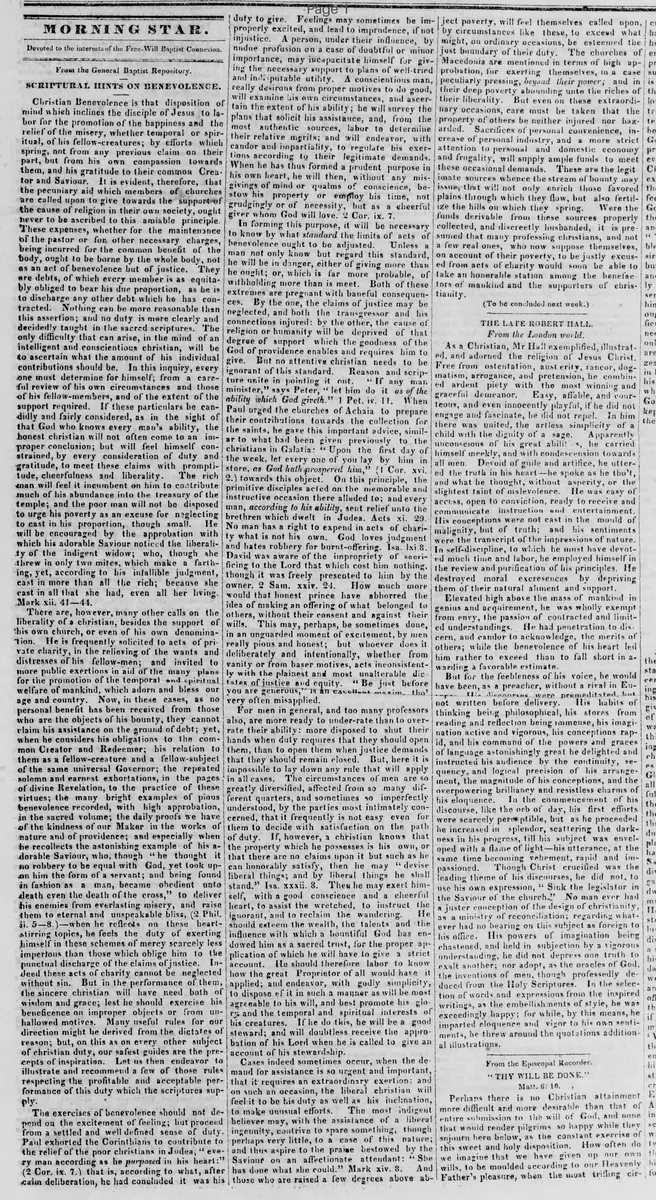
Christian Benevolence is that disposition of mind which inclines the disciple of Jesus to labor for the promotion of the happiness and the relief of the misery, whether temporal or spiritual, of his fellow-creatures; by efforts which spring, not from any previous claim on their part, but from his own compassion towards them, and his gratitude to their common Creator and Saviour. It is evident, therefore, that the pecuniary aid which members of churches are called upon to give towards the support of the cause of religion in their own society, ought never to be ascribed to this amiable principle. These expenses, whether for the maintenance of the pastor or for other necessary charges, being incurred for the common benefit of the body, ought to be borne by the whole body, not as an act of benevolence but of justice. They are debts, of which every member is as equitably obliged to bear his due proportion, as he is to discharge any other debt which he has contracted. Nothing can be more reasonable than this assertion; and no duty is more clearly and decidedly taught in the sacred scriptures. The only difficulty that can arise, in the mind of an intelligent and conscientious christian, will be to ascertain what the amount of his individual contributions should be. In this inquiry, every one must determine for himself; from a careful review of his own circumstances and those of his fellow-members, and of the extent of the support required. If these particulars be candidly and fairly considered, as in the sight of that God who knows every man's ability, the honest christian will not often come to an improper conclusion; but will feel himself constrained, by every consideration of duty and gratitude, to meet these claims with promptitude, cheerfulness and liberality. The rich man will feel it incumbent on him to contribute much of his abundance into the treasury of the temple; and the poor man will not be disposed to urge his poverty as an excuse for neglecting to cast in his proportion, though small. He will be encouraged by the approbation with which his adorable Saviour noticed the liberality of the indigent widow; who, though she threw in only two mites, which make a farthing, yet, according to his infallible judgment, cast in more than all the rich; because she cast in all that she had, even all her living. Mark xii. 41-44.
There are, however, many other calls on the liberality of a christian, besides the support of his own church, or even of his own denomination. He is frequently solicited to acts of private charity, in the relieving of the wants and distresses of his fellow-men; and invited to more public exertions in aid of the many plans for the promotion of the temporal and spiritual welfare of mankind, which adorn and bless our age and country. Now, in these cases, as no personal benefit has been received from those who are the objects of his bounty, they cannot claim his assistance on the ground of debt; yet, when he considers his obligations to the common Creator and Redeemer; his relation to them as a fellow-creature and a fellow-subject of the same universal Governor; the repeated solemn and earnest exhortations, in the pages of divine Revelation, to the practice of these virtues; the many bright examples of pious benevolence recorded, with high approbation, in the sacred volume; the daily proofs we have of the kindness of our Maker in the works of nature and of providence; and especially when he recollects the astonishing example of his adorable Saviour, who, though "he thought it no robbery to be equal with God, yet took upon him the form of a servant; and being found in fashion as a man, became obedient unto death even the death of the cross," to deliver his enemies from everlasting misery, and raise them to eternal and unspeakable bliss, (2 Phil. ii. 5-8.)--when he reflects on these heart-stirring topics, he feels the duty of exerting himself in these schemes of mercy scarcely less imperious than those which oblige him to the punctual discharge of the claims of justice. Indeed these acts of charity cannot be neglected without sin. But in the performance of them, the sincere christian will have need both of wisdom and grace; lest he should exercise his beneficence on improper objects or from unhallowed motives. Many useful rules for our direction might be derived from the dictates of reason; but, on this as on every other subject of christian duty, our safest guides are the precepts of inspiration. Let us then endeavor to illustrate and recommend a few of those rules respecting the profitable and acceptable performance of this duty which the scriptures supply.
The exercises of benevolence should not depend on the excitement of feeling; but proceed from a settled and well defined sense of duty. Paul exhorted the Corinthians to contribute to the relief of the poor christians in Judea, "every man according as he purposed in his heart:" (2 Cor. ix. 7.) that is, according to what, after calm deliberation, he had concluded it was his duty to give. Feelings may sometimes be improperly excited, and lead to imprudence, if not injustice. A person, under their influence, by undue profusion on a case of doubtful or minor importance, may incapacitate himself for giving the necessary support to plans of well-tried and indisputable utility. A conscientious man, really desirous from proper motives to do good, will examine his own circumstances, and ascertain the extent of his ability; he will survey the plans that solicit his assistance, and, from the most authentic sources, labor to determine their relative merits; and will endeavor, with candor and impartiality, to regulate his exertions according to their legitimate demands. When he has thus formed a prudent purpose in his own heart, he will then, without any misgivings of mind or qualms of conscience, bestow his property or employ his time, not grudgingly or of necessity, but as a cheerful giver whom God will love. 2 Cor. ix. 7.
In forming this purpose, it will be necessary to know by what standard the limits of acts of benevolence ought to be adjusted. Unless a man not only know but regard this standard, he will be in danger, either of giving more than he ought; or, which is far more probable, of withholding more than is meet. Both of these extremes are pregnant with baneful consequences. By the one, the claims of justice may be neglected, and both the transgressor and his connections injured: by the other, the cause of religion or humanity will be deprived of that degree of support which the goodness of the God of providence enables and requires him to give. But no attentive christian needs to be ignorant of this standard. Reason and scripture unite in pointing it out. "If any man minister," says Peter, "let him do it as of the ability which God giveth." 1 Pet. iv. 11. When Paul urged the churches of Achaia to prepare their contributions towards the collection for the saints, he gave this important advice, similar to what had been given previously to the christians in Galatia: "Upon the first day of the week, let every one of you lay by him in store, as God hath prospered him," (1 Cor. xvi. 2.) towards this object. On this principle, the primitive disciples acted on the memorable and instructive occasion there alluded to; and every man, according to his ability, sent relief unto the brethren which dwelt in Judea. Acts xi. 29.
No man has a right to expend in acts of charity what is not his own. God loves judgment and hates robbery for burnt-offering. Isa. lxi.8. David was aware of the impropriety of sacrificing to the Lord that which cost him nothing, though it was freely presented to him by the owner. 2 Sam. xxiv. 24. How much more would that honest prince have abhorred the idea of making an offering of what belonged to others, without their consent and against their wills. This may, perhaps, be sometimes done, in an unguarded moment of excitement, by men really pious and honest; but whoever does it deliberately and intentionally, whether from vanity or from baser motives, acts inconsistently with the plainest and most unalterable dictates of justice and equity. "Be just before you are generous," is an excellent maxim, tho' very often misapplied.
For men in general, and too many professors also, are more ready to under-rate than to over-rate their ability: more disposed to shut their hands when duty requires that they should open them, than to open them when justice demands that they should remain closed. But, here it is impossible to lay down any rule that will apply in all cases. The circumstances of men are so greatly diversified, affected from so many different quarters, and sometimes so imperfectly understood, by the parties most intimately concerned, that it frequently is not easy even for them to decide with satisfaction on the path of duty. If, however, a christian knows that the property which he possesses is his own, or that there are no claims upon it but such as he can honorably satisfy, then he may "devise liberal things; and by liberal things he shall stand." Isa. xxxii. 8. Then he may exert himself, with a good conscience and a cheerful heart, to assist the wretched, to instruct the ignorant, and to reclaim the wandering. He should esteem the wealth, the talents and the influence with which a bountiful God has endowed him as a sacred trust, for the proper application of which he will have to give a strict account. He should therefore labor to know how the great Proprietor of all would have it applied; and endeavor, with godly simplicity, to dispose of it in such a manner as will be most agreeable to his will, and best promote his glory and the temporal and spiritual interests of his creatures. If he do this, he will be a good steward; and will doubtless receive the approbation of his Lord when he is called to give an account of his stewardship.
Cases indeed sometimes occur, when the demand for assistance is so urgent and important, that it requires an extraordinary exertion: and on such an occasion, the liberal christian will feel it to be his duty as well as his inclination, to make unusual efforts. The most indigent believer may, with the assistance of a liberal ingenuity, contrive to spare something, though perhaps very little, to a case of this nature; and thus aspire to the praise bestowed by the Saviour on an affectionate attendant: "She has done what she could." Mark xiv. 8. And those who are raised a few degrees above abject poverty, will feel themselves called upon, by circumstances like these, to exceed what might, on ordinary occasions, be esteemed the just boundary of their duty. The churches of Macedonia are mentioned in terms of high approbation, for exerting themselves, in a case peculiarly pressing, beyond their power; and in their deep poverty abounding unto the riches of their liberality. But even on these extraordinary occasions, care must be taken that the property of others be neither injured nor hazarded. Sacrifices of personal convenience, increase of personal industry, and a more strict attention to personal and domestic economy and frugality, will supply ample funds to meet these occasional demands. These are the legitimate sources whence the stream of bounty may issue, that will not only enrich those favored plains through which they flow, but also fertilize the hills on which they spring. Were the funds derivable from these sources properly collected, and discreetly husbanded, it is presumed that many professing christians, and not a few real ones, who now suppose themselves, on account of their poverty, to be justly excused from acts of charity would soon be able to take an honorable station among the benefactors of mankind and the supporters of christianity.
(To be concluded next week.)
Christian Benevolence is that disposition of mind which inclines the disciple of Jesus to labor for the promotion of the happiness and the relief of the misery, whether temporal or spiritual, of his fellow-creatures; by efforts which spring, not from any previous claim on their part, but from his own compassion towards them, and his gratitude to their common Creator and Saviour. It is evident, therefore, that the pecuniary aid which members of churches are called upon to give towards the support of the cause of religion in their own society, ought never to be ascribed to this amiable principle. These expenses, whether for the maintenance of the pastor or for other necessary charges, being incurred for the common benefit of the body, ought to be borne by the whole body, not as an act of benevolence but of justice. They are debts, of which every member is as equitably obliged to bear his due proportion, as he is to discharge any other debt which he has contracted. Nothing can be more reasonable than this assertion; and no duty is more clearly and decidedly taught in the sacred scriptures. The only difficulty that can arise, in the mind of an intelligent and conscientious christian, will be to ascertain what the amount of his individual contributions should be. In this inquiry, every one must determine for himself; from a careful review of his own circumstances and those of his fellow-members, and of the extent of the support required. If these particulars be candidly and fairly considered, as in the sight of that God who knows every man's ability, the honest christian will not often come to an improper conclusion; but will feel himself constrained, by every consideration of duty and gratitude, to meet these claims with promptitude, cheerfulness and liberality. The rich man will feel it incumbent on him to contribute much of his abundance into the treasury of the temple; and the poor man will not be disposed to urge his poverty as an excuse for neglecting to cast in his proportion, though small. He will be encouraged by the approbation with which his adorable Saviour noticed the liberality of the indigent widow; who, though she threw in only two mites, which make a farthing, yet, according to his infallible judgment, cast in more than all the rich; because she cast in all that she had, even all her living. Mark xii. 41-44.
There are, however, many other calls on the liberality of a christian, besides the support of his own church, or even of his own denomination. He is frequently solicited to acts of private charity, in the relieving of the wants and distresses of his fellow-men; and invited to more public exertions in aid of the many plans for the promotion of the temporal and spiritual welfare of mankind, which adorn and bless our age and country. Now, in these cases, as no personal benefit has been received from those who are the objects of his bounty, they cannot claim his assistance on the ground of debt; yet, when he considers his obligations to the common Creator and Redeemer; his relation to them as a fellow-creature and a fellow-subject of the same universal Governor; the repeated solemn and earnest exhortations, in the pages of divine Revelation, to the practice of these virtues; the many bright examples of pious benevolence recorded, with high approbation, in the sacred volume; the daily proofs we have of the kindness of our Maker in the works of nature and of providence; and especially when he recollects the astonishing example of his adorable Saviour, who, though "he thought it no robbery to be equal with God, yet took upon him the form of a servant; and being found in fashion as a man, became obedient unto death even the death of the cross," to deliver his enemies from everlasting misery, and raise them to eternal and unspeakable bliss, (2 Phil. ii. 5-8.)--when he reflects on these heart-stirring topics, he feels the duty of exerting himself in these schemes of mercy scarcely less imperious than those which oblige him to the punctual discharge of the claims of justice. Indeed these acts of charity cannot be neglected without sin. But in the performance of them, the sincere christian will have need both of wisdom and grace; lest he should exercise his beneficence on improper objects or from unhallowed motives. Many useful rules for our direction might be derived from the dictates of reason; but, on this as on every other subject of christian duty, our safest guides are the precepts of inspiration. Let us then endeavor to illustrate and recommend a few of those rules respecting the profitable and acceptable performance of this duty which the scriptures supply.
The exercises of benevolence should not depend on the excitement of feeling; but proceed from a settled and well defined sense of duty. Paul exhorted the Corinthians to contribute to the relief of the poor christians in Judea, "every man according as he purposed in his heart:" (2 Cor. ix. 7.) that is, according to what, after calm deliberation, he had concluded it was his duty to give. Feelings may sometimes be improperly excited, and lead to imprudence, if not injustice. A person, under their influence, by undue profusion on a case of doubtful or minor importance, may incapacitate himself for giving the necessary support to plans of well-tried and indisputable utility. A conscientious man, really desirous from proper motives to do good, will examine his own circumstances, and ascertain the extent of his ability; he will survey the plans that solicit his assistance, and, from the most authentic sources, labor to determine their relative merits; and will endeavor, with candor and impartiality, to regulate his exertions according to their legitimate demands. When he has thus formed a prudent purpose in his own heart, he will then, without any misgivings of mind or qualms of conscience, bestow his property or employ his time, not grudgingly or of necessity, but as a cheerful giver whom God will love. 2 Cor. ix. 7.
In forming this purpose, it will be necessary to know by what standard the limits of acts of benevolence ought to be adjusted. Unless a man not only know but regard this standard, he will be in danger, either of giving more than he ought; or, which is far more probable, of withholding more than is meet. Both of these extremes are pregnant with baneful consequences. By the one, the claims of justice may be neglected, and both the transgressor and his connections injured: by the other, the cause of religion or humanity will be deprived of that degree of support which the goodness of the God of providence enables and requires him to give. But no attentive christian needs to be ignorant of this standard. Reason and scripture unite in pointing it out. "If any man minister," says Peter, "let him do it as of the ability which God giveth." 1 Pet. iv. 11. When Paul urged the churches of Achaia to prepare their contributions towards the collection for the saints, he gave this important advice, similar to what had been given previously to the christians in Galatia: "Upon the first day of the week, let every one of you lay by him in store, as God hath prospered him," (1 Cor. xvi. 2.) towards this object. On this principle, the primitive disciples acted on the memorable and instructive occasion there alluded to; and every man, according to his ability, sent relief unto the brethren which dwelt in Judea. Acts xi. 29.
No man has a right to expend in acts of charity what is not his own. God loves judgment and hates robbery for burnt-offering. Isa. lxi.8. David was aware of the impropriety of sacrificing to the Lord that which cost him nothing, though it was freely presented to him by the owner. 2 Sam. xxiv. 24. How much more would that honest prince have abhorred the idea of making an offering of what belonged to others, without their consent and against their wills. This may, perhaps, be sometimes done, in an unguarded moment of excitement, by men really pious and honest; but whoever does it deliberately and intentionally, whether from vanity or from baser motives, acts inconsistently with the plainest and most unalterable dictates of justice and equity. "Be just before you are generous," is an excellent maxim, tho' very often misapplied.
For men in general, and too many professors also, are more ready to under-rate than to over-rate their ability: more disposed to shut their hands when duty requires that they should open them, than to open them when justice demands that they should remain closed. But, here it is impossible to lay down any rule that will apply in all cases. The circumstances of men are so greatly diversified, affected from so many different quarters, and sometimes so imperfectly understood, by the parties most intimately concerned, that it frequently is not easy even for them to decide with satisfaction on the path of duty. If, however, a christian knows that the property which he possesses is his own, or that there are no claims upon it but such as he can honorably satisfy, then he may "devise liberal things; and by liberal things he shall stand." Isa. xxxii. 8. Then he may exert himself, with a good conscience and a cheerful heart, to assist the wretched, to instruct the ignorant, and to reclaim the wandering. He should esteem the wealth, the talents and the influence with which a bountiful God has endowed him as a sacred trust, for the proper application of which he will have to give a strict account. He should therefore labor to know how the great Proprietor of all would have it applied; and endeavor, with godly simplicity, to dispose of it in such a manner as will be most agreeable to his will, and best promote his glory and the temporal and spiritual interests of his creatures. If he do this, he will be a good steward; and will doubtless receive the approbation of his Lord when he is called to give an account of his stewardship.
Cases indeed sometimes occur, when the demand for assistance is so urgent and important, that it requires an extraordinary exertion: and on such an occasion, the liberal christian will feel it to be his duty as well as his inclination, to make unusual efforts. The most indigent believer may, with the assistance of a liberal ingenuity, contrive to spare something, though perhaps very little, to a case of this nature; and thus aspire to the praise bestowed by the Saviour on an affectionate attendant: "She has done what she could." Mark xiv. 8. And those who are raised a few degrees above abject poverty, will feel themselves called upon, by circumstances like these, to exceed what might, on ordinary occasions, be esteemed the just boundary of their duty. The churches of Macedonia are mentioned in terms of high approbation, for exerting themselves, in a case peculiarly pressing, beyond their power; and in their deep poverty abounding unto the riches of their liberality. But even on these extraordinary occasions, care must be taken that the property of others be neither injured nor hazarded. Sacrifices of personal convenience, increase of personal industry, and a more strict attention to personal and domestic economy and frugality, will supply ample funds to meet these occasional demands. These are the legitimate sources whence the stream of bounty may issue, that will not only enrich those favored plains through which they flow, but also fertilize the hills on which they spring. Were the funds derivable from these sources properly collected, and discreetly husbanded, it is presumed that many professing christians, and not a few real ones, who now suppose themselves, on account of their poverty, to be justly excused from acts of charity would soon be able to take an honorable station among the benefactors of mankind and the supporters of christianity.
(To be concluded next week.)
What sub-type of article is it?
Essay
What themes does it cover?
Religious
Moral Virtue
What keywords are associated?
Christian Benevolence
Charity
Scriptural Duty
Liberal Giving
Stewardship
Justice And Generosity
Literary Details
Title
Scriptural Hints On Benevolence.
Subject
On Christian Benevolence And Scriptural Guidance For Charity
Form / Style
Prose Essay With Biblical References
Key Lines
Christian Benevolence Is That Disposition Of Mind Which Inclines The Disciple Of Jesus To Labor For The Promotion Of The Happiness And The Relief Of The Misery, Whether Temporal Or Spiritual, Of His Fellow Creatures;
"Every Man According As He Purposed In His Heart:" (2 Cor. Ix. 7.)
"She Has Done What She Could." Mark Xiv. 8.
"Be Just Before You Are Generous,"