Thank you for visiting SNEWPapers!
Sign up free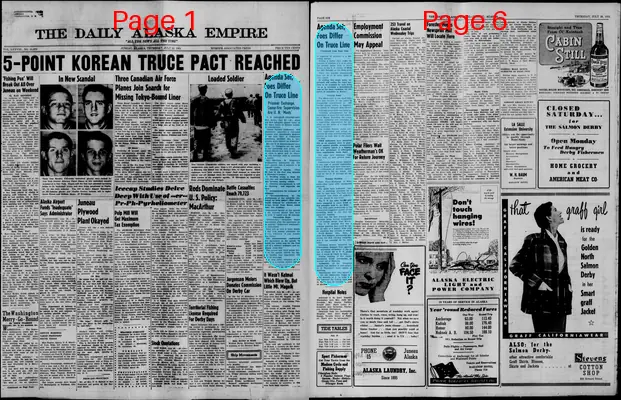
The Daily Alaska Empire
Juneau, Juneau County, Alaska
What is this article about?
UN and Communist delegates in Korea agree on a five-point agenda for armistice negotiations, including truce line, cease-fire supervision, and prisoner exchange, but differ on key points like the buffer zone location. Shooting continues pending full agreement.
Merged-components note: Continuation of the article on Korean armistice negotiations.
Clippings
1 of 2
OCR Quality
Full Text
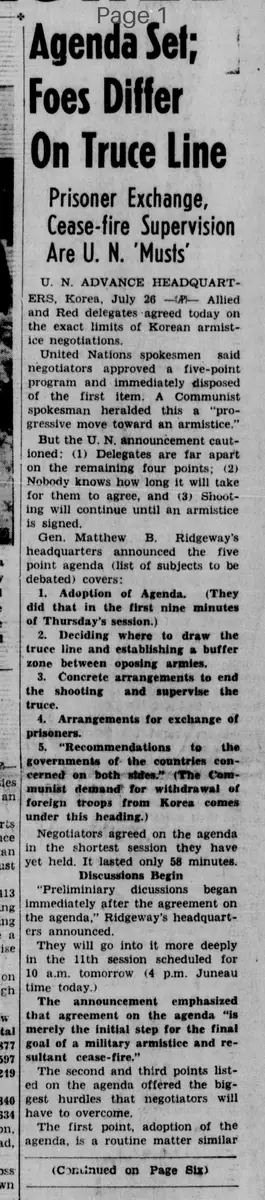
Prisoner Exchange, Cease-fire Supervision Are U. N. 'Musts'
U. N. ADVANCE HEADQUARTERS, Korea, July 26 —(AP)— Allied and Red delegates agreed today on the exact limits of Korean armistice negotiations.
United Nations spokesmen said negotiators approved a five-point program and immediately disposed of the first item. A Communist spokesman heralded this a "progressive move toward an armistice."
But the U. N. announcement cautioned: (1) Delegates are far apart on the remaining four points; (2) Nobody knows how long it will take for them to agree, and (3) Shooting will continue until an armistice is signed.
Gen. Matthew B. Ridgway's headquarters announced the five point agenda (list of subjects to be debated) covers:
1. Adoption of Agenda. (They did that in the first nine minutes of Thursday's session.)
2. Deciding where to draw the truce line and establishing a buffer zone between opposing armies.
3. Concrete arrangements to end the shooting and supervise the truce.
4. Arrangements for exchange of prisoners.
5. "Recommendations to the governments of the countries concerned on both sides." (The Communist demand for withdrawal of foreign troops from Korea comes under this heading.)
Negotiators agreed on the agenda in the shortest session they have yet held. It lasted only 58 minutes.
Discussions Begin
"Preliminary discussions began immediately after the agreement on the agenda," Ridgway's headquarters announced.
They will go into it more deeply in the 11th session scheduled for 10 a.m. tomorrow (4 p.m. Juneau time today.)
The announcement emphasized that agreement on the agenda "is merely the initial step for the final goal of a military armistice and resultant cease-fire."
The second and third points listed on the agenda offered the biggest hurdles that negotiators will have to overcome.
The first point, adoption of the agenda, is a routine matter similar
(Continued on Page Six)
Agenda Set: Foes Differ
On Truce Line
(Continued from Page One)
to approval of minutes of a preceding session.
Setting a buffer zone raises the question of whether it is to be along the present battle lines in North Korea, as the U. N. wishes, or along the 38th Parallel as the Reds want.
These two possible demarcation lines are 20 or 30 miles apart in some places.
In settling this single point, negotiators will outline the exact position to be assumed by each army "so as to establish a demilitarized zone as the basic condition for cessation of hostilities in Korea."
Crucial Point
The third point is the most complex and reaches to the heart of Communist sensitiveness to any foreign groups acting as supervising agents in territory they control.
Officially point three was listed as: "Concrete arrangements for the realization of cease-fire and armistice in Korea, including the composition, authority and functions of a supervising organization for carrying out the terms of a cease-fire and armistice."
The United Nations wants adequate supervision and actual inspection by some international commission on each side of the cease-fire zone.
Allied spokesmen have identified this as an absolute must to guarantee against possible preparations for a surprise attack or a buildup for new advantages if subsequent truce negotiations break down.
The allies have indicated they want both air and ground supervision.
Communists have always objected to any type of ground supervision.
And in Korea there have been specific intimations of protests against supervision in the air, which was ruled by the U. N. through all the fighting.
Prisoner Problem
Point Four—Exchange of Prisoners—Also could offer unexpected obstacles.
The Allies have indicated they want to exchange prisoners on a man for man basis. The Reds have intimated they think all prisoners of war should be sent home.
The U. N. has some 163,000 prisoners compared to about 10,000 allied prisoners held by the Reds.
The fifth point presumably is the Communist-suggested answer to the stumbling block in the first ten cease-fire sessions.
That was the Red demand that armistice terms include withdrawal of all foreign troops from Korea.
The U. N. insisted this was a political question that could be taken up only at a higher level after an armistice was actually in effect.
North Korean Gen. Nam Il, chief Red delegate, presumably presented the Red solution yesterday.
And it was accepted by the allies today.
Informed sources indicated the Communists dropped their demand for immediate settlement of the issue in return for a U. N. pledge that it would be taken up later.
Precise wording of this recommendation would, presumably, be worked out at Kaesong.
Agreement on the five-point agenda was reached in nine minutes of Thursday's tense session at Kaesong.
Immediately after they agreed on it, the two delegations began actually working on it "in order that the potential for halting bloodshed in Korea may be realized as soon as possible."
What sub-type of article is it?
What keywords are associated?
What entities or persons were involved?
Where did it happen?
Foreign News Details
Primary Location
Korea
Event Date
July 26
Key Persons
Outcome
agreement on five-point agenda for armistice negotiations; differences on truce line (battle lines vs. 38th parallel), cease-fire supervision (un wants air/ground, communists object), prisoner exchange (un has 163,000 vs. reds' 10,000); shooting continues; communists drop immediate foreign troop withdrawal demand for later discussion.
Event Details
Allied and Communist delegates at Kaesong approved a five-point agenda for Korean armistice talks: 1. Adoption of agenda (completed in 9 minutes); 2. Truce line and buffer zone; 3. Cease-fire and supervision arrangements; 4. Prisoner exchange; 5. Recommendations to governments (including foreign troop withdrawal). Session lasted 58 minutes; preliminary discussions began; next session scheduled. UN emphasizes supervision needs; major hurdles on points 2-4.