Thank you for visiting SNEWPapers!
Sign up free
Kentucky Gazette
Lexington, Fayette County, Kentucky
What is this article about?
Kentucky Gazette (March 13) covers post-War of 1812 U.S. congressional actions: army cuts to 6,000 men, gunboat sales, volunteer prohibitions; Monroe reappointed Secretary of State, Gallatin to France, Adams to London, Bayard to Russia, Eustis to Holland; peace establishment bill at 10,000; Navy commissioners; Mississippi statehood; Maine separation bid; NJ/OH Senate elections; MA pre-treaty celebrations. (248 chars)
Clipping
OCR Quality
Full Text
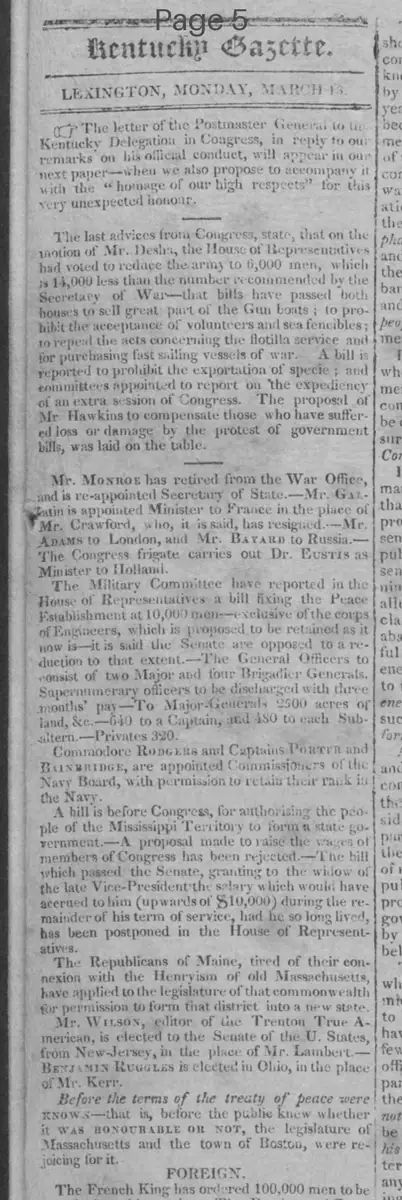
LEXINGTON, MONDAY, MARCH 13.
The letter of the Postmaster General to the Kentucky Delegation in Congress, in reply to our remarks on his official conduct, will appear in our next paper—when we also propose to accompany it with the 'homage of our high respects' for this very unexpected honour.
The last advices from Congress, state, that on the motion of Mr. Desha, the House of Representatives had voted to reduce the army to 6,000 men, which is 14,000 less than the number recommended by the Secretary of War—that bills have passed both houses to sell great part of the Gun boats; to prohibit the acceptance of volunteers and sea fencibles; to repeal the acts concerning the flotilla service and for purchasing fast sailing vessels of war. A bill is reported to prohibit the exportation of specie; and committees appointed to report on the expediency of an extra Session of Congress. The proposal of Mr. Hawkins to compensate those who have suffered loss or damage by the protest of government bills, was laid on the table.
Mr. Monroe has retired from the War Office and is re-appointed Secretary of State.—Mr. Gallatin is appointed Minister to France in the place of Mr. Crawford, who, it is said, has resigned.—Mr. Adams to London, and Mr. Bayard to Russia.—
The Congress frigate carries out Dr. Eustis as Minister to Holland.
The Military Committee have reported in the House of Representatives a bill fixing the Peace Establishment at 10,000 men—exclusive of the corps of Engineers, which is proposed to be retained as it now is—it is said the Senate are opposed to a reduction to that extent.—The General Officers to consist of two Major and four Brigadier Generals.
Supernumerary officers to be discharged with three months' pay—To Major-Generals 2500 acres of land, &c.—640 to a Captain, and 160 to each Subaltern—Privates 320.
Commodore Rodgers and Captains Porter and Bainbridge, are appointed Commissioners of the Navy Board, with permission to retain their rank in the Navy.
A bill is before Congress, for authorising the people of the Mississippi Territory to form a state government.—A proposal made to raise the wages of members of Congress has been rejected.—The bill which passed the Senate, granting to the widow of the late Vice-President the salary which would have accrued to him (upwards of $10,000) during the remainder of his term of service, had he so long lived, has been postponed in the House of Representatives.
The Republicans of Maine, tired of their connexion with the Henryism of old Massachusetts, have applied to the legislature of that commonwealth for permission to form that district into a new state.
Mr. Wilson, editor of the Trenton True American, is elected to the Senate of the U. States, from New-Jersey, in the place of Mr. Lambert.—
Benjamin Ruggles is elected in Ohio, in the place of Mr. Kerr.
Before the terms of the treaty of peace were known—that is, before the public knew whether it was honourable or not, the legislature of Massachusetts and the town of Boston, were rejoicing for it.
What sub-type of article is it?
What keywords are associated?
What entities or persons were involved?
Where did it happen?
Story Details
Key Persons
Location
Lexington, Kentucky; Washington (Implied For Congress)
Event Date
March 13
Story Details
The Kentucky Gazette reports on a forthcoming reply from the Postmaster General, congressional votes to reduce the army to 6,000 men, sell gunboats, prohibit volunteers, repeal flotilla acts, and consider specie export ban and extra session; appointments of Monroe as Secretary of State, Gallatin to France, Adams to London, Bayard to Russia, Eustis to Holland; military peace establishment at 10,000 men with land bounties; Navy Board commissioners; Mississippi Territory statehood bill; rejected Congress wage raise; postponed VP widow pension; Maine statehood application; elections of Wilson and Ruggles; Massachusetts rejoicing before treaty details known.