Thank you for visiting SNEWPapers!
Sign up free
The Recorder
Richmond, Virginia
What is this article about?
In 1803 New York Mayor's Court, George Baron sued soldier Michael Murphew for assault at West Point, instigated by Lt. Robert W. Osborn to silence Baron's complaints. Jury awarded $1000 damages. Editorial satirizes military corruption, comparing to George Hay case.
Clipping
OCR Quality
Full Text
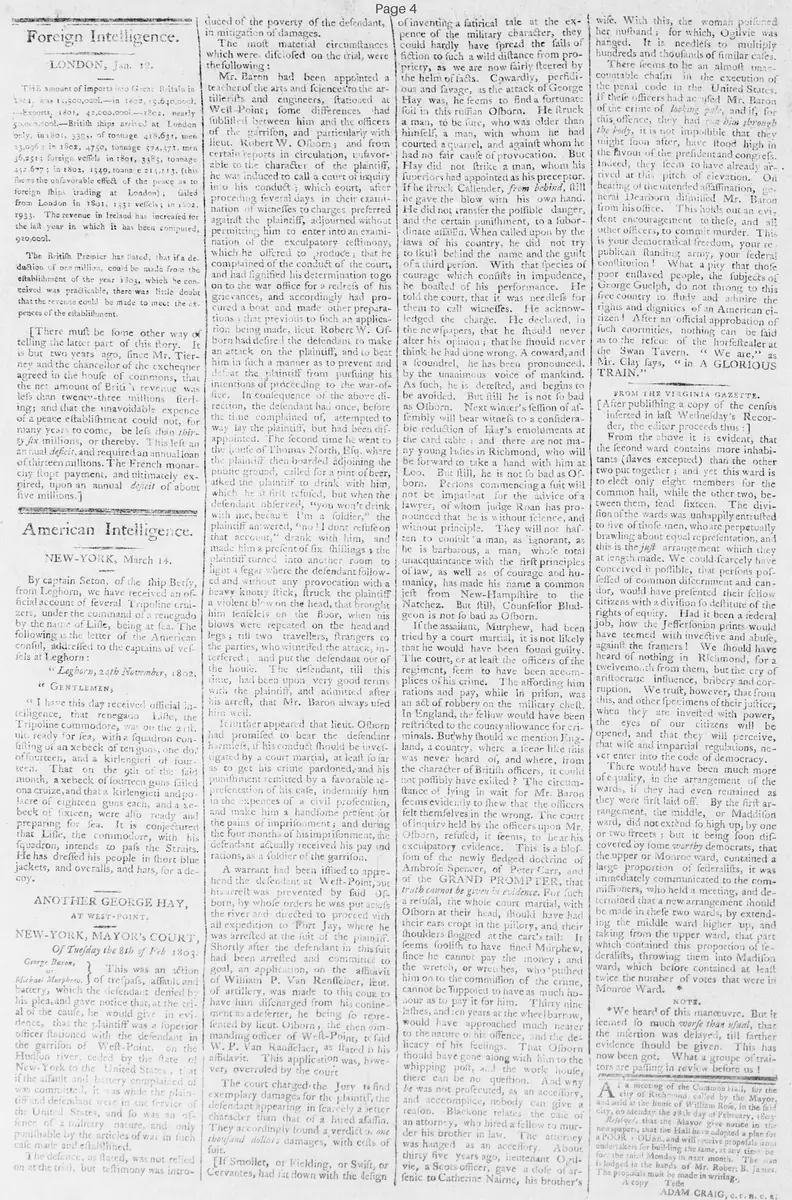
AT WEST-POINT.
NEW-YORK, MAYOR's COURT,
Of Tuesday the 8th of Feb 1803.
George Baron,
vs.
Michael Murphew.
This was an action of trespass, assault and battery, which the defendant denied by his plea, and gave notice that, at the trial of the cause, he would give in evidence, that the plaintiff was a superior officer stationed with the defendant in the garrison of West-Point, on the Hudson river, ceded by the state of New-York to the United States, that if the assault and battery complained of was committed, it was while the plaintiff and defendant were in the service of the United States, and so was any offence, of a military nature, and only punishable by the articles of war in such case made and established.
The defence, as stated, was not relied on at the trial, but testimony was introduced of the poverty of the defendant, in mitigation of damages.
The most material circumstances which were disclosed on the trial, were the following:
Mr. Baron had been appointed a teacher of the arts and sciences to the artillerymen and engineers, stationed at West Point; some differences had subsisted between him and the officers of the garrison, and particularly with lieut. Robert W. Osborn: and from certain reports in circulation, unfavorable to the character of the plaintiff, he was induced to call a court of inquiry into his conduct; which court, after proceeding several days in their examination of witnesses to charges preferred against the plaintiff, adjourned without permitting him to enter into an examination of the exculpatory testimony, which he offered to produce; that he complained of the conduct of the court, and had signified his determination to go on to the war office for a redress of his grievances, and accordingly had procured a boat and made other preparations; that previous to such an application being made, lieut. Robert W. Osborn had desired the defendant to make an attack on the plaintiff, and to beat him in such a manner as to prevent and defeat the plaintiff from pursuing his intentions of proceeding to the war-office. In consequence of the above direction, the defendant had once, before the time complained of, attempted to waylay the plaintiff, but had been disappointed. The second time he went to the house of Thomas North, Esq. where the plaintiff then boarded adjoining the public ground, called for a pint of beer, asked the plaintiff to drink with him, which he first refused, but when the defendant observed, "you won't drink with me, because I'm a soldier," the plaintiff answered, "no! I don't refuse on that account," drank with him, and made him a present of six shillings; the plaintiff turned into another room to light a segar where the defendant followed and without any provocation with a heavy knotty stick, struck the plaintiff a violent blow on the head, that brought him senseless on the floor, when his blows were repeated on the head and legs; till two travellers, strangers to the parties, who witnessed the attack, interfered; and put the defendant out of the house. The defendant, till this time, had been upon very good terms with the plaintiff, and admitted after his arrest, that Mr. Baron always used him well.
It further appeared that lieut. Osborn had promised to bear the defendant harmless, if his conduct should be investigated by a court martial, at least so far as to get his crime pardoned, and his punishment remitted by a favorable representation of his case, indemnify him in the expenses of a civil prosecution, and make him a handsome present for the pains of imprisonment; and during the four months of his imprisonment, the defendant actually received his pay and rations, as a soldier of the garrison.
A warrant had been issued to apprehend the defendant at West-Point, out his arrest was prevented by said Osborn, by whose orders he was put across the river and directed to proceed with all expedition to Fort Jay, where he was arrested at the suit of the plaintiff.
Shortly after the defendant in this suit had been arrested and committed to goal, an application, on the affidavit of William P. Van Rensselaer, lieut. of artillery, was made to this court to have him discharged from his confinement as a deserter, he being so represented by lieut. Osborn, the then commanding officer of West-Point, to said W. P. Van Rensselaer, as stated in his affidavit. This application was, however, overruled by the court.
The court charged the Jury to find exemplary damages for the plaintiff, the defendant appearing in scarcely a better character than that of a hired assassin.
They accordingly found a verdict of one thousand dollars damages, with costs of suit.
[If Smollett, or Fielding, or Swift, or Cervantes, had sat down with the design of inventing a satirical tale at the expense of the military character, they could hardly have spread the sails of fiction to such a wild distance from probability, as we are now fairly steered by the helm of facts. Cowardice, perfidious and savage, as the attack of George Hay was, he seems to find a fortunate foil in this ruffian Osborn. He struck a man, to be sure, who was older than himself, a man, with whom he had courted a quarrel, and against whom he had no fair cause of provocation. But Hay did not strike a man, whom his superiors had appointed as his preceptor. If he struck Callender from behind, still he gave the blow with his own hand. He did not transfer the possible danger, and the certain punishment, to a subordinate assassin. When called upon by the laws of his country, he did not try to skulk behind the name and the guilt of a third person. With that species of courage which consists in impudence, he boasted of his performance. He told the court, that it was needless for them to call witnesses. He acknowledged the charge. He declared, in the newspapers, that he should never alter his opinion; that he should never think he had done wrong. A coward, and a scoundrel, he has been pronounced, by the unanimous voice of mankind. As such, he is deserted, and begins to be avoided. But still, he is not so bad as Osborn. Next winter's session of assembly will bear witness to a considerable reduction of Hay's emoluments at the card table; and there are not many young ladies in Richmond, who will be forward to take a hand with him at Loo. But still, he is not so bad as Osborn. Persons commencing a suit will not be impatient for the advice of a lawyer, of whom judge Roan has pronounced that he is without science, and without principle. They will not hasten to consult a man, as ignorant, as he is barbarous, a man, whose total unacaintance with the first principles of law, as well as of courage and humanity, has made his name a common jest from New-Hampshire to the Natchez. But still, Counsellor Bludgeon is not so bad as Osborn.
If the assailant, Murphew, had been tried by a court martial, it is not likely that he would have been found guilty. The court, or at least the officers of the regiment, seem to have been accomplices of his crime. The affording him rations and pay, while in prison, was an act of robbery on the military chest. In England, the fellow would have been restricted to the county allowance for criminals. But why should we mention England, a country, where a scene like this was never heard of, and where, from the character of British officers, it could not possibly have existed? The circumstance of lying in wait for Mr. Baron seems evidently to show that the officers felt themselves in the wrong. The court of inquiry held by the officers upon Mr. Osborn, refused, it seems, to hear his exculpatory evidence. This is a blossom of the newly fledged doctrine of Ambrose Spencer, of Peter Carr, and of the GRAND PROMPTER, that truth cannot be given in evidence. For such a refusal, the whole court martial, with Osborn at their head, should have had their ears cropt in the pillory, and their shoulders flogged at the cart's tail. It seems foolish to have fined Murphew, since he cannot pay the money; and the wretch, or wretches, who pushed him on to the commission of the crime, cannot be supposed to have as much honor as to pay it for him. Thirty nine lashes, and ten years at the wheel barrow, would have approached much nearer to the nature of his offence, and the delicacy of his feelings. That Osborn should have gone along with him to the whipping post, and the work house, there can be no question. And why he was not prosecuted, as an accessory, and accomplice, nobody can give a reason. Blackstone relates the case of an attorney, who hired a fellow to murder his brother in law. The attorney was hanged as an accessory. About thirty five years ago, lieutenant Ogilvie, a Scots officer, gave a close of arsenic to Catherine Nairne, his brother's wife. With this, the woman poisoned her husband; for which, Ogilvie was hanged.
It is needless to multiply hundreds and thousands of similar cases.
There seems to be an almost unaccountable chasm in the execution of the penal code in the United States. If these officers had accused Mr. Baron of the crime of looking awry, and if, for this offence, they had run him through the body, it is not impossible that they might soon after, have stood high in the favour of the president and congress. Indeed, they seem to have already arrived at this pitch of elevation. On hearing of the intended assassination, general Dearborn dismissed Mr. Baron from his office. This holds out an evident encouragement to these, and all other officers, to commit murder. This is your democratical freedom, your republican standing army, your federal constitution! What a pity that those poor enslaved people, the subjects of George Guelph, do not throng to this free country to study and admire the rights and dignities of an American citizen! After an official approbation of such enormities, nothing can be said as to the rescue of the horse-stealer at the Swan Tavern. "We are," as Mr. Clay says, "in A GLORIOUS TRAIN."
What sub-type of article is it?
What themes does it cover?
What keywords are associated?
What entities or persons were involved?
Where did it happen?
Story Details
Key Persons
Location
West Point, On The Hudson River
Event Date
Tuesday The 8th Of Feb 1803
Story Details
George Baron, a teacher at West Point, was assaulted by soldier Michael Murphew at Lt. Osborn's instigation to prevent Baron from complaining to the War Office about a biased court of inquiry. Murphew waylaid and beat Baron severely. Osborn promised to protect Murphew. Civil court awarded Baron $1000 damages, criticizing the military's role. Editorial condemns Osborn's cowardice and compares to George Hay's assault, highlighting military corruption.