Thank you for visiting SNEWPapers!
Sign up free
Story
February 26, 1852
Watchman And Observer
Richmond, Virginia
What is this article about?
Justice Catron recounts his boyhood experiences in Western Virginia schools, highlighting classical education under teachers like James Priestley and Rev. James Witherspoon, the emphasis on dead languages, and the superiority of local education over Eastern colleges for future success.
Clipping
OCR Quality
98%
Excellent
Full Text
The Schools in Western Virginia
In the Boyhood of Justice Catron, of the U. S. Court, given by himself.
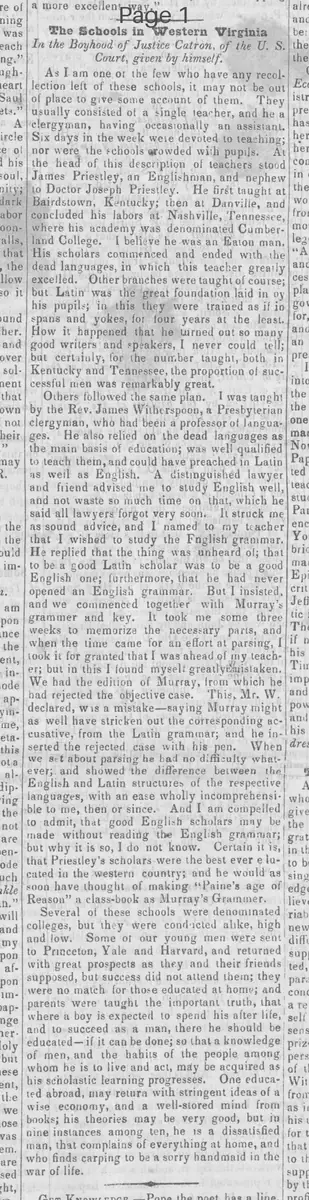
As I am one of the few who have any recollection left of these schools, it may not be out of place to give some account of them. They usually consisted of a single teacher, and he a clergyman, having occasionally an assistant. Six days in the week were devoted to teaching; nor were the schools crowded with pupils. At the head of this description of teachers stood James Priestley, an Englishman, and nephew to Doctor Joseph Priestley. He first taught at Bairdstown, Kentucky; then at Danville, and concluded his labors at Nashville, Tennessee, where his academy was denominated Cumberland College. I believe he was an Eton man. His scholars commenced and ended with the dead languages, in which this teacher greatly excelled. Other branches were taught of course; but Latin was the great foundation laid in by his pupils; in this they were trained as if in spans and yokes, for four years at the least. How it happened that he turned out so many good writers and speakers, I never could tell; but certainly, for the number taught, both in Kentucky and Tennessee, the proportion of successful men was remarkably great.
Others followed the same plan. I was taught by the Rev. James Witherspoon, a Presbyterian clergyman, who had been a professor of languages. He also relied on the dead languages as the main basis of education; was well qualified to teach them, and could have preached in Latin as well as English. A distinguished lawyer and friend advised me to study English well, and not waste so much time on that, which he said all lawyers forgot very soon. It struck me as sound advice, and I named to my teacher that I wished to study the English grammar. He replied that the thing was unheard of; that to be a good Latin scholar was to be a good English one; furthermore, that he had never opened an English grammar. But I insisted, and we commenced together with Murray's grammar and key. It took me some three weeks to memorize the necessary parts, and when the time came for an effort at parsing, I took it for granted that I was ahead of my teacher; but in this I found myself greatly mistaken. We had the edition of Murray, from which he had rejected the objective case. This, Mr. W. declared, was a mistake—saying Murray might as well have stricken out the corresponding accusative, from the Latin grammar; and he inserted the rejected case with his pen. When we set about parsing he had no difficulty whatever; and showed the difference between the English and Latin structures of the respective languages, with an ease wholly incomprehensible to me, then or since. And I am compelled to admit, that good English scholars may be made without reading the English grammar; but why it is so, I do not know. Certain it is, that Priestley's scholars were the best ever educated in the western country; and he would as soon have thought of making "Paine's Age of Reason" a class-book as Murray's Grammar.
Several of these schools were denominated colleges, but they were conducted alike, high and low. Some of our young men were sent to Princeton, Yale and Harvard, and returned with great prospects as they and their friends supposed, but success did not attend them; they were no match for those educated at home; and parents were taught the important truth, that where a boy is expected to spend his after life, and to succeed as a man, there he should be educated—if it can be done; so that a knowledge of men, and the habits of the people among whom he is to live and act, may be acquired as his scholastic learning progresses. One educated abroad, may return with stringent ideas of a wise economy, and a well-stored mind from books; his theories may be very good, but in nine instances among ten, he is a dissatisfied man, that complains of everything at home, and who finds carping to be a sorry handmaid in the war of life.
In the Boyhood of Justice Catron, of the U. S. Court, given by himself.
As I am one of the few who have any recollection left of these schools, it may not be out of place to give some account of them. They usually consisted of a single teacher, and he a clergyman, having occasionally an assistant. Six days in the week were devoted to teaching; nor were the schools crowded with pupils. At the head of this description of teachers stood James Priestley, an Englishman, and nephew to Doctor Joseph Priestley. He first taught at Bairdstown, Kentucky; then at Danville, and concluded his labors at Nashville, Tennessee, where his academy was denominated Cumberland College. I believe he was an Eton man. His scholars commenced and ended with the dead languages, in which this teacher greatly excelled. Other branches were taught of course; but Latin was the great foundation laid in by his pupils; in this they were trained as if in spans and yokes, for four years at the least. How it happened that he turned out so many good writers and speakers, I never could tell; but certainly, for the number taught, both in Kentucky and Tennessee, the proportion of successful men was remarkably great.
Others followed the same plan. I was taught by the Rev. James Witherspoon, a Presbyterian clergyman, who had been a professor of languages. He also relied on the dead languages as the main basis of education; was well qualified to teach them, and could have preached in Latin as well as English. A distinguished lawyer and friend advised me to study English well, and not waste so much time on that, which he said all lawyers forgot very soon. It struck me as sound advice, and I named to my teacher that I wished to study the English grammar. He replied that the thing was unheard of; that to be a good Latin scholar was to be a good English one; furthermore, that he had never opened an English grammar. But I insisted, and we commenced together with Murray's grammar and key. It took me some three weeks to memorize the necessary parts, and when the time came for an effort at parsing, I took it for granted that I was ahead of my teacher; but in this I found myself greatly mistaken. We had the edition of Murray, from which he had rejected the objective case. This, Mr. W. declared, was a mistake—saying Murray might as well have stricken out the corresponding accusative, from the Latin grammar; and he inserted the rejected case with his pen. When we set about parsing he had no difficulty whatever; and showed the difference between the English and Latin structures of the respective languages, with an ease wholly incomprehensible to me, then or since. And I am compelled to admit, that good English scholars may be made without reading the English grammar; but why it is so, I do not know. Certain it is, that Priestley's scholars were the best ever educated in the western country; and he would as soon have thought of making "Paine's Age of Reason" a class-book as Murray's Grammar.
Several of these schools were denominated colleges, but they were conducted alike, high and low. Some of our young men were sent to Princeton, Yale and Harvard, and returned with great prospects as they and their friends supposed, but success did not attend them; they were no match for those educated at home; and parents were taught the important truth, that where a boy is expected to spend his after life, and to succeed as a man, there he should be educated—if it can be done; so that a knowledge of men, and the habits of the people among whom he is to live and act, may be acquired as his scholastic learning progresses. One educated abroad, may return with stringent ideas of a wise economy, and a well-stored mind from books; his theories may be very good, but in nine instances among ten, he is a dissatisfied man, that complains of everything at home, and who finds carping to be a sorry handmaid in the war of life.
What sub-type of article is it?
Biography
Historical Event
What themes does it cover?
Moral Virtue
What keywords are associated?
Western Virginia Schools
Classical Education
Dead Languages
Local Education
James Priestley
English Grammar
What entities or persons were involved?
Justice Catron
James Priestley
Rev. James Witherspoon
Doctor Joseph Priestley
Where did it happen?
Western Virginia, Kentucky, Tennessee
Story Details
Key Persons
Justice Catron
James Priestley
Rev. James Witherspoon
Doctor Joseph Priestley
Location
Western Virginia, Kentucky, Tennessee
Event Date
Boyhood Of Justice Catron
Story Details
Justice Catron describes early schools led by clergymen focusing on classical languages, his personal education under Witherspoon including a debate on English grammar, the success of Priestley's pupils, and the lesson that local education better prepares for life than Eastern colleges.