Thank you for visiting SNEWPapers!
Sign up free
Editorial
March 17, 1864
St. Mary's Gazette
Leonardtown, Saint Mary's County, Maryland
What is this article about?
Editorial discusses Republican Party divisions over presidential succession between Lincoln and Chase supporters, criticisms of Radical policies on slaveholders, and alleged corruption in Chase's Treasury Department administration.
Clipping
OCR Quality
95%
Excellent
Full Text
THE REPUBLICAN PARTY.
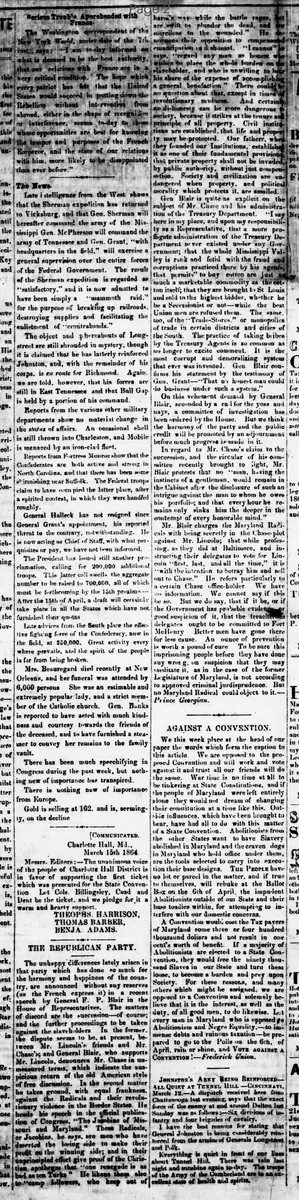
The unhappy differences lately arisen in that party which has done so much for the harmony and happiness of the country, are announced without any reserves (as the French express it) in a recent speech by General F. P. Blair in the House of Representatives. The matters of discord are the succession—of course; and the further proceedings to be taken against the slaveholders. In the former, the dispute seems to be, at present, between Mr. Lincoln's friends and Mr. Chase's; and General Blair, who supports Mr. Lincoln, denounces Mr. Chase in unmeasured terms, which indicate the auspicious return of the old American style of free discussion. In the second matter he takes ground, with equal frankness, against the Radicals and their revolutionary violence in the Border States. He heads his speech in the official publication of Congress, 'The Jacobins of Missouri and Maryland.' These Radicals, or Jacobins, he says, are men who have deserted the losing side to make their profit on the winning side; and in their unprincipled effort give proof of the Christian apothegm that 'one renegade is as bad as ten Turks.' He likens them also to 'camp followers, who keep out of harm's way while the battle rages, are swift to plunder the dead, and merciless to the wounded.' He denounces their opposition to compensated emancipation as dishonest. 'I cannot,' says he, 'regard any man as honest who wishes to place the whole burden on the slaveholder, and who is unwilling to bear his share of the expense of accomplishing a general benefaction.' There could be no question about that, except in times of revolutionary madness. And certain no dishonesty can be more dangerous to society, because it strikes at the tenure and principle of all property. Civil institutions are established that life and property may be protected. Our fathers, when they founded our Institutions, established it as one of their fundamental provisions that private property shall not be invaded by public authority, without just compensation. Society and civilization are endangered when property, and political morality which protects it, are assailed.
Gen. Blair is quite as explicit on the subject of Mr. Chase and his administration of the Treasury Department. 'I say here in my place, and upon my responsibility as a Representative, that a more profligate administration of the Treasury Department never existed under any Government; that the whole Mississippi Valley is rank and fetid with the fraud and corruptions practiced there by his agents; that permits to buy cotton are just as much a marketable commodity as the cotton itself; that they are brought to St. Louis and sold to the highest bidder, whether he be a Secessionist or not—while the best Union men are refused them. The same, too, of the Trade-Stores,' or monopolies of trade in certain districts and cities of the South. The practice of taking bribes by the Treasury Agents is so common as no longer to excite comment. It is the most corrupt and demoralizing system that ever was invented.' Gen. Blair confirms his statement by the testimony of Gen. Grant—'That no honest man could do business under such a system.'
On this vehement demand by General Blair, seconded by a call for the yeas and nays, a committee of investigation has been ordered by the House. But we think the harmony of the party and the public credit will be promoted by an adjournment before much progress is made in it.
In regard to Mr. Chase's claim to the succession, and the circular of his committee recently brought to light, Mr. Blair protests that no man, having the instincts of a gentleman, would remain in the Cabinet after the disclosure of such an intrigue against the man to whom he owes his portfolio; and that every hour he remains only sinks him the deeper in the contempt of every honorable mind.'
Mr. Blair charges the Maryland Radicals with being secretly in the Chase-plot against Mr. Lincoln; that while professing, as they did at Baltimore, and instructing their delegates to vote for Lincoln 'first, last, and all the time,' it is …with the intention to betray him and sell out to Chase.' He refers particularly to a certain Chase office-holder. We have no information. We cannot say if this be so. But we do say, that if it be, or if the Government has probable evidence or good suspicion of it, that the treacherous delegates ought to be committed to Fort McHenry. Better men have gone there for less cause. An ounce of prevention is worth a pound of cure. To be sure this imprisoning people before they have done any wrong, on suspicion that they may meditate it, as in the case of the former Legislature of Maryland, is not according to approved criminal jurisprudence. But no Maryland Radical could object to it.
Prince Georgian.
The unhappy differences lately arisen in that party which has done so much for the harmony and happiness of the country, are announced without any reserves (as the French express it) in a recent speech by General F. P. Blair in the House of Representatives. The matters of discord are the succession—of course; and the further proceedings to be taken against the slaveholders. In the former, the dispute seems to be, at present, between Mr. Lincoln's friends and Mr. Chase's; and General Blair, who supports Mr. Lincoln, denounces Mr. Chase in unmeasured terms, which indicate the auspicious return of the old American style of free discussion. In the second matter he takes ground, with equal frankness, against the Radicals and their revolutionary violence in the Border States. He heads his speech in the official publication of Congress, 'The Jacobins of Missouri and Maryland.' These Radicals, or Jacobins, he says, are men who have deserted the losing side to make their profit on the winning side; and in their unprincipled effort give proof of the Christian apothegm that 'one renegade is as bad as ten Turks.' He likens them also to 'camp followers, who keep out of harm's way while the battle rages, are swift to plunder the dead, and merciless to the wounded.' He denounces their opposition to compensated emancipation as dishonest. 'I cannot,' says he, 'regard any man as honest who wishes to place the whole burden on the slaveholder, and who is unwilling to bear his share of the expense of accomplishing a general benefaction.' There could be no question about that, except in times of revolutionary madness. And certain no dishonesty can be more dangerous to society, because it strikes at the tenure and principle of all property. Civil institutions are established that life and property may be protected. Our fathers, when they founded our Institutions, established it as one of their fundamental provisions that private property shall not be invaded by public authority, without just compensation. Society and civilization are endangered when property, and political morality which protects it, are assailed.
Gen. Blair is quite as explicit on the subject of Mr. Chase and his administration of the Treasury Department. 'I say here in my place, and upon my responsibility as a Representative, that a more profligate administration of the Treasury Department never existed under any Government; that the whole Mississippi Valley is rank and fetid with the fraud and corruptions practiced there by his agents; that permits to buy cotton are just as much a marketable commodity as the cotton itself; that they are brought to St. Louis and sold to the highest bidder, whether he be a Secessionist or not—while the best Union men are refused them. The same, too, of the Trade-Stores,' or monopolies of trade in certain districts and cities of the South. The practice of taking bribes by the Treasury Agents is so common as no longer to excite comment. It is the most corrupt and demoralizing system that ever was invented.' Gen. Blair confirms his statement by the testimony of Gen. Grant—'That no honest man could do business under such a system.'
On this vehement demand by General Blair, seconded by a call for the yeas and nays, a committee of investigation has been ordered by the House. But we think the harmony of the party and the public credit will be promoted by an adjournment before much progress is made in it.
In regard to Mr. Chase's claim to the succession, and the circular of his committee recently brought to light, Mr. Blair protests that no man, having the instincts of a gentleman, would remain in the Cabinet after the disclosure of such an intrigue against the man to whom he owes his portfolio; and that every hour he remains only sinks him the deeper in the contempt of every honorable mind.'
Mr. Blair charges the Maryland Radicals with being secretly in the Chase-plot against Mr. Lincoln; that while professing, as they did at Baltimore, and instructing their delegates to vote for Lincoln 'first, last, and all the time,' it is …with the intention to betray him and sell out to Chase.' He refers particularly to a certain Chase office-holder. We have no information. We cannot say if this be so. But we do say, that if it be, or if the Government has probable evidence or good suspicion of it, that the treacherous delegates ought to be committed to Fort McHenry. Better men have gone there for less cause. An ounce of prevention is worth a pound of cure. To be sure this imprisoning people before they have done any wrong, on suspicion that they may meditate it, as in the case of the former Legislature of Maryland, is not according to approved criminal jurisprudence. But no Maryland Radical could object to it.
Prince Georgian.
What sub-type of article is it?
Partisan Politics
Slavery Abolition
Economic Policy
What keywords are associated?
Republican Party
Succession Dispute
Chase Corruption
Compensated Emancipation
Radicals Betrayal
Treasury Fraud
What entities or persons were involved?
General F. P. Blair
Mr. Lincoln
Mr. Chase
Radicals
Jacobins Of Missouri And Maryland
Gen. Grant
Editorial Details
Primary Topic
Republican Party Divisions Over Succession And Policies Toward Slaveholders
Stance / Tone
Critical Of Chase And Radicals, Supportive Of Lincoln And Compensated Emancipation
Key Figures
General F. P. Blair
Mr. Lincoln
Mr. Chase
Radicals
Jacobins Of Missouri And Maryland
Gen. Grant
Key Arguments
Dispute Between Lincoln And Chase Supporters Over Succession
Radicals Oppose Compensated Emancipation Dishonestly
Chase's Treasury Administration Is Profligate And Corrupt
Permits To Buy Cotton Are Sold Corruptly
Maryland Radicals Secretly Plot Against Lincoln For Chase
Committee Of Investigation Ordered But Adjournment Suggested