Thank you for visiting SNEWPapers!
Sign up free
The Virginia Gazette
Williamsburg, Virginia
What is this article about?
Junius' letter from April 22 in the Public Advertiser denounces the House of Commons' overreach in claiming unlimited privileges, seeing it as a tool for Crown arbitrary power, and calls for defining limits to protect liberty.
Merged-components note: These components form the complete 'Letter of Junius' article, which continues across pages 1 and 2. The final part was mislabeled as 'editorial' but is political commentary fitting 'foreign_news'.
Clippings
1 of 2
OCR Quality
Full Text
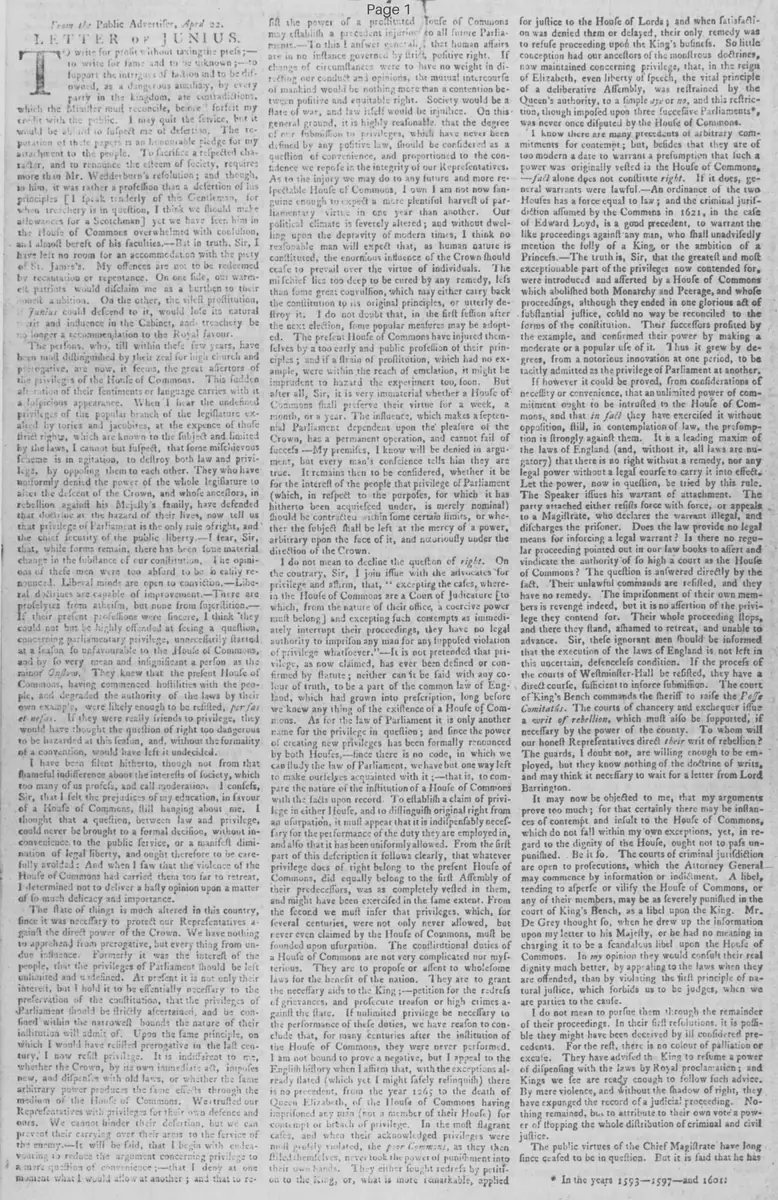
LETTER OF JUNIUS.
To write for the public without taxing the press; to write for fame and to be unknown; to support the intrigues of faction and to be disowned, as a dangerous auxiliary, by every party in the kingdom, are contradictions which the minister must reconcile, before I forfeit my credit with the public. I may quit the service, but it would be absurd to suspect me of desertion. The reputation of those papers is an honourable badge for my acts hence to the people. To sacrifice a respected character, and to renounce the esteem of society, requires more than Mr. Wedderburn's resolution; and though, in him, it was rather a profession than a desertion of his principles [I speak tenderly of this Gentleman, for when treachery is in question, I think we should make allowances for a Scotchman] yet we have seen him in the House of Commons overwhelmed with confusion, and almost bereft of his faculties.--But in truth, Sir, I have left no room for an accommodation with the piety of St. James's. My offences are not to be redeemed by recantation or repentance. On one side, our warmest patriots would disclaim me as a burden to their honest ambition. On the other, the vilest prostitution, Junius could descend to it, would lose its natural art and influence in the Cabinet, and treachery be no longer a recommendation to the Royal favour.
The persons, who, till within these few years, have been most distinguished by their zeal for high church and prerogative, are now, it seems, the great assertors of the privileges of the House of Commons. This sudden alteration of their sentiments or language carries with it a suspicious appearance. When I hear the undefined privileges of the popular branch of the legislature exalted by tories and jacobites, at the expense of those strict rights, which are known to the subject and limited by the laws, I cannot but suspect, that some mischievous scheme is in agitation, to destroy both law and privilege, by opposing them to each other. They who have uniformly denied the power of the whole legislature to alter the descent of the Crown, and whose ancestors, in rebellion against his Majesty's family, have defended that doctrine at the hazard of their lives, now tell us that privilege of Parliament is the only rule of right, and the chief security of the public liberty.--I fear, Sir, that, while forms remain, there has been some material change in the substance of our constitution. The opinions of these men were too absurd to be believed renounced. Liberal minds are open to conviction.--Liberal doctrines are capable of improvement.--There are proselytes from atheism, but none from superstition.--If their present professions were sincere, I think they could not but be highly offended at seeing a question, concerning parliamentary privilege, unnecessarily started at a season so unfavourable to the House of Commons, and by so very mean and insignificant a person as the minister Onslow. They knew that the present House of Commons, having commenced hostilities with the people, and degraded the authority of the laws by their own example, were likely enough to be resisted, per fas et nefas. If they were really friends to privilege, they would have thought the question of right too dangerous to be hazarded at this season, and, without the formality of a convention, would have left it undecided.
I have been silent hitherto, though not from that shameful indifference about the interests of society, which too many of us profess, and call moderation. I confess, Sir, that I felt the prejudices of my education, in favour of a House of Commons, still hanging about me. I thought that a question, between law and privilege, could never be brought to a formal decision, without inconvenience, to the public service, or a manifest diminution of legal liberty, and ought therefore to be carefully avoided: And when I saw that the violence of the House of Commons had carried them too far to retreat, I determined not to deliver a hasty opinion upon a matter of so much delicacy and importance.
The state of things is much altered in this country, since it was necessary to protect our Representatives against the direct power of the Crown. We have nothing to apprehend from prerogative, but every thing from undue influence. Formerly it was the interest of the people, that the privileges of Parliament should be left unlimited and undefined. At present it is not only their interest, but I hold it to be essentially necessary to the preservation of the constitution, that the privileges of Parliament should be strictly ascertained, and be confined within the narrowest bounds the nature of their institution will admit of. Upon the same principle, on which I would have resisted prerogative in the last century, I now resist privilege. It is indifferent to me, whether the Crown, by its own immediate act, imposes new, and dispenses with old laws, or whether the same arbitrary power produces the same effects through the medium of the House of Commons. We trusted our Representatives with privileges for their own defence and ours. We cannot hinder their desertion, but we can prevent their carrying over their arms to the service of the enemy.--It will be said, that I begin with endeavouring to reduce the argument concerning privilege to a mere question of convenience;--that I deny at one moment what I would allow at another; and that to resist privilege in the last century. I now resist privilege. It is indifferent to me, whether the Crown, by its own immediate act, imposes new, and dispenses with old laws, or whether the same arbitrary power produces the same effects through the medium of the House of Commons. We trusted our Representatives with privileges for their own defence and ours. We cannot hinder their desertion, but we can prevent their carrying over their arms to the service of the enemy.--It will be said, that I begin with endeavouring to reduce the argument concerning privilege to a mere question of convenience;--that I deny at one in the power of a prostituted House of Commons may establish a precedent injurious to all future Parliaments.--To this I answer generally, that human affairs are in no instance governed by strict, positive right. If change of circumstances were to have no weight in directing our conduct and opinions, the mutual intercourse of mankind would be nothing more than a contention between positive and equitable right. Society would be a state of war, and law itself would be injustice. On this general ground, it is highly reasonable, that the degree of our submission to privileges, which have never been defined by any positive law, should be considered as a question of convenience, and proportioned to the confidence we repose in the integrity of our Representatives. As to the injury we may do to any future and more reformable House of Commons, I own I am not now sanguine enough to expect a more plentiful harvest of parliamentary virtue in one year than another. Our political climate is severely altered; and without dwelling upon the depravity of modern times, I think no reasonable man will expect that, as human nature is constituted, the enormous influence of the Crown should cease to prevail over the virtue of individuals. The mischief lies too deep to be cured by any remedy, less than some great convulsion, which may either carry back the constitution to its original principles, or utterly destroy it. I do not doubt that, in the first session after the next election, some popular measures may be adopted. The present House of Commons have injured themselves by a too early and public profession of their principles; and if a strain of prostitution, which had no example, were within the reach of emulation, it might be imprudent to hazard the experiment too soon. But after all, Sir, it is very immaterial whether a House of Commons shall preserve their virtue for a week, a month, or a year. The influence, which makes a septennial Parliament dependent upon the pleasure of the Crown, has a permanent operation, and cannot fail of success. My premises, I know will be denied in argument, but every man's conscience tells him they are true. It remains then to be considered, whether it be for the interest of the people that privilege of Parliament (which, in respect to the purposes, for which it has hitherto been acquiesced under, is merely nominal) should be contracted within some certain limits, or whether the subject shall be left at the mercy of a power, arbitrary upon the face of it, and arbitrarily under the direction of the Crown.
I do not mean to decline the question of right. On the contrary, Sir, I join issue with the advocates for privilege and affirm, that, "excepting the cases, wherein the House of Commons are a Court of Judicature [to which, from the nature of their office, a coercive power must belong] and excepting such contempts as immediately interrupt their proceedings, they have no legal authority to imprison any man for any supposed violation of privilege whatsoever."--It is not pretended that privilege, as now claimed, has ever been defined or confirmed by statute: neither can it be said with any colour of truth, to be a part of the common law of England, which had grown into prescription, long before we knew any thing of the existence of a House of Commons. As for the law of Parliament it is only another name for the privilege in question; and since the power of creating new privileges has been formally renounced by both Houses,--since there is no code, in which we can study the law of Parliament, we have but one way left to make ourselves acquainted with it ;--that is, to compare the nature of the institution of a House of Commons with the facts upon record. To establish a claim of privilege in either House, and to distinguish original right from an usurpation, it must appear that it is indispensably necessary for the performance of the duty they are employed in, and also that it has been uniformly allowed. From the first part of this description it follows clearly, that whatever privilege does of right belong to the present House of Commons, did equally belong to the first Assembly of their predecessors, was as completely vested in them, and might have been exercised in the same extent. From the record we must infer that privileges, which, for several centuries, were not only never allowed, but never even claimed by the House of Commons, must be founded upon usurpation. The constitutional duties of a House of Commons are not very complicated nor mysterious. They are to propose or assent to wholesome laws for the benefit of the nation. They are to grant the necessary aids to the King;--petition for the redress of grievances, and prosecute treason or high crimes against the state. If unlimited privilege be necessary to the performance of these duties, we have reason to conclude that, for many centuries after the institution of the House of Commons, they were never performed.
I am not bound to prove a negative, but I appeal to the English history when I affirm that, with the exceptions already stated (which yet I might safely relinquish) there is no precedent, from the year 1265 to the death of Queen Elizabeth, of the House of Commons having imprisoned any man (not a member of their House) for contempt or breach of privilege. In the most flagrant cases, and when their acknowledged privileges were most grossly violated, the poor Commons, as they then styled themselves, never took the power of punishment into their own hands. They either sought redress by petition to the King, or, what is more remarkable, applied for justice to the House of Lords : and when satisfaction was denied them or delayed, their only remedy was to refuse proceeding upon the King's business. So little conception had our ancestors of the monstrous doctrines, now maintained concerning privilege, that, in the reign of Elizabeth, even liberty of speech, the vital principle of a deliberative Assembly, was restrained by the Queen's authority, to a simple aye or no, and this restriction, though imposed upon three successive Parliaments* was never once disputed by the House of Commons.
I know there are many precedents of arbitrary commitments for contempt; but, besides that they are of too modern a date to warrant a presumption that such a power was originally vested in the House of Commons,--fact alone does not constitute right. If it does, general warrants were lawful.--An ordinance of the two Houses has a force equal to law ; and the criminal jurisdiction assumed by the Commons in 1621, in the case of Edward Floyd, is a good precedent, to warrant the like proceedings against any man, who shall unadvisedly mention the folly of a King, or the ambition of a Princess. The truth is, Sir, that the greatest and most exceptionable part of the privileges now contended for, were introduced and asserted by a House of Commons which abolished both Monarchy and Peerage, and whose proceedings, although they ended in one glorious act of substantial justice, could no way be reconciled to the forms of the constitution. Their successors profited by the example, and confirmed their power by making a moderate or a popular use of it. Thus it grew by degrees, from a notorious innovation at one period, to be tacitly admitted as the privilege of Parliament at another.
If however it could be proved, from considerations of necessity or convenience, that an unlimited power of commitment ought to be intrusted to the House of Commons, and that in fact they have exercised it without opposition, still, in contemplation of law, the presumption is strongly against them. It is a leading maxim of the laws of England (and, without it, all laws are nugatory) that there is no right without a remedy, nor any legal power without a legal course to carry it into effect. Let the power, now in question, be tried by this rule. The Speaker issues his warrant of attachment. The party attached either resists force with force, or appeals to a Magistrate, who declares the warrant illegal, and discharges the prisoner. Does the law provide no legal means for enforcing a legal warrant ? Is there no regular proceeding pointed out in our law books to assert and vindicate the authority of so high a court as the House of Commons? The question is answered directly by the fact. Their unlawful commands are resisted, and they have no remedy. The imprisonment of their own members is revenge indeed, but it is no assertion of the privilege they contend for. Their whole proceeding stops, and there they stand, ashamed to retreat, and unable to advance. Sir, these ignorant men should be informed that the execution of the laws of England is not left in this uncertain, defenceless condition. If the process of the courts of Westminster-Hall be resisted, they have a direct course, sufficient to enforce submission. The court of King's Bench commands the sheriff to raise the Posse Comitatus. The courts of chancery and exchequer issue a writ of rebellion, which must also be supported, if necessary by the power of the county. To whom will our honest Representatives direct their writ of rebellion? The guards, I doubt not, are willing enough to be employed, but they know nothing of the doctrine of writs, and may think it necessary to wait for a letter from Lord Barrington.
It may now be objected to me, that my arguments prove too much; for that certainly there may be instances of contempt and insult to the House of Commons, which do not fall within my own exceptions, yet, in regard to the dignity of the House, ought not to pass unpunished. Be it so. The courts of criminal jurisdiction are open to prosecutions, which the Attorney General may commence by information or indictment. A libel, tending to asperse or vilify the House of Commons, or any of their members, may be as severely punished in the court of King's Bench, as a libel upon the King. Mr. De Grey thought so, when he drew up the information upon my letter to his Majesty, or he had no meaning in charging it to be a scandalous libel upon the House of Commons. In my opinion they would consult their real dignity much better, by appealing to the laws when they are offended, than by violating the first principle of natural justice, which forbids us to be judges, when we are parties to the cause.
I do not mean to pursue them through the remainder of their proceedings. In their first resolutions, it is possible they might have been deceived by ill considered precedents. For the rest, there is no colour of palliation or excuse. They have advised the King to resume a power of dispensing with the laws by Royal proclamation; and Kings we see are ready enough to follow such advice. By mere violence, and without the shadow of right, they have expunged the record of a judicial proceeding. Nothing remained, but to attribute to their own vote a power of stopping the whole distribution of criminal and civil justice.
The public virtues of the Chief Magistrate have long since ceased to be in question. But it is said that he has private good qualities, and I myself have been ready to acknowledge them. They are now brought to the test.
If he loves his people, he will dissolve a Parliament, which they can never confide in or respect. If he has any regard for his own honour, he will disdain to be any longer connected with such abandoned prostitution.
But if it were conceivable, that a King of this country had lost all sense of personal honour, and all concern for the welfare of his subjects, I confess, Sir, I should be contented to renounce the forms of the constitution once more, if there were no other way to obtain substantial justice for the people.
JUNIUS.
What sub-type of article is it?
What keywords are associated?
What entities or persons were involved?
Where did it happen?
Foreign News Details
Primary Location
England
Event Date
April 22
Key Persons
Event Details
Junius writes a letter critiquing the House of Commons' claims to undefined privileges, arguing they exceed legal bounds and serve Crown influence rather than public interest. He discusses historical precedents, the evolution of privileges, and urges the King to dissolve the current Parliament.