Thank you for visiting SNEWPapers!
Sign up free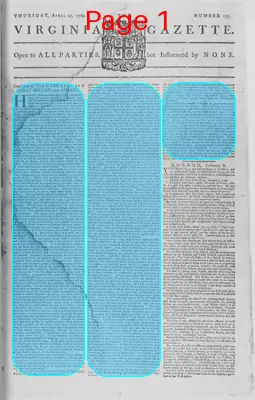
Editorial
April 27, 1769
The Virginia Gazette
Williamsburg, Virginia
What is this article about?
This editorial concludes an argument against Britain's oppressive policies toward its American colonies, emphasizing that such measures are both unjust and impolitic. It advocates repealing taxation acts, retaining commercial regulation, and preserving colonial liberty to ensure loyalty and mutual prosperity, warning of potential rebellion otherwise.
Clipping
OCR Quality
98%
Excellent
Full Text
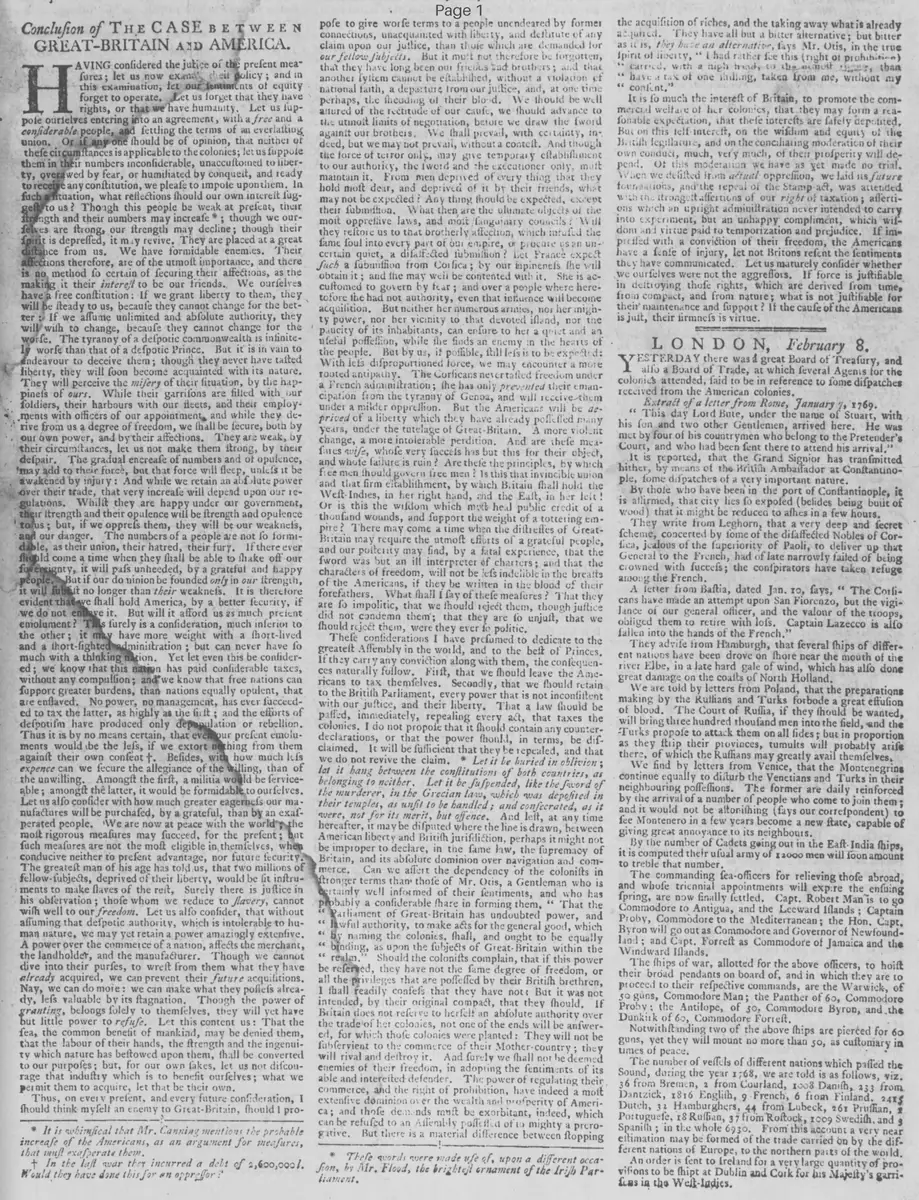
Conclusion of THE CASE BETWEEN GREAT-BRITAIN AND AMERICA.
Having considered the justice of the present measures; let us now examine their policy: and in this examination, let our sentiments of equity forget to operate. Let us forget that they have rights, or that we have humanity. Let us suppose ourselves entering into an agreement, with a free and a considerable people, and settling the terms of an everlasting union. Or if any one should be of opinion, that neither of these circumstances is applicable to the colonies; let us suppose them in their numbers inconsiderable, unaccustomed to liberty, overawed by fear, or humiliated by conquest, and ready to receive any constitution we please to impose upon them. In such a situation, what reflections should our own interest suggest to us? Though this people be weak at present, their strength and their numbers may increase*; though we ourselves are strong, our strength may decline; though their spirit is depressed, it may revive. They are placed at a great distance from us. We have formidable enemies. Their affections therefore, are of the utmost importance, and there is no method so certain of securing their affections, as the making it their interest to be our friends. We ourselves have a free constitution: If we grant liberty to them, they will be steady to us, because they cannot change for the better: If we assume unlimited and absolute authority, they will wish to change, because they cannot change for the worse. The tyranny of a despotic commonwealth is infinitely worse than that of a despotic Prince. But it is in vain to endeavour to deceive them; though they never have tasted liberty, they will soon become acquainted with its nature. They will perceive the misery of their situation, by the happiness of ours. While their garrisons are filled with our soldiers, their harbours with our fleets, and their employments with officers of our appointment and while they derive from us a degree of freedom, we shall be secure, both by our own power, and by their affections. They are weak, by their circumstances, let us not make them strong, by their despair. The gradual increase of numbers and of opulence, may add to their force, but that force will sleep, unless it be awakened by injury: And while we retain an absolute power over their trade, that very increase will depend upon our regulations. Whilst they are happy under our government, their strength and their opulence will be strength and opulence to us; but, if we oppress them, they will be our weakness, and our danger. The numbers of a people are not so formidable, as their union, their hatred, their fury. If there ever should come a time when they shall be able to shake off our sovereignty, it will pass unheeded, by a grateful and happy people. But if our dominion be founded only in our strength, it will subsist no longer than their weakness. It is therefore evident that we shall hold America, by a better security, if we do not enslave it. But will it afford us as much present emolument? This surely is a consideration, much inferior to the other; it may have more weight with a short-lived and a short-sighted administration: but can never have so much with a thinking nation. Yet let even this be considered: we know that this nation has paid considerable taxes, without any compulsion; and we know that free nations can support greater burdens, than nations equally opulent, that are enslaved. No power, no management, has ever succeeded to tax the latter, as highly as the first: and the efforts of despotism have produced only depopulation or rebellion. Thus it is by no means certain, that even our present emoluments would be the less, if we extort nothing from them against their own consent. Besides, with how much less expense can we secure the allegiance of the willing, than of the unwilling. Amongst the first, a militia would be serviceable; amongst the latter, it would be formidable to ourselves. Let us also consider with how much greater eagerness our manufactures will be purchased, by a grateful, than by an exasperated people. We are now at peace with the world: the most rigorous measures may succeed, for the present; but such measures are not the most eligible in themselves, when conducive neither to present advantage, nor future security. The greatest man of his age has told us, that two millions of fellow-subjects, deprived of their liberty, would be fit instruments to make slaves of the rest. Surely there is justice in his observation; those whom we reduce to slavery, cannot wish well to our freedom. Let us also consider, that without assuming that despotic authority, which is intolerable to human nature, we may yet retain a power amazingly extensive. A power over the commerce of a nation, affects the merchant, the landholder, and the manufacturer. Though we cannot dive into their purses, to wrest from them what they have already acquired, we can prevent their future acquisitions. Nay, we can do more: we can make what they possess already less valuable by its stagnation. Though the power of granting, belongs solely to themselves, they will yet have but little power to refuse. Let this content us: That the sea, the common benefit of mankind, may be denied them, that the labour of their hands, the strength and the ingenuity which nature has bestowed upon them, shall be converted to our purposes; but, for our own sakes, let us not discourage that industry which is to benefit ourselves; what we permit them to acquire, let that be their own. Thus, on every present, and every future consideration, I should think myself an enemy to Great-Britain, should I propose to give worse terms to a people unendeared by former connections, unacquainted with liberty, and destitute of any claim upon our justice, than those which are demanded for our fellow subjects. But it must not therefore be forgotten, that they have long been our friends and brothers; and that another system cannot be established, without a violation of national faith, a departure from our justice, and, at one time perhaps, the shedding of their blood. We should be well assured of the rectitude of our cause, we should advance to the utmost limits of negotiation, before we draw the sword against our brothers. We shall prevail, with certainty, indeed, but we may not prevail, without a contest. And though the force of terror only, may give temporary establishment to our authority, the sword and the executioner only, must maintain it. From men deprived of every thing that they hold most dear, and deprived of it by their friends, what may not be expected? Any thing should be expected, except their submission. What then are the ultimate objects of the most oppressive laws, and most sanguinary councils? Will they restore us to that brotherly affection, which must fill the same soul into every part of our empire, or procure us an uncertain quiet, a disaffected submission? Let France expect such a submission from Corsica; by our supineness she will obtain it; and she may well be contented with it. She is accustomed to govern by fear; and over a people where heretofore she had not authority, even that influence will become acquisition. But neither her numerous armies, nor her mighty power, nor her vicinity to that devoted island, nor the paucity of its inhabitants, can ensure to her a quiet and an useful possession, while she finds an enemy in the hearts of the people. But by us, it possible, still less is to be expected: With less disproportioned force, we may encounter a more rooted antipathy. The Corsicans never tasted freedom under a French administration; she has only prevented their emancipation from the tyranny of Genoa, and will receive them under a milder oppression. But the Americans will be deprived of a liberty which they have already possessed many years, under the tutelage of Great-Britain. A more violent change, a more intolerable perdition. And are these measures wise, whose very success has but this for their object, and whose failure is ruin? Are these the principles, by which free men should govern free men? Is this that invincible union and that firm establishment, by which Britain shall hold the West-Indies, in her right hand, and the East, in her left! Or is this the wisdom which must heal public credit of a thousand wounds, and support the weight of a tottering empire? There may come a time when the distresses of Great-Britain may require the utmost efforts of a grateful people, and our posterity may find, by a fatal experience, that the word was but an ill interpreter of charters: and that the characters of freedom, will not be less indelible in the breasts of the Americans, if they be written in the blood of their forefathers. What shall I say of these measures? That they are so impolitic, that we should reject them, though justice did not condemn them; that they are so unjust, that we should reject them, were they ever so politic. These considerations I have presumed to dedicate to the greatest Assembly in the world, and to the best of Princes. If they carry any conviction along with them, the consequences naturally follow. First, that we should leave the Americans to tax themselves. Secondly, that we should retain to the British Parliament, every power that is not inconsistent with our justice, and their liberty. That a law should be passed, immediately, repealing every act, that taxes the colonies. I do not propose that it should contain any counter-declarations, or that the power should, in terms, be disclaimed. It will be sufficient that they be repealed, and that we do not revive the claim.* Let it be buried in oblivion: let it hang between the constitutions of both countries, as belonging to neither. Let it be suspended, like the sword of the murderer, in the Grecian law, which was deposited in their temples, as unfit to be handled; and consecrated, as it were, not for its merit, but offence. And lest, at any time hereafter, it may be disputed where the line is drawn, between American liberty and British jurisdiction, perhaps it might not be improper to declare, in the same law, the supremacy of Britain, and its absolute dominion over navigation and commerce. Can we assert the dependency of the colonists in stronger terms than those of Mr. Otis, a Gentleman who is certainly well informed of their sentiments, and who has probably a considerable share in forming them, "That the Parliament of Great-Britain has undoubted power, and lawful authority, to make acts for the general good, which by naming the colonies, shall, and ought to be equally binding, as upon the subjects of Great-Britain within the realm." Should the colonists complain, that if this power be reserved, they have not the same degree of freedom, or all the privileges that are possessed by their British brethren, I shall readily confess that they have not: But it was not intended, by their original compact, that they should. If Britain does not reserve to herself an absolute authority over the trade of her colonies, not one of the ends will be answered, for which those colonies were planted: They will not be subservient to the commerce of their Mother-country; they will rival and destroy it. And surely we shall not be deemed enemies of their freedom, in adopting the sentiments of its able and interested defender. The power of regulating their commerce, and the right of prohibition, have indeed a most extensive dominion over the wealth and prosperity of America: and those demands must be exorbitant, indeed, which can be refused to an Assembly possessed of so mighty a prerogative. But there is a material difference between stopping the acquisition of riches, and the taking away what is already acquired. They have all but a bitter alternative; but bitter as it is, they have an alternative, says Mr. Otis, in the true spirit of liberty, "I had rather see this (right of prohibition) carried, with a high hand, to the utmost hedge, than have a tax of one shilling, taken from me, without my consent."
It is so much the interest of Britain, to promote the commercial welfare of her colonies, that they may form a reasonable expectation, that these interests are safely deposited. But on this self-interest, on the wisdom and equity of the British legislature, and on the conciliating moderation of their own conduct, much, very much, of their prosperity will depend. Of this moderation we have as yet made no trial. When we desisted from actual oppression, we laid no future foundations, and the repeal of the Stamp act, was attended with the strongest assertions of our right of taxation; assertions which an upright administration never intended to carry into experiment, but an unhappy compliment, which wisdom and virtue paid to temporization and prejudice. If impressed with a conviction of their freedom, the Americans have a sense of injury, let not Britons resent the sentiments they have communicated. Let us maturely consider whether we ourselves were not the aggressors. If force is justifiable in destroying those rights, which are derived from time, from compact, and from nature; what is not justifiable for their maintenance and support? If the cause of the Americans is just, their firmness is virtue.
* It is whimsical that Mr. Canning mentions the probable increase of the Americans, as an argument for measures, that must exasperate them.
+ In the last war they incurred a debt of 2,500,000l. Would they have done this for an oppressor?
These words were made use of, upon a different occasion, by Mr. Flood, the brightest ornament of the Irish Parliament.
Having considered the justice of the present measures; let us now examine their policy: and in this examination, let our sentiments of equity forget to operate. Let us forget that they have rights, or that we have humanity. Let us suppose ourselves entering into an agreement, with a free and a considerable people, and settling the terms of an everlasting union. Or if any one should be of opinion, that neither of these circumstances is applicable to the colonies; let us suppose them in their numbers inconsiderable, unaccustomed to liberty, overawed by fear, or humiliated by conquest, and ready to receive any constitution we please to impose upon them. In such a situation, what reflections should our own interest suggest to us? Though this people be weak at present, their strength and their numbers may increase*; though we ourselves are strong, our strength may decline; though their spirit is depressed, it may revive. They are placed at a great distance from us. We have formidable enemies. Their affections therefore, are of the utmost importance, and there is no method so certain of securing their affections, as the making it their interest to be our friends. We ourselves have a free constitution: If we grant liberty to them, they will be steady to us, because they cannot change for the better: If we assume unlimited and absolute authority, they will wish to change, because they cannot change for the worse. The tyranny of a despotic commonwealth is infinitely worse than that of a despotic Prince. But it is in vain to endeavour to deceive them; though they never have tasted liberty, they will soon become acquainted with its nature. They will perceive the misery of their situation, by the happiness of ours. While their garrisons are filled with our soldiers, their harbours with our fleets, and their employments with officers of our appointment and while they derive from us a degree of freedom, we shall be secure, both by our own power, and by their affections. They are weak, by their circumstances, let us not make them strong, by their despair. The gradual increase of numbers and of opulence, may add to their force, but that force will sleep, unless it be awakened by injury: And while we retain an absolute power over their trade, that very increase will depend upon our regulations. Whilst they are happy under our government, their strength and their opulence will be strength and opulence to us; but, if we oppress them, they will be our weakness, and our danger. The numbers of a people are not so formidable, as their union, their hatred, their fury. If there ever should come a time when they shall be able to shake off our sovereignty, it will pass unheeded, by a grateful and happy people. But if our dominion be founded only in our strength, it will subsist no longer than their weakness. It is therefore evident that we shall hold America, by a better security, if we do not enslave it. But will it afford us as much present emolument? This surely is a consideration, much inferior to the other; it may have more weight with a short-lived and a short-sighted administration: but can never have so much with a thinking nation. Yet let even this be considered: we know that this nation has paid considerable taxes, without any compulsion; and we know that free nations can support greater burdens, than nations equally opulent, that are enslaved. No power, no management, has ever succeeded to tax the latter, as highly as the first: and the efforts of despotism have produced only depopulation or rebellion. Thus it is by no means certain, that even our present emoluments would be the less, if we extort nothing from them against their own consent. Besides, with how much less expense can we secure the allegiance of the willing, than of the unwilling. Amongst the first, a militia would be serviceable; amongst the latter, it would be formidable to ourselves. Let us also consider with how much greater eagerness our manufactures will be purchased, by a grateful, than by an exasperated people. We are now at peace with the world: the most rigorous measures may succeed, for the present; but such measures are not the most eligible in themselves, when conducive neither to present advantage, nor future security. The greatest man of his age has told us, that two millions of fellow-subjects, deprived of their liberty, would be fit instruments to make slaves of the rest. Surely there is justice in his observation; those whom we reduce to slavery, cannot wish well to our freedom. Let us also consider, that without assuming that despotic authority, which is intolerable to human nature, we may yet retain a power amazingly extensive. A power over the commerce of a nation, affects the merchant, the landholder, and the manufacturer. Though we cannot dive into their purses, to wrest from them what they have already acquired, we can prevent their future acquisitions. Nay, we can do more: we can make what they possess already less valuable by its stagnation. Though the power of granting, belongs solely to themselves, they will yet have but little power to refuse. Let this content us: That the sea, the common benefit of mankind, may be denied them, that the labour of their hands, the strength and the ingenuity which nature has bestowed upon them, shall be converted to our purposes; but, for our own sakes, let us not discourage that industry which is to benefit ourselves; what we permit them to acquire, let that be their own. Thus, on every present, and every future consideration, I should think myself an enemy to Great-Britain, should I propose to give worse terms to a people unendeared by former connections, unacquainted with liberty, and destitute of any claim upon our justice, than those which are demanded for our fellow subjects. But it must not therefore be forgotten, that they have long been our friends and brothers; and that another system cannot be established, without a violation of national faith, a departure from our justice, and, at one time perhaps, the shedding of their blood. We should be well assured of the rectitude of our cause, we should advance to the utmost limits of negotiation, before we draw the sword against our brothers. We shall prevail, with certainty, indeed, but we may not prevail, without a contest. And though the force of terror only, may give temporary establishment to our authority, the sword and the executioner only, must maintain it. From men deprived of every thing that they hold most dear, and deprived of it by their friends, what may not be expected? Any thing should be expected, except their submission. What then are the ultimate objects of the most oppressive laws, and most sanguinary councils? Will they restore us to that brotherly affection, which must fill the same soul into every part of our empire, or procure us an uncertain quiet, a disaffected submission? Let France expect such a submission from Corsica; by our supineness she will obtain it; and she may well be contented with it. She is accustomed to govern by fear; and over a people where heretofore she had not authority, even that influence will become acquisition. But neither her numerous armies, nor her mighty power, nor her vicinity to that devoted island, nor the paucity of its inhabitants, can ensure to her a quiet and an useful possession, while she finds an enemy in the hearts of the people. But by us, it possible, still less is to be expected: With less disproportioned force, we may encounter a more rooted antipathy. The Corsicans never tasted freedom under a French administration; she has only prevented their emancipation from the tyranny of Genoa, and will receive them under a milder oppression. But the Americans will be deprived of a liberty which they have already possessed many years, under the tutelage of Great-Britain. A more violent change, a more intolerable perdition. And are these measures wise, whose very success has but this for their object, and whose failure is ruin? Are these the principles, by which free men should govern free men? Is this that invincible union and that firm establishment, by which Britain shall hold the West-Indies, in her right hand, and the East, in her left! Or is this the wisdom which must heal public credit of a thousand wounds, and support the weight of a tottering empire? There may come a time when the distresses of Great-Britain may require the utmost efforts of a grateful people, and our posterity may find, by a fatal experience, that the word was but an ill interpreter of charters: and that the characters of freedom, will not be less indelible in the breasts of the Americans, if they be written in the blood of their forefathers. What shall I say of these measures? That they are so impolitic, that we should reject them, though justice did not condemn them; that they are so unjust, that we should reject them, were they ever so politic. These considerations I have presumed to dedicate to the greatest Assembly in the world, and to the best of Princes. If they carry any conviction along with them, the consequences naturally follow. First, that we should leave the Americans to tax themselves. Secondly, that we should retain to the British Parliament, every power that is not inconsistent with our justice, and their liberty. That a law should be passed, immediately, repealing every act, that taxes the colonies. I do not propose that it should contain any counter-declarations, or that the power should, in terms, be disclaimed. It will be sufficient that they be repealed, and that we do not revive the claim.* Let it be buried in oblivion: let it hang between the constitutions of both countries, as belonging to neither. Let it be suspended, like the sword of the murderer, in the Grecian law, which was deposited in their temples, as unfit to be handled; and consecrated, as it were, not for its merit, but offence. And lest, at any time hereafter, it may be disputed where the line is drawn, between American liberty and British jurisdiction, perhaps it might not be improper to declare, in the same law, the supremacy of Britain, and its absolute dominion over navigation and commerce. Can we assert the dependency of the colonists in stronger terms than those of Mr. Otis, a Gentleman who is certainly well informed of their sentiments, and who has probably a considerable share in forming them, "That the Parliament of Great-Britain has undoubted power, and lawful authority, to make acts for the general good, which by naming the colonies, shall, and ought to be equally binding, as upon the subjects of Great-Britain within the realm." Should the colonists complain, that if this power be reserved, they have not the same degree of freedom, or all the privileges that are possessed by their British brethren, I shall readily confess that they have not: But it was not intended, by their original compact, that they should. If Britain does not reserve to herself an absolute authority over the trade of her colonies, not one of the ends will be answered, for which those colonies were planted: They will not be subservient to the commerce of their Mother-country; they will rival and destroy it. And surely we shall not be deemed enemies of their freedom, in adopting the sentiments of its able and interested defender. The power of regulating their commerce, and the right of prohibition, have indeed a most extensive dominion over the wealth and prosperity of America: and those demands must be exorbitant, indeed, which can be refused to an Assembly possessed of so mighty a prerogative. But there is a material difference between stopping the acquisition of riches, and the taking away what is already acquired. They have all but a bitter alternative; but bitter as it is, they have an alternative, says Mr. Otis, in the true spirit of liberty, "I had rather see this (right of prohibition) carried, with a high hand, to the utmost hedge, than have a tax of one shilling, taken from me, without my consent."
It is so much the interest of Britain, to promote the commercial welfare of her colonies, that they may form a reasonable expectation, that these interests are safely deposited. But on this self-interest, on the wisdom and equity of the British legislature, and on the conciliating moderation of their own conduct, much, very much, of their prosperity will depend. Of this moderation we have as yet made no trial. When we desisted from actual oppression, we laid no future foundations, and the repeal of the Stamp act, was attended with the strongest assertions of our right of taxation; assertions which an upright administration never intended to carry into experiment, but an unhappy compliment, which wisdom and virtue paid to temporization and prejudice. If impressed with a conviction of their freedom, the Americans have a sense of injury, let not Britons resent the sentiments they have communicated. Let us maturely consider whether we ourselves were not the aggressors. If force is justifiable in destroying those rights, which are derived from time, from compact, and from nature; what is not justifiable for their maintenance and support? If the cause of the Americans is just, their firmness is virtue.
* It is whimsical that Mr. Canning mentions the probable increase of the Americans, as an argument for measures, that must exasperate them.
+ In the last war they incurred a debt of 2,500,000l. Would they have done this for an oppressor?
These words were made use of, upon a different occasion, by Mr. Flood, the brightest ornament of the Irish Parliament.
What sub-type of article is it?
Constitutional
Imperialism
Economic Policy
What keywords are associated?
Colonial Policy
British Taxation
American Liberty
Commercial Regulation
Stamp Act Repeal
Parliamentary Supremacy
Imperial Union
What entities or persons were involved?
Great Britain
America
British Parliament
Mr. Otis
Mr. Canning
Mr. Flood
France
Corsica
Editorial Details
Primary Topic
Opposition To British Oppressive Measures Against American Colonies
Stance / Tone
Advocacy For Colonial Liberty And Repeal Of Taxation Acts While Retaining Commercial Regulation
Key Figures
Great Britain
America
British Parliament
Mr. Otis
Mr. Canning
Mr. Flood
France
Corsica
Key Arguments
Oppressive Policies Are Impolitic As They Alienate Colonies And Risk Future Rebellion
Granting Liberty Secures Affections And Loyalty Better Than Force
Free Colonies Will Contribute More In Taxes And Trade Than Enslaved Ones
Repeal Taxation Acts Immediately Without Reviving The Claim
Retain Absolute Dominion Over Navigation And Commerce
Colonies Were Planted To Serve British Commerce, Not Rival It
Americans' Past Loyalty, Like War Debt, Shows Potential For Gratitude
Comparison To France's Troubles In Corsica Warns Against Heart Based Enmity