Thank you for visiting SNEWPapers!
Sign up free
Alexandria Advertiser And Commercial Intelligencer
Alexandria, Virginia
What is this article about?
In the US Senate, Mr. R. urges action against Spain's violation of the 1795 treaty by denying US rights to the Mississippi River and New Orleans deposit, warning of economic ruin for over half a million Western citizens and potential national disunion if not addressed by empowering the President to seize control.
Merged-components note: The component on page 3 is a direct continuation of the Senate debate narrative from page 2, forming a single story article.
Clippings
1 of 2
OCR Quality
Full Text
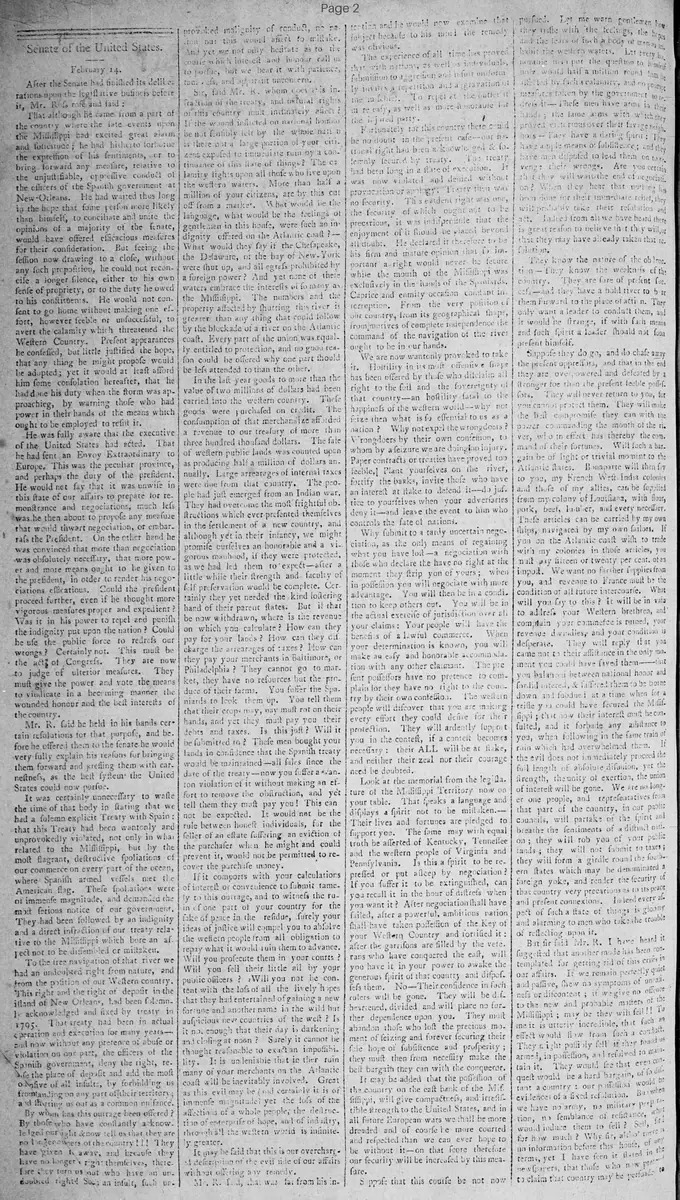
After the Senate had finished its deliberations upon the legislative business before it, Mr. R. rose and said:
That although he came from a part of the country where the late events upon the Mississippi had excited great alarm and solicitude; he had hitherto forbore the expression of his sentiments, or to bring forward any measure, relative to the unjustifiable, oppressive conduct of the officers of the Spanish government at New Orleans. He had waited thus long in the hope that some person more likely than himself, to conciliate and unite the opinions of a majority of the Senate, would have offered efficacious measures for their consideration. But seeing the session now drawing to a close, without any such proposition, he could not reconcile a longer silence, either to his own sense of propriety, or to the duty he owed to his constituents. He would not consent to go home without making one effort, however feeble or unsuccessful, to avert the calamity which threatened the Western Country. Present appearances he confessed, but little justified the hope, that any thing he might propose would be adopted; yet it would at least afford him some consolation hereafter, that he had done his duty when the storm was approaching, by warning those who had power in their hands of the means which ought to be employed to resist it.
He was fully aware that the executive of the United States had acted. That he had sent an Envoy Extraordinary to Europe. This was the peculiar province, and perhaps the duty of the president. He would not say that it was unwise in this state of our affairs to prepare for remonstrance and negotiations, much less was he then about to propose any measure that would thwart negotiation, or embarrass the President. On the other hand he was convinced that more than negotiation was absolutely necessary, that more power and more means ought to be given to the president, in order to render his negotiations efficacious. Could the president proceed further, even if he thought more rigorous measures proper and expedient? Is it in his power to repel and punish the indignity put upon the nation? Could he use the public force to redress our wrongs? Certainly not. This must be the act of Congress. They are now to judge of ulterior measures. They must give the power and vote the means to vindicate in a becoming manner the wounded honour and the best interests of the country.
Mr. R. said he held in his hands certain resolutions for that purpose, and before he offered them to the Senate he would very fully explain his reasons for bringing them forward and pressing them with earnestness, as the best system the United States could now pursue.
It was certainly unnecessary to waste the time of that body in stating that we had a solemn explicit Treaty with Spain: that this Treaty had been wantonly and unprovokedly violated, not only in what related to the Mississippi, but by the most flagrant, destructive spoliations of our commerce on every part of the ocean, where Spanish armed vessels met the American flag. These spoliations were of immense magnitude, and demanded the most serious notice of our government. They had been followed by an indignity and a direct infraction of our treaty relative to the Mississippi which bore an aspect not to be dissembled or mistaken. To the free navigation of that river we had an undoubted right from nature, and from the position of our Western country. This right and the right of deposit in the island of New Orleans, had been solemnly acknowledged and fixed by treaty in 1795.
That treaty had been in actual operation and execution for many years-- and now without any pretence of abuse or violation on our part, the officers of the Spanish government, deny the right, refuse the place of deposit and add the most offensive of all insults, by forbidding us from landing on any part of their territory; and by treating us out as a common nuisance. By whom has this outrage been offered? By those who have constantly acknowledged our right & now tell us that they are no longer owners of the country!!!! They have given it away, and because they have no longer right themselves, therefore they turn us out who have an undoubted right. Such an insult, such union near this wound affect to mistake.
And yet we not only hesitate as to the course which interest and honour call us to pursue, but we bear it with patience, tamely, and supinely unconcerned.
"Sir," said Mr. R. "whom does this infraction of the treaty, and federal rights most intimately affect? If the wound inflicted on national honour be not sensibly felt by the whole nation, is there not a large portion of your citizens exposed to immediate ruin by a continuance of this state of things? The calamity lights upon all those who live upon the western waters. More than half a million of your citizens, are by this cut off from a market. What would be the language, what would be the feelings of gentlemen in this house, were such an indignity offered on the Atlantic coast?-- What would they say if the Chesapeake, the Delaware, or the bay of New-York were shut up, and all egress prohibited by a foreign power? And yet none of their waters embrace the interests of so many as the Mississippi. The numbers and the property affected by shutting this river is greater than any thing that could follow by the blockade of a river on the Atlantic coast. Every part of the union was equally entitled to protection, and no good reason could be offered why one part should be less attended to than the other.
In the last year goods to more than the value of two millions of dollars had been carried into the western country. These goods were purchased on credit. The consumption of that merchandize afforded a revenue to our treasury of more than three hundred thousand dollars. The sale of western public lands was counted upon as producing half a million of dollars annually. Large arrearages of internal taxes were due from that country. The people had just emerged from an Indian war. They had overcome the most frightful obstructions which ever presented themselves in the settlement of a new country, and although yet in their infancy, we might promise ourselves an honorable and a vigorous manhood, if they were protected, as we had led them to expect-after a little while their strength and faculty of self preservation would be complete. Certainly they yet needed the kind fostering hand of their parent states. But if that be now withdrawn, where is the revenue on which you calculate? How can they pay for your lands? How can they discharge the arrearages of taxes? How can they pay your merchants in Baltimore, or Philadelphia? They cannot go to market, they have no resources but the produce of their farms. You suffer the Spaniards to lock them up. You tell them that their crops may, nay must rot on their hands, and yet they must pay you their debts and taxes. Is this just? Will it be submitted to? These men bought your lands in confidence that the Spanish treaty would be maintained -all sales since the date of the treaty--now you suffer a wanton violation of it without making an effort to remove the obstruction, and yet tell them they must pay you! This can not be expected. It would not be the rule between honest individuals, for the seller of an estate suffering an eviction of the purchaser when he might and could prevent it, would not be permitted to recover the purchase money.
If it comports with your calculations of interest or convenience to submit tamely to this outrage, and to witness the ruin of one part of your country for the sake of peace in the residue, surely your ideas of justice will compel you to absolve the western people from all obligation to repay what it would ruin them to advance. Will you prosecute them in your courts? Will you sell their little all by your public officers? Will you not be content with the loss of all the lively hopes that they had entertained of gaining a new fortune and another name in the wild but auspicious new countries of the west? Is it not enough that their day is darkening and closing at noon? Surely it cannot be thought reasonable to exact an impossibility. It is undeniable that in their ruin many of your merchants on the Atlantic coast will be inevitably involved. Great as this evil may be (and certainly it is of immense magnitude) yet the loss of the affections of a whole people; the destruction of enterprise of hope, and of industry, through all the western world is infinitely greater.
It may be said that this is our overcharged description of the evil side of our affairs without offering a remedy.
Mr. R. said, that was far from his intention and he would now examine that subject because to his mind the remedy was obvious.
The experience of all time has proved submission to aggression and insult uniformly the most which. To repel it at the utmost it invites a repetition and a gradation of injury, as well as more honorable for the injured party.
Fortunately for this country there could be no doubt in the present case--our natural right had been acknowledged & solemnly secured by treaty. The treaty had been long in a state of execution. It was now violated and denied without provocation or apology: Treaty then was no security. This evident right was one, the security of which ought not to be precarious, it was indispensable that the enjoyment of it should be placed beyond all doubt. He declared it therefore to be his firm and mature opinion that so important a right would never be secure while the mouth of the Mississippi was exclusively in the hands of the Spaniards. Caprice and enmity occasion constant interruption. From the very position of our country, from its geographical shape, from motives of complete independence the command of the navigation of the river ought to be in our hands.
We are now wantonly provoked to take it. Hostility in its most offensive shape has been offered by those who disclaim all right to the soil and the sovereignty of that country--an hostility fatal to the happiness of the western world--why not seize then what is so essential to us as a nation? Why not expel the wrongdoers? Wrongdoers by their own confession, to whom by a seizure we are doing no injury. Paper contracts or treaties have proved too feeble. Plant yourselves on the river, fortify the banks. Invite those who have an interest to take to defend it--do justice to yourselves when your adversaries deny it--and leave the event to him who controls the fate of nations.
Why submit to a tardy uncertain negotiation, as the only means of regaining what you have lost-a negotiation with those who declare they have no right at the moment they strip you of yours; when in possession you will negotiate with more advantage. You will then be in a condition to keep others out. You will be in the actual exercise of jurisdiction over all your claims: Your people will have the benefits of a lawful commerce. When your determination is known, you will make an easy and honorable accommodation with any other claimant. The present possessors have no pretence to complain for they have no right to the country by their own confession. The western people will discover that you are making every effort they could desire for their protection. They will ardently support you in the contest, if a contest becomes necessary: their ALL will be at stake, and neither their zeal nor their courage need be doubted.
Look at the memorial from the legislature of the Mississippi Territory now on your table. That speaks a language and displays a spirit not to be mistaken.-- Their lives and fortunes are pledged to support you. The same may with equal truth be asserted of Kentucky, Tennessee and the western people of Virginia and Pennsylvania. Is this a spirit to be repressed or put asleep by negotiation? If you suffer it to be extinguished, can you recall it in the hour of distress when you want it? After negotiations shall have failed, after a powerful ambitious nation shall have taken possession of the Key of your Western Country and fortified it: after the garrisons are filled by the veterans who have conquered the east, will you have it in your power to awake the generous spirit of that country and dispose them. No--Their confidence in such rulers will be gone. They will be disheartened, divided and will place no further dependence upon you. They must abandon those who lost the precious moment of seizing and forever securing their sole hope of subsistence and prosperity; they must then from necessity make the best bargain they can with the conqueror.
It may be added that the possession of the country on the east bank of the Mississippi, will give compactness, and irresistible strength to the United States, and in all future European wars we shall be more dreaded and of course the more courted and respected than we can ever hope to be without it-on that score therefore our security will be increased by this measure.
Suppose that this course be not now pursued. Let me warn gentlemen how they trifle with the feelings, the hopes and the fears of such a body of men as inhabit the western waters. Let every honorable man put the question to himself now would half a million around him be affected by such a calamity, and no prompt measures taken by the government to redress it--these men have arms in their hands; the same arms with which they proved vigorous over their savage neighbors - they have a daring spirit : They have but little means of subsistence; and they have one disposed to lead them on for vengeance their wrongs. Are you certain that they will wait the end of negotiation? When they hear that nothing has been done for their immediate relief, they will probably take their resolution and act. Lately from all we have heard there is great reason to believe that they will, or that they may have already taken that resolution.
They know the nature of the obstruction -They know the weakness of the country. They are sure of present success -and they have a bold river to bear them forward to the place of action. They only want a leader to conduct them, and it would be strange, if with such means and such spirit a leader should not soon present himself.
Suppose they do go, and do chase away the present oppressors, and that in the end they are overpowered and defeated by a stronger foe than the present feeble possessors. They will never return to you, for you cannot protect them. They will make the best compromise they can with the power commanding the mouth of the river, who in effect has thereby the command of their fortunes. Will such a bargain be of light or trivial moment to the Atlantic states. Bonaparte will then say to you, my French West-India colonies and those of my allies, can be supplied from my colony of Louisiana, with flour pork, beef, lumber, and every necessary. These articles can be carried by my own ships, navigated by my own sailors. If you on the Atlantic coast wish to trade with my colonies in those articles, you must pay fifteen or twenty per cent. of an impost. We want no farther supplies from you, and revenue to France must be the condition of all future intercourse. What will you say to this? It will be in vain to address your Western brethren, and complain your commerce is ruined, your revenue dwindles, and your condition is desperate. They will reply that you came not to their assistance in the only moment you could have saved them---that you balanced between national honor and sordid interest, & suffered them to be borne down and subdued at a time when for a trifle you could have secured the Mississippi ; that now their interest must be consulted, and it forbade any assistance to you, when following in the same train of ruin which had overwhelmed them. If the evil does not immediately proceed the full length of absolute disunion, yet the strength, the unity of exertion, the union of interest will be gone. We are no longer one people, and representatives from that part of the country, in our public councils, will partake of the spirit and breathe the sentiments of a distinct nation ; they will rob you of your public lands ; they will not submit to taxes ; they will form a girdle round the southern states which may be denominated a foreign yoke, and render the security of and present connexions. Indeed every aspect of such a state of things is gloomy and alarming to men who take the trouble of reflecting upon it.
But sir said Mr. R. I have heard it suggested that another mode has been contemplated for getting rid of this crisis in our affairs. If we remain perfectly quiet and passive, shew no symptoms of uneasiness or discontent ; if we give no offence to the new and probable masters of the Mississippi ; may be they will sell!! To effect would flow from such a conduct. They might possibly sell if they found us armed, in possession, and resolved to maintain it. They would see that even conquest would be a hard bargain, of so distant a country : our passion would be evidence of a fixed resolution. But when we have no army, no military preparation, no semblance of resistance. what would induce them to sell? Sell. sir! no information before this house, of any terms, yet I have seen it stated in the newspapers, that those who now pretend to claim that country may be persuaded to sell for how much? Why sir. alas! there is
All, by giving two million of dollars to certain influential persons about the course.
Mr. Ross rose and said that he thought here Mr. Wright of Maryland called information which in his opinion should be kept secret.
Essential information in that house.
Mr. R. denied that there was any confidential information before the Senate.
The Vice-President said there was nothing improper or out of order in what he recollected, and that he perceived had been said.
What sub-type of article is it?
What themes does it cover?
What keywords are associated?
What entities or persons were involved?
Where did it happen?
Story Details
Key Persons
Location
Senate Of The United States, Mississippi River, New Orleans
Event Date
1795 Treaty, Recent Events
Story Details
Mr. R. proposes resolutions to empower the President to seize the mouth of the Mississippi from Spanish control due to treaty violations denying navigation and deposit rights, warning of economic devastation to the Western country, loss of revenue, potential Western rebellion, and national disunion if inaction persists.