Thank you for visiting SNEWPapers!
Sign up free
The Gary American
Gary, Lake County, Indiana
What is this article about?
The NAACP secures a victory in the Eighth Circuit Court of Appeals on June 19, 1944, reversing a lower court dismissal and ordering equalization of salaries for Negro teachers in Little Rock, Arkansas, in the case involving Susie Morris and Frances P. Hibbler against the school board.
Clipping
OCR Quality
Full Text
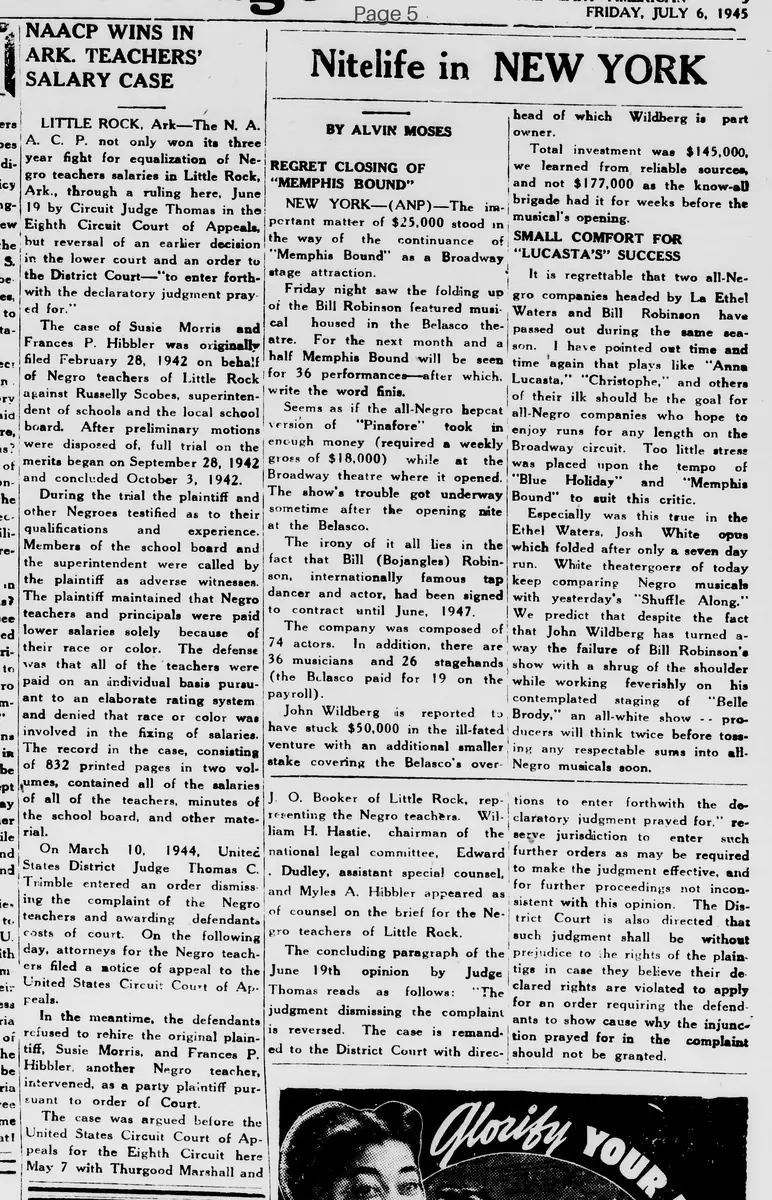
LITTLE ROCK, Ark.--The N. A. A. C. P. not only won its three year fight for equalization of Negro teachers salaries in Little Rock, Ark., through a ruling here, June 19 by Circuit Judge Thomas in the Eighth Circuit Court of Appeals, but reversal of an earlier decision in the lower court and an order to the District Court-"to enter forthwith the declaratory judgment prayed for."
The case of Susie Morris and Frances P. Hibbler was originally filed February 28, 1942 on behalf of Negro teachers of Little Rock against Russelly Scobes, superintendent of schools and the local school board. After preliminary motions were disposed of, full trial on the merits began on September 28, 1942 and concluded October 3, 1942.
During the trial the plaintiff and other Negroes testified as to their qualifications and experience. Members of the school board and the superintendent were called by the plaintiff as adverse witnesses.
The plaintiff maintained that Negro teachers and principals were paid lower salaries solely because of their race or color. The defense was that all of the teachers were paid on an individual basis pursuant to an elaborate rating system and denied that race or color was involved in the fixing of salaries.
The record in the case, consisting of 832 printed pages in two volumes, contained all of the salaries of all of the teachers, minutes of the school board, and other material.
On March 10, 1944, United States District Judge Thomas C. Trimble entered an order dismissing the complaint of the Negro teachers and awarding defendants costs of court. On the following day, attorneys for the Negro teachers filed a notice of appeal to the United States Circuit Court of Appeals.
In the meantime, the defendants refused to rehire the original plaintiff, Susie Morris, and Frances P. Hibbler, another Negro teacher, intervened, as a party plaintiff pursuant to order of Court.
The case was argued before the United States Circuit Court of Appeals for the Eighth Circuit here May 7 with Thurgood Marshall and J. O. Booker of Little Rock, representing the Negro teachers. William H. Hastie, chairman of the national legal committee, Edward . Dudley, assistant special counsel, and Myles A. Hibbler appeared as of counsel on the brief for the Negro teachers of Little Rock.
The concluding paragraph of the June 19th opinion by Judge Thomas reads as follows:
"The judgment dismissing the complaint is reversed. The case is remanded to the District Court with directions to enter forthwith the declaratory judgment prayed for," reserving jurisdiction to enter such further orders as may be required to make the judgment effective, and for further proceedings not inconsistent with this opinion. The District Court is also directed that such judgment shall be without prejudice to the rights of the plaintiffs in case they believe their declared rights are violated to apply for an order requiring the defendants to show cause why the injunction prayed for in the complaint should not be granted."
What sub-type of article is it?
What themes does it cover?
What keywords are associated?
What entities or persons were involved?
Where did it happen?
Story Details
Key Persons
Location
Little Rock, Ark.
Event Date
February 28, 1942 To June 19, 1944
Story Details
The NAACP filed suit in 1942 on behalf of Negro teachers in Little Rock for salary equalization, claiming racial discrimination. After a trial and dismissal by District Judge Trimble in 1944, the Eighth Circuit Court of Appeals reversed the decision on June 19, 1944, ordering a declaratory judgment for equal pay.