Thank you for visiting SNEWPapers!
Sign up free
Editorial
September 22, 1927
Springfield Weekly Republican
Springfield, Hampden County, Massachusetts
What is this article about?
British scientist Miss M. A. Boas discovers dried eggs poisonous to some animals due to egg white, neutralized by certain starches. Raises concerns on food preservation safety, dietary complexities, and limits of animal testing for human diet.
Clipping
OCR Quality
95%
Excellent
Full Text
Synthetic Diet
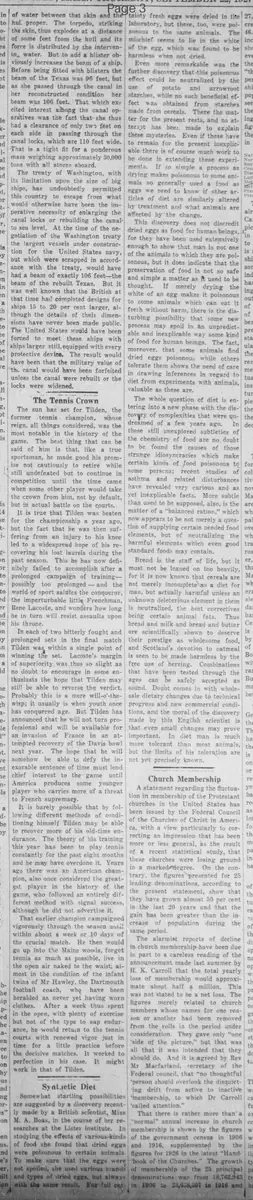
Somewhat startling possibilities are suggested by a discovery recently made by a British scientist, Miss M. A. Boas, in the course of her researches at the Lister institute. In testing one kind of food she found that dried eggs were poisonous to certain animals. To make sure that the eggs were not spoiled, she used various brands and types of dried eggs, but always with the same result. For full certainty fresh eggs were dried in the laboratory, but these, too, were poisonous to the same animals. The mischief seems to lie in the white of the egg, which was found to be harmless when not dried.
Even more remarkable was the further discovery that this poisonous effect could be neutralized by the use of potato and arrowroot starches, while no such beneficial effect was obtained from starches made from cereals. There the matter for the present rests, and no attempt has been made to explain these mysteries. Even if these have to remain for the present inexplicable there is of course much work to be done in extending these experiments. If so simple a process as drying makes poisonous to some animals so generally used a food as eggs we need to know if other articles of diet are similarly altered by treatment and what animals are affected by the change.
This discovery does not discredit dried eggs as food for human beings, for they have been used extensively enough to show that man is not one of the animals to which they are poisonous, but it does indicate that the preservation of food is not so safe and simple a matter as it used to be thought. If merely drying the white of an egg makes it poisonous to some animals which can eat it fresh without harm, there is the disturbing possibility that some new process may spoil in an unpredictable and inexplicable way some kind of food for human beings. The fact, moreover, that some animals find dried eggs poisonous while others tolerate them shows the need of care in drawing inferences in regard to diet from experiments with animals, valuable as these are.
The whole question of diet is entering into a new phase with the discovery of complexities that were undreamed of a few years ago. In these still unexplored subtleties of the chemistry of food are no doubt to be found the causes of those strange idiosyncrasies which make certain kinds of food poisonous to some persons; recent studies of asthma and related disturbances have revealed very curious and as yet inexplicable facts. More subtle than used to be supposed, also, is the matter of a "balanced ration," which now appears to be not merely a question of supplying certain needed food elements, but of neutralizing the harmful elements which even good standard foods may contain.
Bread is the staff of life, but it must not be leaned on too heavily, for it is now known that cereals are not merely incomplete as a diet for man, but actually harmful unless an unknown deleterious element in them is neutralized, the best correctives being certain animal fats. Thus bread and milk and bread and butter are scientifically shown to deserve their prestige as wholesome food, and Scotland's devotion to oatmeal is seen to be made harmless by the free use of herring. Combinations that have been tested through the ages can be safely accepted as sound. Doubt comes in with wholesale dietary changes due to technical progress and new commercial conditions, and the moral of the discovery made by this English scientist is that even small changes may prove important. In diet man is much more tolerant than most animals, but the limits of his toleration are not yet precisely known.
Somewhat startling possibilities are suggested by a discovery recently made by a British scientist, Miss M. A. Boas, in the course of her researches at the Lister institute. In testing one kind of food she found that dried eggs were poisonous to certain animals. To make sure that the eggs were not spoiled, she used various brands and types of dried eggs, but always with the same result. For full certainty fresh eggs were dried in the laboratory, but these, too, were poisonous to the same animals. The mischief seems to lie in the white of the egg, which was found to be harmless when not dried.
Even more remarkable was the further discovery that this poisonous effect could be neutralized by the use of potato and arrowroot starches, while no such beneficial effect was obtained from starches made from cereals. There the matter for the present rests, and no attempt has been made to explain these mysteries. Even if these have to remain for the present inexplicable there is of course much work to be done in extending these experiments. If so simple a process as drying makes poisonous to some animals so generally used a food as eggs we need to know if other articles of diet are similarly altered by treatment and what animals are affected by the change.
This discovery does not discredit dried eggs as food for human beings, for they have been used extensively enough to show that man is not one of the animals to which they are poisonous, but it does indicate that the preservation of food is not so safe and simple a matter as it used to be thought. If merely drying the white of an egg makes it poisonous to some animals which can eat it fresh without harm, there is the disturbing possibility that some new process may spoil in an unpredictable and inexplicable way some kind of food for human beings. The fact, moreover, that some animals find dried eggs poisonous while others tolerate them shows the need of care in drawing inferences in regard to diet from experiments with animals, valuable as these are.
The whole question of diet is entering into a new phase with the discovery of complexities that were undreamed of a few years ago. In these still unexplored subtleties of the chemistry of food are no doubt to be found the causes of those strange idiosyncrasies which make certain kinds of food poisonous to some persons; recent studies of asthma and related disturbances have revealed very curious and as yet inexplicable facts. More subtle than used to be supposed, also, is the matter of a "balanced ration," which now appears to be not merely a question of supplying certain needed food elements, but of neutralizing the harmful elements which even good standard foods may contain.
Bread is the staff of life, but it must not be leaned on too heavily, for it is now known that cereals are not merely incomplete as a diet for man, but actually harmful unless an unknown deleterious element in them is neutralized, the best correctives being certain animal fats. Thus bread and milk and bread and butter are scientifically shown to deserve their prestige as wholesome food, and Scotland's devotion to oatmeal is seen to be made harmless by the free use of herring. Combinations that have been tested through the ages can be safely accepted as sound. Doubt comes in with wholesale dietary changes due to technical progress and new commercial conditions, and the moral of the discovery made by this English scientist is that even small changes may prove important. In diet man is much more tolerant than most animals, but the limits of his toleration are not yet precisely known.
What sub-type of article is it?
Science Or Medicine
What keywords are associated?
Dried Eggs
Poisonous Food
Diet Chemistry
Food Preservation
Animal Experiments
Balanced Ration
Egg White Toxicity
What entities or persons were involved?
Miss M. A. Boas
Lister Institute
Editorial Details
Primary Topic
Discovery Of Poisonous Effects Of Dried Eggs On Certain Animals
Stance / Tone
Informative And Cautionary
Key Figures
Miss M. A. Boas
Lister Institute
Key Arguments
Dried Eggs Are Poisonous To Certain Animals But Fresh Eggs Are Not
Poisonous Effect Lies In The Egg White
Potato And Arrowroot Starches Neutralize The Poison, Unlike Cereal Starches
Discovery Highlights Risks In Food Preservation Processes
Emphasizes Need For Caution In Dietary Inferences From Animal Experiments
Suggests Complexities In Diet Chemistry Explain Food Idiosyncrasies In Humans
Cereals Are Harmful Unless Neutralized By Animal Fats
Traditional Food Combinations Are Scientifically Sound