Thank you for visiting SNEWPapers!
Sign up free
Editorial
December 25, 1804
The New Hampshire Gazette
Portsmouth, Rockingham County, New Hampshire
What is this article about?
A 1804 editorial in the Political Observatory uses rhetorical questions to criticize John Adams for monarchical leanings, oppressive taxes, and fearfulness, while praising Thomas Jefferson for saving America from monarchy, repealing taxes, and embodying republican virtues.
Clipping
OCR Quality
95%
Excellent
Full Text
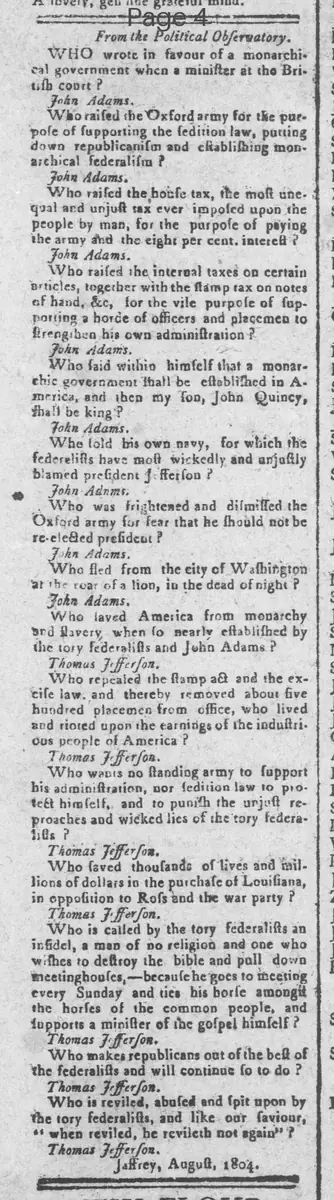
From the Political Observatory
WHO wrote in favour of a monarchical
government when a minister at the British
court?
John Adams.
Who raised the Oxford army for the purpose
of supporting the sedition law, putting
down republicanism and establishing mon-
archical federalism?
John Adams.
Who raised the house tax, the most unequal
and unjust tax ever imposed upon the
people by man, for the purpose of paying
the army and the eight per cent. interest?
John Adams.
Who raised the internal taxes on certain
articles, together with the stamp tax on notes
of hand, &c, for the vile purpose of supporting
a horde of officers and placemen to
strengthen his own administration?
John Adams.
Who said within himself that a monarchical
government shall be established in America,
and then my son, John Quincy,
shall be king?
John Adams.
Who sold his own navy, for which the
federalists have most wickedly and unjustly
blamed president Jefferson?
John Adams.
Who was frightened and dismissed the
Oxford army for fear that he should not be
re-elected president?
John Adams.
Who fled from the city of Washington
at the roar of a lion, in the dead of night?
John Adams.
Who saved America from monarchy
and slavery, when so nearly established by
the tory federalists and John Adams?
Thomas Jefferson.
Who repealed the stamp and the excise
law, and thereby removed about five
hundred placemen from office, who lived
and rioted upon the earnings of the industrious
people of America?
Thomas Jefferson.
Who wants no standing army to support
his administration, nor sedition law to protect
himself, and to punish the unjust reproaches
and wicked lies of the tory federalists?
Thomas Jefferson.
Who saved thousands of lives and millions
of dollars in the purchase of Louisiana,
in opposition to Ross and the war party?
Thomas Jefferson.
Who is called by the tory federalists an
infidel, a man of no religion and one who
wishes to destroy the bible and pull down
meetinghouses, —because he goes to meeting
every Sunday and ties his horse amongst
the horses of the common people, and
supports a minister of the gospel himself?
Thomas Jefferson.
Who makes republicans out of the best of
the federalists and will continue so to do?
Thomas Jefferson.
Who is reviled, abused and spit upon by
the tory federalists, and like our saviour
"when reviled, he revileth not again?"
Thomas Jefferson.
Jaffrey, August, 1804.
WHO wrote in favour of a monarchical
government when a minister at the British
court?
John Adams.
Who raised the Oxford army for the purpose
of supporting the sedition law, putting
down republicanism and establishing mon-
archical federalism?
John Adams.
Who raised the house tax, the most unequal
and unjust tax ever imposed upon the
people by man, for the purpose of paying
the army and the eight per cent. interest?
John Adams.
Who raised the internal taxes on certain
articles, together with the stamp tax on notes
of hand, &c, for the vile purpose of supporting
a horde of officers and placemen to
strengthen his own administration?
John Adams.
Who said within himself that a monarchical
government shall be established in America,
and then my son, John Quincy,
shall be king?
John Adams.
Who sold his own navy, for which the
federalists have most wickedly and unjustly
blamed president Jefferson?
John Adams.
Who was frightened and dismissed the
Oxford army for fear that he should not be
re-elected president?
John Adams.
Who fled from the city of Washington
at the roar of a lion, in the dead of night?
John Adams.
Who saved America from monarchy
and slavery, when so nearly established by
the tory federalists and John Adams?
Thomas Jefferson.
Who repealed the stamp and the excise
law, and thereby removed about five
hundred placemen from office, who lived
and rioted upon the earnings of the industrious
people of America?
Thomas Jefferson.
Who wants no standing army to support
his administration, nor sedition law to protect
himself, and to punish the unjust reproaches
and wicked lies of the tory federalists?
Thomas Jefferson.
Who saved thousands of lives and millions
of dollars in the purchase of Louisiana,
in opposition to Ross and the war party?
Thomas Jefferson.
Who is called by the tory federalists an
infidel, a man of no religion and one who
wishes to destroy the bible and pull down
meetinghouses, —because he goes to meeting
every Sunday and ties his horse amongst
the horses of the common people, and
supports a minister of the gospel himself?
Thomas Jefferson.
Who makes republicans out of the best of
the federalists and will continue so to do?
Thomas Jefferson.
Who is reviled, abused and spit upon by
the tory federalists, and like our saviour
"when reviled, he revileth not again?"
Thomas Jefferson.
Jaffrey, August, 1804.
What sub-type of article is it?
Partisan Politics
What keywords are associated?
John Adams Criticism
Thomas Jefferson Praise
Federalist Attacks
Monarchical Federalism
Republican Virtues
Sedition Law
Stamp Tax Repeal
Louisiana Purchase
What entities or persons were involved?
John Adams
Thomas Jefferson
Federalists
Tory Federalists
Editorial Details
Primary Topic
Criticism Of John Adams And Defense Of Thomas Jefferson
Stance / Tone
Strongly Anti Federalist And Pro Republican
Key Figures
John Adams
Thomas Jefferson
Federalists
Tory Federalists
Key Arguments
John Adams Favored Monarchy As Minister In Britain
Adams Raised Oxford Army To Suppress Republicanism
Adams Imposed Unjust House And Internal Taxes To Fund Army And Officers
Adams Planned To Make His Son King
Adams Sold The Navy And Blamed Jefferson
Adams Dismissed Army Out Of Fear Of Re Election Loss
Adams Fled Washington In Fear
Jefferson Saved America From Monarchy And Slavery
Jefferson Repealed Stamp And Excise Laws, Removing Placemen
Jefferson Opposes Standing Army And Sedition Laws
Jefferson Secured Louisiana Purchase Against War Hawks
Jefferson Is Falsely Accused Of Irreligion By Federalists Despite His Piety
Jefferson Converts Federalists To Republicans
Jefferson Endures Federalist Abuse Without Retaliation