Thank you for visiting SNEWPapers!
Sign up free
The Virginia Gazette
Williamsburg, Virginia
What is this article about?
Detailed account of the 1771 London printers' affair: publishers like John Wheble arrested under parliamentary orders and royal proclamation for reporting Commons proceedings; discharged by magistrates including John Wilkes and the Lord Mayor; leading to counter-charges, commitments, and debates in the House of Commons over privileges and press freedom.
Merged-components note: These components form a single continuous article detailing the proceedings related to the printers and John Wilkes in London.
Clippings
1 of 2
OCR Quality
Full Text
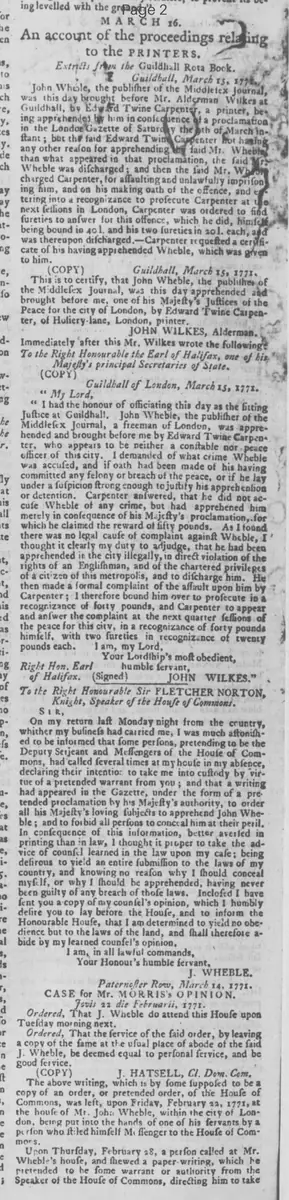
An account of the proceedings relating to the PRINTERS.
Extracts from the Guildhall Rotabook.
Guildhall, March 15, 1771.
John Wheble, the publisher of the Middlesex Journal, was this day brought before Mr. Alderman Wilkes at Guildhall, by Edward Twine Carpenter, a printer, being apprehended by him in consequence a proclamation in the London Gazette of Saturday the 9th of March instant; but the said Edward Twine Carpenter not having any other reason for apprehending said Mr. Wheble than what appeared in that proclamation, the said Mr. Wheble was discharged; and then the said Mr. Wheble charged Carpenter, for assaulting and unlawfully imprisoning him, and on his making oath of the offence, and entering into a recognizance to prosecute Carpenter at the next sessions in London, Carpenter was ordered to find sureties to answer for this offence, which he did, himself being bound in 40 l. and his two sureties in 20 l. each, and was thereupon discharged. Carpenter requested a certificate of his having apprehended Wheble, which was given to him.
(COPY)
Guildhall, March 15, 1771.
This is to certify, that John Wheble, the publisher of the Middlesex Journal, was this day apprehended and brought before me, one of his Majesty's Justices of the Peace for the city of London, by Edward Twine Carpenter, of Hosiery-lane, London, printer.
JOHN WILKES, Alderman.
Immediately after this Mr. Wilkes wrote the following.
To the Right Honourable the Earl of Halifax, one of his Majesty's principal Secretaries of State.
(COPY)
Guildhall of London, March 15, 1771.
"My Lord,
"I had the honour of officiating this day as the Sitting Justice at Guildhall, John Wheble, the publisher of the Middlesex Journal, a freeman of London, was apprehended and brought before me by Edward Twine Carpenter, who appears to be neither a constable nor peace officer of this city. I demanded of what crime Wheble was accused, and if oath had been made of his having committed any felony or breach of the peace, or if he lay under a suspicion strong enough to justify his apprehension or detention. Carpenter answered, that he did not accuse Wheble of any crime, but had apprehended him merely in consequence of his Majesty's proclamation, for which he claimed the reward of fifty pounds. As I found there was no legal cause of complaint against Wheble, I thought it clearly my duty to adjudge, that he had been apprehended in the city illegally, in direct violation of the rights of an Englishman, and of the chartered privileges of a citizen of this metropolis, and to discharge him. He then made a formal complaint of the assault upon him by Carpenter; I therefore bound him over to prosecute in a recognizance of forty pounds, and Carpenter to appear and answer the complaint at the next quarter sessions of the peace for this city, in a recognizance of forty pounds himself, with two sureties in recognizance of twenty pounds each.
I am, my Lord,
Your Lordship's most obedient,
Right Hon. Earl of Halifax. (Signed)
humble servant,
JOHN WILKES."
To the Right Honourable Sir FLETCHER NORTON, Knight, Speaker of the House of Commons.
SIR,
On my return last Monday night from the country, whither my business had carried me, I was much astonished to be informed that some persons, pretending to be the Deputy Serjeant and Messengers of the House of Commons, had called several times at my house in my absence, declaring their intention to take me into custody by virtue of a pretended warrant from you; and that a writing had appeared in the Gazette, under the form of a pretended proclamation by his Majesty's authority, to order all his Majesty's loving subjects to apprehend John Wheble: and to forbid all persons to conceal him at their peril.
In consequence of this information, better versed in printing than in law, I thought it proper to take the advice of counsel learned in the law upon my case: being desirous to yield an entire submission to the laws of my country, and knowing no reason why I should conceal myself, or why I should be apprehended, having never been guilty of any breach of those laws. Inclosed I have sent you a copy of my counsel's opinion, which I humbly desire you to lay before the House, and to inform the Honourable House, that I am determined to yield no obedience but to the laws of the land, and shall therefore abide by my learned counsel's opinion.
I am, in all lawful commands,
Your Honour's humble servant,
J. WHEBLE.
Paternoster Row, March 14, 1771.
CASE for Mr. MORRIS's OPINION.
Fovis 22 die Februarii, 1771.
Ordered, That J. Wheble do attend this House upon Tuesday morning next.
Ordered, That the service of the said order, by leaving a copy of the same at the usual place of abode of the said J. Wheble, be deemed equal to personal service, and be good service.
(COPY)
J. HATSELL, Cl. Dom. Com.
The above writing, which is by some supposed to be a copy of an order, or pretended order, of the House of Commons, was left, upon Friday, February 22, 1771, at the house of Mr. John Wheble, within the city of London, being put into the hands of one of his servants by a person who called himself Messenger to the House of Commons.
Upon Thursday, February 28, a person called at Mr. Wheble's house, and shewed a paper writing, which he pretended to be some warrant or authority from the Speaker of the House of Commons, directing him to take...
John Wheble into custody, for his contempt in not obeying the orders of the House for his attendance on that House.
Upon Saturday, March 9, a paper, in the form of a Royal proclamation, appeared in the Gazette, intituled, By the King, a proclamation for apprehending John Wheble and R. Thompson.
Mr. Wheble did not appear to the above summons, neither has he been apprehended upon the pretended warrant to the Speaker, or the pretended proclamation.
Upon the confidence of Col. Onslow's motion, H. Baldwin, T. Evans, Jr. Wright, and S. Bladon, publishers of four evening papers, attended the House of Commons; whilst they were waiting there, T. Evans was sent for home, his wife having broke her leg. About two o'clock H. Baldwin was called to the bar, and after some questions asked by the Speaker (which by the way was irregular, for the Chair does not usually examine) was directed to withdraw, and having been called in, and sent out several times, he was at length, between twelve and one o'clock, ordered to be reprimanded upon his knees; and being set at the bar, and upon his knees, the Speaker reprimanded him for having committed a breach of the privileges of that House, in printing the proceedings, and misrepresenting the speeches of the members. Having received the reprimand upon his knees, he promised not to do so any more, upon which he was discharged.
Then T. Wright and S. Bladon were called in, the former having received the like reprimand upon his knees, both made the same promise, were also discharged.
W. Woodfall was likewise complained of; but another complaint being made against him in the Lords, he had been by them committed to Newgate for one month, and ordered to pay £100 fine; so that he could not attend the Commons.
The minority debated this affair so strongly, that the House sat up till four o'clock yesterday morning.
The publisher of the London Evening Post was yesterday, between the hours of two and three in the afternoon, seized and made a prisoner in his own house, by one William Whitlam, a messenger of the House of Commons. He sent directly for a constable, to whom he gave the messenger in charge, and the messenger did the same by him. They proceeded together, and with several other persons who were witnesses of the whole transaction, to Guildhall: but the sitting Justice, Mr. Alderman Wilkes, having dispatched the business of the day, and signed the Rota book, was going to the Mansion House. They went immediately there, and made application to the Lord Mayor, who was in his bed-chamber ill of the gout.
The messenger desired that he might have leave to send to John Clementson, Esq; Deputy Serjeant at Arms, which was granted: and the Lord Mayor adjourned the hearing of the business till six o'clock in the evening. At that hour the Lord Mayor, and the Aldermen Wilkes and Oliver heard the cause in his Lordship's bed chamber, Clementson being present as well as the messenger, publisher, Robert Morris, Esq: as his counsel, and many other persons. Mr. Clementson said, he came from the Speaker of the House of Commons to demand both the messenger, and Mr. Miller, the publisher, which demand was refused by the Lord Mayor, and the refusal minuted down by the Serjeant in a book.
The Lord Mayor demanded of the messenger what his accusation was against Mr. Miller, and by what right he apprehended one of his citizens, and if he was a peace officer in the city. The messenger declared that he did not accuse Mr. Miller of any thing criminal, but had taken him into custody by virtue of an order of the House of Commons. The Lord Mayor demanded to see the order, which, after much altercation, was given in by Mr. Clementson. Mr. Morris then argued the whole cause very ably, and insisted particularly on the invalidity of such a warrant. Mr. Clementson desired him to confine himself to its being signed by Sir Fletcher Norton, Speaker of the House of Commons, and to the two demands he then made of the messenger, and Mr. Miller being delivered to him. The Lord Mayor then and the Aldermen Wilkes and Oliver discharged Mr. Miller from the custody of the messenger. They proceeded next to the complaint of the publisher for the assault and false imprisonment, which was clearly proved. The messenger had no witness, and Mr. Clementson admitted the facts.
The Lord Mayor then asked the messenger for bail to answer the complaint, but he said he had none; and Mr. Clementson declared that the messenger should not give bail. On this refusal the Lord Mayor and the two Aldermen signed the mittimus of the messenger of the House of Commons to the Compter. As soon as this was done, Mr. Clementson said, I waited for this, and now I see the warrant of commitment actually signed, I will offer bail; upon which the messenger was bound over for his appearance in a recognizance of £40l. with two sureties in £20l. each, and the publisher in a recognizance of £40l. to prosecute for the assault and false imprisonment. Almost every man in the room offered to be bail for the messenger. The Mansion House was exceedingly full of people, but not the least confusion or disturbance happened.
Soon after Mr. Miller's matter was determined, Mr. R. Thompson, printer of the Gazetteer, was brought into the Mansion House in custody by one John Cook, who charged him with being one of the persons named in the King's proclamation. Mr. Morris also attended upon this occasion, as counsel for Mr. Thompson; and has effectually overturned, by his argument, the King's proclamation, as he had before done the Speaker's warrant. The Alderman adjudged the proclamation entirely illegal. Accordingly Mr. Thompson was immediately discharged. However Mr. Alderman Oliver granted the man a certificate, in order to obtain the reward, if it would be paid. Mr. Morris said he had no doubt of that, 'For the King was too much of a Gentleman not to keep his word.'
The affair of Mr. Wheble will most assuredly produce very spirited, if not very dangerous, consequences; as at the same time that the House are resolved to vindicate their privileges, the people seem determined to bring their liberties to the severest test.
The lovers of their country sincerely lament the passing of some late resolutions, as they must be attended with a disagreeable consequence. Should they have effect, farewell to the liberty of the press! Should they, on the contrary, be found illegal, as it is generally believed they are, the importance of a certain Assembly is at an end.
This day a Privy Council was summoned in order to determine upon the measures which are to be taken, in consequence of the spirited conduct of the Lord Mayor and Magistrates of London.
Orders are given for the immediate coinage of £10,000l. in silver, to be ready for delivery the first of June.
March 20. Soon after the Lord Mayor entered the House of Commons yesterday he desired that the business on which he was summoned might be brought on, as he was very ill, and wished to retire. The Speaker then offered him the use of his room. His Lordship asked if there was a bed in it; and being answered in the negative, said it would then be of little service to him, as he was too ill to sit up. The business at the Mansion House on Friday being then taken into consideration, his Lordship, in his place, avowed the part he had taken: asserted that what he had done was agreeable to his oath, and the charters of the city of London; and that he would act in the same manner, on any future similar occasion. Mr. Alderman Oliver also spoke in defence of the rights and privileges of the citizens of London. A motion was then made to adjourn the farther consideration of this affair until that day fortnight, which was carried in the affirmative.
A motion was then made by Sir Joseph Mawbey, for Mr. Wilkes to attend the House, which was agreed to.
The Lord Mayor, when he went to the House of Commons yesterday, was accompanied by a vast concourse of people. The number increased considerably the nearer he approached to Westminster. About Exeter Exchange, in the Strand, they began their acclamations, which did not cease until he had got into the House of Commons, for in the very lobby, as he came through, and even when the door of the House of Commons was set open for him, there was not a voice or hand among some hundreds of persons, of genteel appearance, that was not employed to demonstrate their approbation of his conduct; in consequence of which immediate orders were given to clear the lobby, and every person was turned out.
When the Lord Mayor left the House, the populace, to show their regard to that patriotic Magistrate, took his Lordship's horses from his coach, and drew him themselves in triumph to the Mansion House, amidst the loud and incessant acclamations of his applauding fellow citizens.
March 21. At eight o'clock yesterday morning Mr. Wilkes received a summons to attend the House of Commons yesterday; but considering that it would be absurd in him to submit to an authority which he had so often denied in the case of others, he has sent to the Speaker a letter signifying his determined resolution to resist, even unto death, any power not founded on the laws of his country.
Last night the printer of a morning paper was discharged from his confinement in Newgate, by order of an august Assembly.
March 22. Mr. Wilkes, on Tuesday, having been served with an order to attend the House of Commons on Wednesday, wrote the following letter to Sir Fletcher Norton.
'SIR,
London, March 20, 1771.
'I this morning received an order commanding my attendance this day in the House of Commons. I observe that no notice was taken of me in your order as a member of the House, and that I am not required to attend in my place. Both these circumstances, according to the settled form, ought to have been mentioned in my case, and I hold them absolutely indispensable. In the name of the freeholders of Middlesex, I again demand my seat in Parliament; having the honour to be freely chosen, by a very great majority, one of the Representatives of the said county. I am ready to take the oaths prescribed by law, and to give in my qualification as Knight of the Shire. When I have been admitted to my seat I will immediately give the House the most exact detail, which will necessarily comprehend a full justification of my conduct relative to the late illegal proclamation, equally injurious to the honour of the Crown and the rights of the subject, and likewise the whole business of the printers. I have acted entirely from a sense of duty to this great city, whose franchises I am sworn to maintain; and to my country, whose noble constitution I reverence; and whose liberties, at the price of my blood, to the last moment of my life, I will defend and support.
I am, Sir,
Your most humble servant,
JOHN WILKES.'
It is beyond a doubt that the obstinacy of the printers (as the Ministry term the noble stand made by the printers in defence of the liberty of the subject, and the law of the land) has gravelled the government beyond any incident since the commencement of the glorious reign of George the Third.
March 26. The House of Commons had divided twice, and remained sitting when this paper went to press. According to their late custom, no strangers were admitted into the galleries; and to keep their debates still more secret, the lobby doors were shut to all but members. The numbers, on their second division, were, for adjournment, 214 noes, 97 ayes. By what could be learnt from such Members as came out, it appeared to be the intended resolution of the House to commit both the Lord Mayor and Mr. Alderman Oliver to the Tower: but as those honourable friends who favour this paper with parliamentary intelligence did not divide with the majority, or come at all out of the House, we must defer a farther and more full account of this important matter till tomorrow's paper. At one o'clock the House was dividing, for the third time. The Lord Mayor desired to withdraw at half after ten, on account of his illness.
It is thought that both Houses of Parliament will adjourn on Thursday next until Tuesday the 2nd of April.
Yesterday afternoon, between 4 and 5 o'clock, a motion was made in the Lower Assembly whether the Right Honourable the Lord Mayor, in his late conduct to one of the messengers of their House, had not been guilty of a breach of privilege. Sir George Saville immediately moved for the previous question, and declared that if the first motion was carried, he, and he hoped every independent Gentleman, would immediately quit the House; upon which a long debate ensued.
Yesterday the Right Honourable the Lord Mayor, and Mr. Alderman Oliver, went through the city to the House of Commons, in consequence of an order of the House to attend this day in their places. The Lord Mayor was attended in his coach by his chaplain (Mr. Evans) and Mr. George Bellas. They were accompanied by the Aldermen Stephenson, Turner, Kirkman, and the several Common Council that were ordered of the committee, and were met at the House by Alderman Sir Charles Whitworth. When they arrived there, the Lord Mayor, his chaplain, the Aldermen, and Common Council, were ordered into the House. They were accompanied thither by a prodigious concourse of people, among whom was a great number of Gentlemen, merchants, and reputable tradesmen, many of whom went in their carriages.
Two o'clock, The printer has just received intelligence that Alderman Oliver is committed to the Tower; and that the farther consideration of the Lord Mayor's affair, which the House terms a high misdemeanor, is to be debated tomorrow, and that the House still continues sitting.
How wretched must have been the conduct of the Ministry in regard to the affair of the printers, when it is universally condemned by friends and enemies! Nay, their loudest abettors in the House, it is well known, condemn them out of it.
WILLIAMSBURG, May 9.
By Capt. Barron, who left London the 27th of March, we are informed that the Lord Mayor had been committed to the Tower: That the merchants of London, by subscription, had offered to bail him for five millions; and, on its being refused, they came to a resolution of drawing on the bank for the whole sum: That the populace had entirely demolished Lord North's coach, and cut off the tails and ears of his coach horses.
What sub-type of article is it?
What keywords are associated?
What entities or persons were involved?
Where did it happen?
Foreign News Details
Primary Location
London
Event Date
March 15 To March 26, 1771
Key Persons
Outcome
printers like wheble, miller, thompson discharged after arrests; messengers bound over; reprimands to publishers baldwin, wright, bladon; woodfall fined and imprisoned by lords; alderman oliver committed to tower; lord mayor's commitment debated; public support for magistrates.
Event Details
Proceedings at Guildhall and Mansion House where printers arrested under Commons orders and royal proclamation for reporting parliamentary debates were discharged by magistrates including Alderman Wilkes and Lord Mayor; counter-charges against apprehenders; House of Commons debates privileges, reprimands printers, summons magistrates who defend actions; public acclamations; later reports of commitments and unrest.