Thank you for visiting SNEWPapers!
Sign up free
Story
November 17, 1836
Herald Of The Times
Newport, Newport County, Rhode Island
What is this article about?
The New York Gazette explains the origin of 'Indian Summer' as a term used by early New England settlers for mild winter weather that brought fears of Native American attacks, contrasting modern pleasant associations. It references harassment during King Philip's wars.
Clipping
OCR Quality
98%
Excellent
Full Text
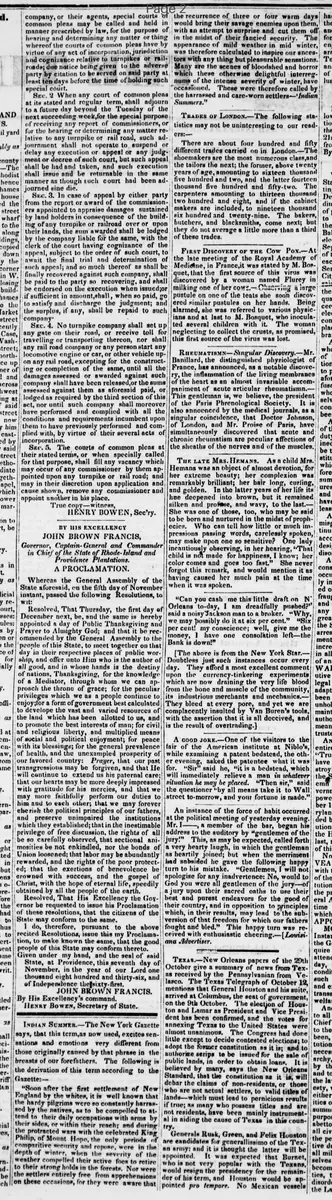
Indian Summer.--The New York Gazette says, that this term, as now used, excites sensations and emotions very different from those originally caused by that phrase in the breasts of our forefathers. The following is the derivation of this term according to the Gazette:--
"Soon after the first settlement of New England by the whites, it is well known that the hardy pilgrims were so constantly harassed by the natives, as to be compelled to attend to their daily occupations with arms by their sides, or within their reach; and during the protracted wars with the celebrated King Philip, of Mount Hope, the only periods of comparative security and repose, were in the depth of winter, when the severity of the weather compelled their active foes to retire to their strong holds in the forests. Nor were the settlers entirely free from apprehensions on these occasions, for they were aware that the recurrence of three or four warm days would bring their savage enemies upon them, with an attempt to surprise and cut them off in the midst of their fancied security. The appearance of mild weather in mid winter, was therefore calculated to inspire our ancestors with any thing but pleasurable sensations. Many are the scenes of bloodshed and horror which these otherwise delightful interregnums of the intense severity of winter, have occasioned. These were therefore called by the harassed and care-worn settlers--'Indian Summers.'"
"Soon after the first settlement of New England by the whites, it is well known that the hardy pilgrims were so constantly harassed by the natives, as to be compelled to attend to their daily occupations with arms by their sides, or within their reach; and during the protracted wars with the celebrated King Philip, of Mount Hope, the only periods of comparative security and repose, were in the depth of winter, when the severity of the weather compelled their active foes to retire to their strong holds in the forests. Nor were the settlers entirely free from apprehensions on these occasions, for they were aware that the recurrence of three or four warm days would bring their savage enemies upon them, with an attempt to surprise and cut them off in the midst of their fancied security. The appearance of mild weather in mid winter, was therefore calculated to inspire our ancestors with any thing but pleasurable sensations. Many are the scenes of bloodshed and horror which these otherwise delightful interregnums of the intense severity of winter, have occasioned. These were therefore called by the harassed and care-worn settlers--'Indian Summers.'"
What sub-type of article is it?
Historical Event
Curiosity
What themes does it cover?
Misfortune
Nature
What keywords are associated?
Indian Summer
New England Settlers
King Philip Wars
Native Attacks
Winter Weather
What entities or persons were involved?
King Philip
Where did it happen?
New England, Mount Hope
Story Details
Key Persons
King Philip
Location
New England, Mount Hope
Event Date
Soon After The First Settlement Of New England; During The Protracted Wars With King Philip
Story Details
Early New England settlers faced constant harassment from natives, finding winter security until mild weather brought attacks; such periods were termed 'Indian Summers' due to associated fears and bloodshed.