Thank you for visiting SNEWPapers!
Sign up free
Literary
August 26, 1837
Richmond Indiana Palladium
Richmond, Wayne County, Indiana
What is this article about?
Narrative of an elderly African princess, daughter of a powerful prince on the Senegal, abducted by Moors in 1770, trafficked to England, protected by Prince William Henry, then sold to the West Indies and New York, escaping slavery to live in New York for 50 years, now in an almshouse.
Clipping
OCR Quality
95%
Excellent
Full Text
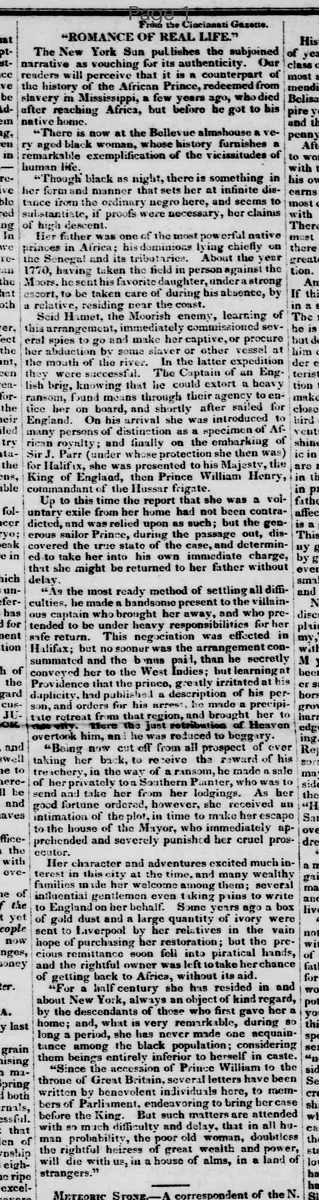
From the Cincinnati Gazette.
"ROMANCE OF REAL LIFE."
The New York Sun publishes the subjoined narrative as vouching for its authenticity. Our readers will perceive that it is a counterpart of the history of the African Prince, redeemed from slavery in Mississippi, a few years ago, who died after reaching Africa, but before he got to his native home.
"There is now at the Bellevue almshouse a very aged black woman, whose history furnishes a remarkable exemplification of the vicissitudes of human life.
"Though black as night, there is something in her form and manner that sets her at infinite distance from the ordinary negro here, and seems to substantiate, if proofs were necessary, her claims of high descent.
Her father was one of the most powerful native princes in Africa; his dominions lying chiefly on the Senegal and its tributaries. About the year 1770, having taken the field in person against the Moors. he sent his favorite daughter, under a strong escort, to be taken care of during his absence, by a relative. residing near the coast.
Seid Hamet, the Moorish enemy, learning of this arrangement, immediately commissioned several spies to go and make her captive, or procure her abduction by some slaver or other vessel at the mouth of the river. In the latter expedition they were successful. The Captain of an English brig, knowing that he could extort a heavy ransom, found means through their agency to entice her on board, and shortly after sailed for England. On his arrival she was introduced to many persons of distinction as a specimen of African royalty; and finally on the embarking of Sir J. Parr (under whose protection she then was) for Halifax, she was presented to his Majesty, the King of England, then Prince William Henry, commandant of the Hussar frigate.
Up to this time the report that she was a voluntary exile from her home had not been contradicted, and was relied upon as such; but the generous sailor Prince, during the passage out, discovered the true state of the case, and determined to take her into his own immediate charge, that she might be returned to her father without delay.
"As the most ready method of settling all difficulties, he made a handsome present to the villainous captain who brought her away, and who pretended to be under heavy responsibilities for her safe return. This negociation was effected in Halifax; but no sooner was the arrangement consummated and the bonus paid, than he secretly conveyed her to the West Indies; but learning at Providence that the prince, greatly irritated at his duplicity, had published a description of his person, and orders for his arrest, he made a precipitate retreat from that region, and brought her to New York. Here the just retribution of Heaven overtook him, an i he was reduced to beggary.
"Being now cut off from all prospect of ever taking her back, to receive the reward of his treachery, in the way of a ransom, he made a sale of her privately to Southern Planter, who was to send and take her from her lodgings. As her good fortune ordered, however, she received an intimation of the plot, in time to make her escape to the house of the Mayor, who immediately apprehended and severely punished her cruel prosecutor.
Her character and adventures excited much interest in this city at the time, and many wealthy families made her welcome among them; several influential gentlemen even taking pains to write to England on her behalf. Some years ago a box of gold dust and a large quantity of ivory were sent to Liverpool by her relatives in the vain hope of purchasing her restoration; but the precious remittance soon fell into piratical hands, and the rightful owner was left to take her chance of getting back to Africa, without its aid.
"For a half century she has resided in and about New York, always an object of kind regard, by the descendants of those who first gave her a home; and, what is very remarkable, during so long a period, she has never made one acquaintance among the black population; considering them beings entirely inferior to herself in caste.
"Since the accession of Prince William to the throne of Great Britain, several letters have been written by benevolent individuals here, to members of Parliament. endeavoring to bring her case before the King. But such matters are attended with so much difficulty and delay, that in all human probability, the poor old woman, doubtless the rightful heiress of great wealth and power, will die with us, in a house of alms, in a land of strangers."
"ROMANCE OF REAL LIFE."
The New York Sun publishes the subjoined narrative as vouching for its authenticity. Our readers will perceive that it is a counterpart of the history of the African Prince, redeemed from slavery in Mississippi, a few years ago, who died after reaching Africa, but before he got to his native home.
"There is now at the Bellevue almshouse a very aged black woman, whose history furnishes a remarkable exemplification of the vicissitudes of human life.
"Though black as night, there is something in her form and manner that sets her at infinite distance from the ordinary negro here, and seems to substantiate, if proofs were necessary, her claims of high descent.
Her father was one of the most powerful native princes in Africa; his dominions lying chiefly on the Senegal and its tributaries. About the year 1770, having taken the field in person against the Moors. he sent his favorite daughter, under a strong escort, to be taken care of during his absence, by a relative. residing near the coast.
Seid Hamet, the Moorish enemy, learning of this arrangement, immediately commissioned several spies to go and make her captive, or procure her abduction by some slaver or other vessel at the mouth of the river. In the latter expedition they were successful. The Captain of an English brig, knowing that he could extort a heavy ransom, found means through their agency to entice her on board, and shortly after sailed for England. On his arrival she was introduced to many persons of distinction as a specimen of African royalty; and finally on the embarking of Sir J. Parr (under whose protection she then was) for Halifax, she was presented to his Majesty, the King of England, then Prince William Henry, commandant of the Hussar frigate.
Up to this time the report that she was a voluntary exile from her home had not been contradicted, and was relied upon as such; but the generous sailor Prince, during the passage out, discovered the true state of the case, and determined to take her into his own immediate charge, that she might be returned to her father without delay.
"As the most ready method of settling all difficulties, he made a handsome present to the villainous captain who brought her away, and who pretended to be under heavy responsibilities for her safe return. This negociation was effected in Halifax; but no sooner was the arrangement consummated and the bonus paid, than he secretly conveyed her to the West Indies; but learning at Providence that the prince, greatly irritated at his duplicity, had published a description of his person, and orders for his arrest, he made a precipitate retreat from that region, and brought her to New York. Here the just retribution of Heaven overtook him, an i he was reduced to beggary.
"Being now cut off from all prospect of ever taking her back, to receive the reward of his treachery, in the way of a ransom, he made a sale of her privately to Southern Planter, who was to send and take her from her lodgings. As her good fortune ordered, however, she received an intimation of the plot, in time to make her escape to the house of the Mayor, who immediately apprehended and severely punished her cruel prosecutor.
Her character and adventures excited much interest in this city at the time, and many wealthy families made her welcome among them; several influential gentlemen even taking pains to write to England on her behalf. Some years ago a box of gold dust and a large quantity of ivory were sent to Liverpool by her relatives in the vain hope of purchasing her restoration; but the precious remittance soon fell into piratical hands, and the rightful owner was left to take her chance of getting back to Africa, without its aid.
"For a half century she has resided in and about New York, always an object of kind regard, by the descendants of those who first gave her a home; and, what is very remarkable, during so long a period, she has never made one acquaintance among the black population; considering them beings entirely inferior to herself in caste.
"Since the accession of Prince William to the throne of Great Britain, several letters have been written by benevolent individuals here, to members of Parliament. endeavoring to bring her case before the King. But such matters are attended with so much difficulty and delay, that in all human probability, the poor old woman, doubtless the rightful heiress of great wealth and power, will die with us, in a house of alms, in a land of strangers."
What sub-type of article is it?
Prose Fiction
What themes does it cover?
Slavery Abolition
Liberty Freedom
What keywords are associated?
African Princess
Abduction
Slavery
Ransom
New York
Prince William Henry
Senegal
Moors
What entities or persons were involved?
From The Cincinnati Gazette.
Literary Details
Title
"Romance Of Real Life."
Author
From The Cincinnati Gazette.
Subject
The Abduction And Extraordinary Life Of An African Princess In America.
Key Lines
Though Black As Night, There Is Something In Her Form And Manner That Sets Her At Infinite Distance From The Ordinary Negro Here, And Seems To Substantiate, If Proofs Were Necessary, Her Claims Of High Descent.
Her Father Was One Of The Most Powerful Native Princes In Africa; His Dominions Lying Chiefly On The Senegal And Its Tributaries.
For A Half Century She Has Resided In And About New York, Always An Object Of Kind Regard, By The Descendants Of Those Who First Gave Her A Home; And, What Is Very Remarkable, During So Long A Period, She Has Never Made One Acquaintance Among The Black Population; Considering Them Beings Entirely Inferior To Herself In Caste.