Thank you for visiting SNEWPapers!
Sign up free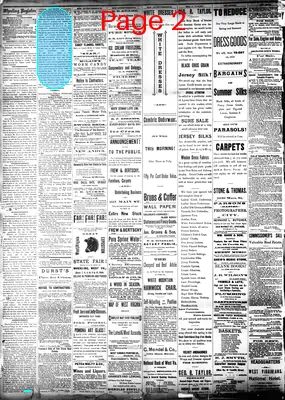
Wheeling Register
Wheeling, Ohio County, West Virginia
What is this article about?
Following Gen. Ulysses S. Grant's death, Democrats and Republicans unite in praising him as a patriot, closing controversies over his administration. The text reflects on James G. Blaine's leadership in the Republican Party's anti-Grant faction, detailing battles in 1876, 1880, and 1884 conventions that led to nominations of Hayes, Garfield, and Blaine, ultimately contributing to the party's defeat and a Democratic presidency.
Clipping

OCR Quality
Full Text
Mr. Blaine was the chieftain of the forces within the Republican party that opposed Gen. Grant's primacy, and resisted and twice defeated the political plans of Gen. Grant's friends. Mr. Blaine is the most conspicuous representative, living or dead, of the counter movement that divided the Republican party into two factions, bitterly hostile and mutually destructive. Three national conventions have been the three great battle fields of this nine years' war. If Mr. Blaine experienced defeat at Cincinnati in 1876, the movement which he led prevented the renomination of Gen. Grant at that time, or the nomination of any Grant Republican; and thus we had Hayes. Again, in 1880 when the third term for Grant was the direct issue, Blaine was victor and victim: thus we had Garfield. For the next four years the conflict was incessant and intense. It was carried into every Republican township or ward caucus, affecting every political event, little or big, and it finally broke the Republican party. Mr. Blaine prevailed at Chicago last year, but the return blow came with decisive effect from the Stalwarts of Central New York on the day when a Democratic President was elected.
Are the passions and resentments of that long struggle buried in Gen. Grant's grave?
What sub-type of article is it?
What keywords are associated?
What entities or persons were involved?
Domestic News Details
Event Date
1885
Key Persons
Outcome
republican party divided and defeated, leading to democratic presidential victory in 1884; unity in praise of grant after his death.
Event Details
James G. Blaine led opposition to Ulysses S. Grant's influence in the Republican Party, resulting in defeats of Grant's renomination plans in 1876 (leading to Hayes) and 1880 (leading to Garfield), Blaine's nomination in 1884, and subsequent party split contributing to Democratic win.