Thank you for visiting SNEWPapers!
Sign up free
The National Intelligencer And Washington Advertiser
Washington, District Of Columbia
What is this article about?
Prussian Minister Count Haugwitz transmits a note to British Ambassador Lord Carysfort defending the Northern maritime alliance as defensive and just, denying hostile intent toward Britain, announcing Prussia's formal accession to the convention between Russia, Denmark, and Sweden on December 16, and calling for Britain to lift its embargo to restore peace.
Clipping
OCR Quality
Full Text
LEIPZIG, Feb. 16.
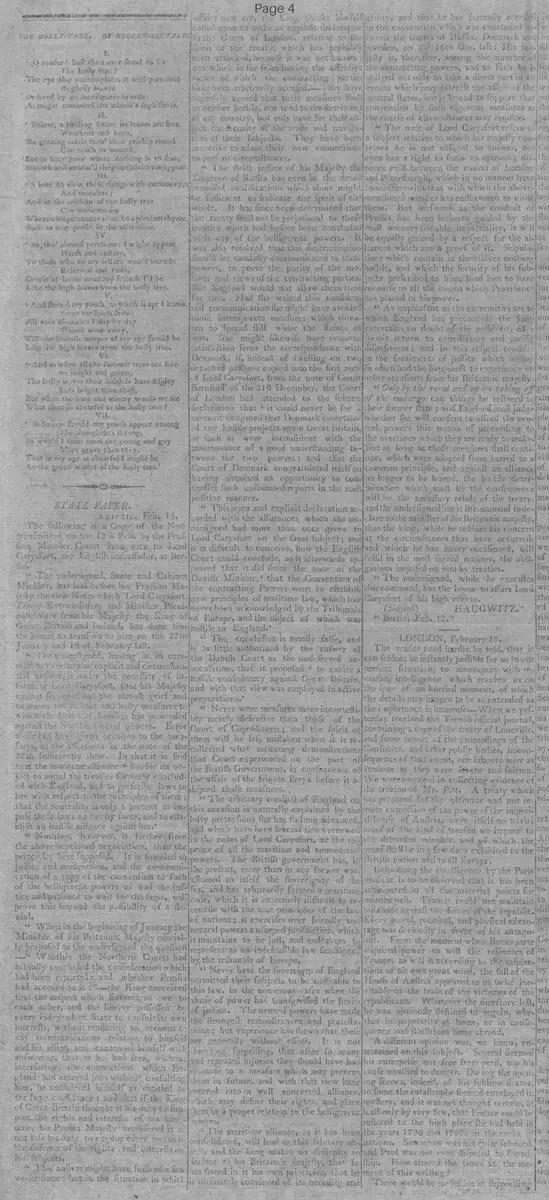
The following is a Copy of the Note transmitted on the 12th Feb. by the Prussian Minister Count Haugwitz to Lord Carysfort, the English ambassador, at Berlin.
"The undersigned, State and Cabinet Minister, has laid before his Prussian Majesty the two Notes which Lord Carysfort, Envoy Extraordinary and Minister Plenipotentiary from his Majesty the King of Great Britain and Ireland, has done him the honor to transmit to him on the 27th January and 1st of February last.
"The undersigned, having it in commands returns an explicit and circumstantial answer, is under the necessity of informing Lord Carysfort, that his Majesty cannot see, without the utmost grief and concern, the violent and hasty measures to which the Court of London has proceeded against the Northern naval powers. Errors at least have given occasion to the measures, as the assertions in the note of the 27th sufficiently shew. In that it is said that the maritime alliance has for its object to annul the treaties formerly concluded with England, and to prescribe laws to her with respect to the principles of them; that the neutrality is only a pretext to impose these laws on her by force, and to establish a hostile alliance against her."
"Nothing, however, is farther from the above mentioned negociation, than the principles here supposed. It is founded in justice and moderation, and the communication of a copy of the convention to each of the belligerent powers as had the justice and patience to wait for the same, will prove this beyond the possibility of a denial.
"When in the beginning of January the Minister of his Britannic Majesty officially proposed to the undersigned the question Whether the Northern Courts had actually concluded the confederation which had been reported: and whether Prussia had acceded to it ?—the King conceived that the respect which Sovereigns owe to each other, and the liberty possessed by every independent State to consult its own interests, without rendering an account to any, communications relative to himself and his allies, and contented himself with answering, that as he had seen, without interfering, the connections which England had entered into without consulting him, he considered himself as entitled to the same confidence: and that if the King of Great Britain thought it his duty to support the rights and interests of his kingdom, his Prussian Majesty considered it no less his duty to employ every means in the defence of the rights and interests of his subjects.
"This answer might have sufficed a few weeks since; but in the situation in which affairs now are, the King thinks himself called upon to make an explicit declaration to the Court of London, relative to the spirit of the treaty, which has probably been attacked, because it was not known: and which is far from having the offensive views of which the contracting parties have been arbitrarily accused. They have expressly agreed that their measures shall be neither hostile, nor tend to the detriment of any country, but only have for their object the security of their trade and navigation of their subjects. They have been attentive to adapt their new connection to present circumstances.
"The strict justice of his Majesty the Emperor of Russia has even in the detail proposed modifications which alone might be sufficient to indicate the spirit of the whole. It has since been determined that the treaty shall not be prejudicial to those treaties which had before been concluded with any of the belligerent powers. It was also resolved that this determination should be candidly communicated to these powers, to prove the purity of the motives and views of the contracting parties. But England would not allow them time for this. Had she waited this confidential communication she might have avoided those intemperate measures which threaten to spread still wider the flames of war. She might likewise have received satisfaction from the correspondence with Denmark, if, instead of dwelling on two detached passages copied into the first note of Lord Carysfort, from the note of Count Bernstorff of the 31st December, the Court of London had attended to the solemn declaration that it could never be for a moment imagined that Denmark entertained any hostile projects against Great Britain, or such as were inconsistent with the maintenance of a good understanding between the two powers: and that the Court of Denmark congratulated itself on having obtained an opportunity to contradict such unfounded reports in the most positive manner.
"This open and explicit declaration accorded with the assurances which the undersigned had more than once given to Lord Carysfort on the same subject; and it is difficult to conceive, how the English Court could conclude, as it afterwards appeared that it did from the note of the Danish Minister, 'that the Convention of the contracting Powers went to establish new principles of maritime law, which had never been acknowledged by the Tribunals of Europe, and the object of which was hostile to England.' The conclusion is totally false, and is as little authorized by the answer of the Danish Court as the undeserved accusation, that it proposed to excite a hostile confederacy against Great Britain, and with that view was employed in active preparations.'
"Never were measures more incontestibly merely defensive than those of the Court of Copenhagen; and the spirit of them will be less mistaken when it is recollected what menacing demonstrations that Court experienced on the part of the British Government, in consequence of the affair of the frigate Freya before it adopted those measures.
"The arbitrary conduct of England on this occasion is naturally explained by the lofty pretensions she has so long advanced, and which have been several times renewed in the notes of Lord Carysfort, at the expense of all the maritime and commercial powers. The British government has, in the present, more than in any former war, assumed to itself the sovereignty of the sea, and has arbitrarily formed a maritime code, which it is extremely difficult to reconcile with the true principles of the law of nations; it exercises over friendly and neutral powers a usurped jurisdiction, which it maintains to be just, and endeavors to represent as an indefeasible law sanctioned by the tribunals of Europe,
"Never have the sovereigns of England permitted their subjects to be amenable to this law, in the numerous cases when the abuse of power has transgressed the limits of justice. The neutral powers have made the strongest remonstrances and protestations; but experience has shown that these are generally without effect. It is not therefore surprising, that after so many and repeated injuries they should have had recourse to a measure which may prevent them in future, and with that view have entered into a well concerted alliance, which may define their rights, and place them in a proper relation to the belligerent powers.
"The maritime alliance, as it has been consolidated, will lead to this salutary object, and the king makes no difficulty to declare to his Britannic majesty, that he has found in it his own principles, that he is ultimately convinced of its necessity and utility, and that he has formally acceded to the convention which was concluded between the courts of Russia, Denmark and Sweden, on the 16th Dec. last: His majesty is, therefore, among the number of the contracting powers, and as such he is obliged not only to take a direct part in all events which may interest the affair of the neutral states, but is bound to support that convention by such vigorous measures as the course of circumstances may require.
"The note of Lord Carysfort refers to a subject relative to which his majesty conceives he is not obliged to answer, nor even has a right to form an opinion; disputes exist between the courts of London and Petersburg, which in no manner have connection with that with which the above-mentioned minister has endeavored to unite them. But inasmuch as the conduct of Prussia has been hitherto guided by the most unexceptionable impartiality, it will be equally guided by a respect for the alliances which are a proof of it. Stipulations which contain in themselves nothing hostile, and which the security of his subjects prescribed to him, bind him to have recourse to all the means which Providence has placed in his power.
"As unpleasant as the extremities are to which England has proceeded, the king entertains no doubt of the possibility of a speedy return to conciliatory and pacific dispositions; and in this respect confides in the sentiments of justice which he has so often had the happiness to experience on other occasions from his Britannic majesty.
"Only by the recall and entire taking off of the embargo can things be restored to their former state; and England must judge whether she will consent to afford the neutral powers this means of proceeding to the overtures which they are ready to make. But as long as those measures shall continue, which were adopted from hatred to a common principle, and against an alliance no longer to be feared, the hostile determination which must be the consequence will be the necessary result of the treaty. And the undersigned has it in command to declare to the minister of his Britannic majesty, that the king, while he testifies his concern at the circumstances that have occurred, and which he has never occasioned, will fulfil in the most sacred manner, the obligations imposed on him by treaties.
"The undersigned, while he executes this command, has the honor to assure Lord Carysfort of his high esteem.
(Signed) HAUGWITZ."
Berlin, Feb. 12.
What sub-type of article is it?
What keywords are associated?
What entities or persons were involved?
Where did it happen?
Foreign News Details
Primary Location
Berlin
Event Date
12th February
Key Persons
Outcome
prussia formally accedes to the northern maritime convention of 16th december between russia, denmark, and sweden; commits to support neutral rights with vigorous measures if needed; urges britain to lift embargo for reconciliation.
Event Details
Count Haugwitz's note to Lord Carysfort defends the Northern alliance as defensive and non-hostile, refutes British accusations of offensive intent, explains the convention's focus on securing neutral trade and navigation without prejudicing existing treaties, highlights Russia's modifications for justice, criticizes Britain's hasty embargo and maritime pretensions, and announces Prussia's accession and obligation to uphold the treaty.