Thank you for visiting SNEWPapers!
Sign up free
Story
April 1, 1938
Las Vegas Age
Las Vegas, Clark County, Lincoln County, Nevada
What is this article about?
Article by John van Guilder explains how to create indoor snapshots imitating firelight, candle-light, or lamp-light using concealed photo bulbs and flood lights, with diagrams for setup.
Clipping
OCR Quality
98%
Excellent
Full Text
UNUSUAL SNAPS!
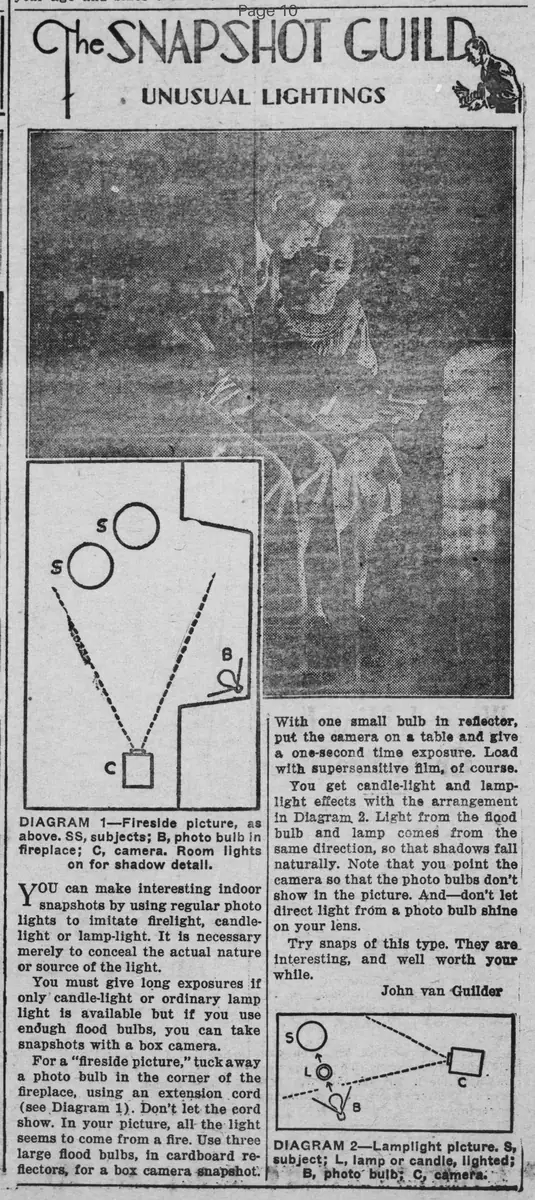
DIAGRAM 1—Fireside picture, as above. SS, subjects; B, photo bulb in fireplace; C, camera. Room lights on for shadow detail.
You can make interesting indoor snapshots by using regular photo lights to imitate firelight, candle-light or lamp-light. It is necessary merely to conceal the actual nature or source of the light.
You must give long exposures if only candle-light or ordinary lamp light is available but if you use enough flood bulbs, you can take snapshots with a box camera.
For a "fireside picture," tuck away a photo bulb in the corner of the fireplace, using an extension cord (see Diagram 1). Don't let the cord show. In your picture, all the light seems to come from a fire. Use three large flood bulbs, in cardboard reflectors, for a box camera snapshot.
With one small bulb in reflector, put the camera on a table and give a one-second time exposure. Load with supersensitive film, of course.
You get candle-light and lamp-light effects with the arrangement in Diagram 2. Light from the flood bulb and lamp comes from the same direction, so that shadows fall naturally. Note that you point the camera so that the photo bulbs don't show in the picture. And don't let direct light from a photo bulb shine on your lens.
Try snaps of this type. They are interesting, and well worth your while.
John van Guilder
DIAGRAM 2—Lamplight picture. S subject; L, lamp or candle, lighted; B, photo bulb; C, camera.
DIAGRAM 1—Fireside picture, as above. SS, subjects; B, photo bulb in fireplace; C, camera. Room lights on for shadow detail.
You can make interesting indoor snapshots by using regular photo lights to imitate firelight, candle-light or lamp-light. It is necessary merely to conceal the actual nature or source of the light.
You must give long exposures if only candle-light or ordinary lamp light is available but if you use enough flood bulbs, you can take snapshots with a box camera.
For a "fireside picture," tuck away a photo bulb in the corner of the fireplace, using an extension cord (see Diagram 1). Don't let the cord show. In your picture, all the light seems to come from a fire. Use three large flood bulbs, in cardboard reflectors, for a box camera snapshot.
With one small bulb in reflector, put the camera on a table and give a one-second time exposure. Load with supersensitive film, of course.
You get candle-light and lamp-light effects with the arrangement in Diagram 2. Light from the flood bulb and lamp comes from the same direction, so that shadows fall naturally. Note that you point the camera so that the photo bulbs don't show in the picture. And don't let direct light from a photo bulb shine on your lens.
Try snaps of this type. They are interesting, and well worth your while.
John van Guilder
DIAGRAM 2—Lamplight picture. S subject; L, lamp or candle, lighted; B, photo bulb; C, camera.
What sub-type of article is it?
Photography Tutorial
Diy Guide
What keywords are associated?
Indoor Snapshots
Photo Lights
Firelight Imitation
Candle Light Effects
Flood Bulbs
Time Exposure
What entities or persons were involved?
John Van Guilder
Story Details
Key Persons
John Van Guilder
Story Details
Instructions for simulating firelight, candle-light, and lamp-light in indoor snapshots using concealed photo bulbs, extension cords, flood bulbs, and specific camera setups as shown in diagrams.