Thank you for visiting SNEWPapers!
Sign up free
The Oroville Weekly Gazette
Oroville, Okanogan County, Washington
What is this article about?
Prospector W.E. Coyle discovers rich placer gold nuggets on the Similkameen River near Oroville, Washington, after 66 years of sporadic mining since 1856. The find evokes memories of the 1856 Similkameen rush and the 1883 Coeur d'Alene discovery by A.J. Prichard, which sparked a major gold rush.
Clipping
OCR Quality
Full Text
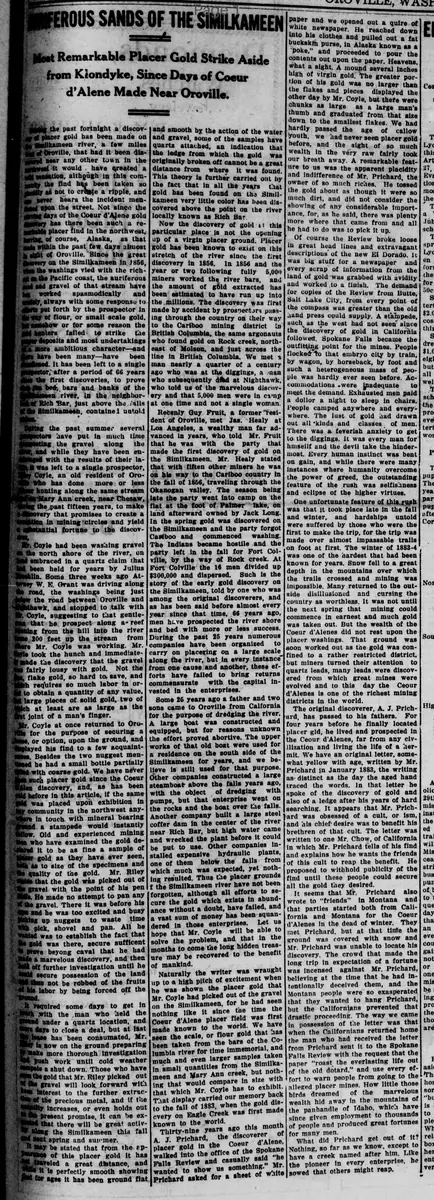
Naturally the writer was wrought up to a high pitch of excitement when he was shown the placer gold that Mr. Coyle had picked out of the gravel on the Similkameen, for he had seen nothing like it since the time the Coeur d'Alene placer field was first made known to the world. We have seen the scale, or flour gold that has been taken from the bars of the Columbia river for time immemorial, and much and even larger samples taken in small quantities from the Similkameen and Mary Ann creek, but nothing that would compare in size with that which Mr. Coyle has to exhibit. That display carried our memory back to the fall of 1883, when the gold discovery on Eagle Creek was first made known to the world.
Thirty-nine years ago this month A. J. Prichard, the discoverer of placer gold in the Coeur d'Alene, walked into the office of the Spokane Falls Review and casually said 'he wanted to show us something.' Mr. Prichard asked for a sheet of white paper and we opened out a quire of white newspaper. He reached down into his clothes and pulled out a fat buckskin purse, in Alaska known as a 'poke,' and proceeded to pour the contents out upon the paper. Heavens, what a sight. A mound several inches high of virgin gold. The greater portion of his gold was no larger than the flakes and pieces displayed the other day by Mr. Coyle, but there were chunks as large as a large man's thumb and graduated from that size down to the smallest flakes. We had hardly passed the age of callow youth, we had never seen placer gold before, and the sight of so much wealth in the very raw fairly took our breath away. A remarkable feature to us was the apparent placidity and indifference of Mr. Prichard, the owner of so much riches. He tossed the gold about as though it were so much dirt, and did not consider the showing of any considerable importance, for, as he said, there was plenty more where that came from and all he had to do was to pick it up. Of course the Review broke loose in great head lines and extravagant descriptions of the new El Dorado. It was big stuff for a newspaper and every scrap of information from the land of gold was grabbed with avidity and worked to a finish. The demand for copies of the Review from Butte, Salt Lake City, from every point of the compass was greater than the old hand press could supply. A stampede, such as the west had not seen since the discovery of gold in California followed, Spokane Falls became the outfitting point for the mines. People flocked to that embryo city by train, by wagon, by horseback, by foot and such a heterogeneous mass of people was hardly ever seen before. Accommodations were inadequate to meet the demand. Exhausted men paid a dollar a night to sleep in chairs. People camped anywhere and everywhere. The lust of gold had drawn out all kinds and classes of men. There was a feverish anxiety to get to the diggings. It was every man for himself and the devil take the hindermost. Every human instinct was bent on gain, and while there were many instances where humanity overcome the power of greed, the outstanding feature of the rush was selfishness and eclipse of the higher virtues. One unfortunate feature of this rush was that it took place late in the fall and winter, and hardships untold were suffered by those who were the first to make the trip, for the trip was made over almost impassable trails on foot at first. The winter of 1883-4 was one of the hardest that had been known for years. Snow fell to a great depth in the mountains over which the trails crossed and mining was impossible. Many returned to the outside disillusioned and cursing the country as worthless. It was not until the next spring that mining could commence in earnest and much gold was taken out. But the wealth of the Coeur d'Alenes did not rest upon the placer washings. That ground was soon worked out as the gold was confined to a rather restricted district, but miners turned their attention to quartz leads, many leads were discovered from which great mines were evolved and to this day the Coeur d'Alenes is one of the richest mining districts in the world. The original discoverer, A. J. Prichard, has passed to his fathers. For four years before he finally located placer gold, he lived and prospected in the Coeur d'Alenes, far from any civilization and living the life of a hermit. We have an original letter, somewhat yellow with age, written by Mr. Prichard in January 1883, the writing as distinct as the day the aged hand traced the words. In that letter he spoke of the discovery of gold and also of a ledge after his years of hard searching. It appears that Mr. Prichard was obsessed of a cult, or ism, and his chief desire was to benefit his brethren of that cult. The letter was written to one Mr. Chow, of California in which Mr. Prichard tells of his find and explains how he wants the friends of this cult to reap the benefit. He proposed to withhold publicity of the find until these people could secure all the gold they desired. It seems that Mr. Prichard also wrote to 'friends' in Montana and that parties started both from California and Montana for the Coeur d'Alenes in the dead of winter. They met Prichard, but at that time the ground was covered with snow and Mr. Prichard was unable to locate his discovery. The crowd that made the long trip in expectation of a fortune was incensed against Mr. Prichard believing at the time that he had intentionally deceived them, and the Montana people were so exasperated that they wanted to hang Prichard, but the Californians prevented that drastic proceeding. The way we came in possession of the letter was that when the Californians returned home the man who had received the letter from Prichard sent it to the Spokane Falls Review with the request that the paper 'roast the everlasting life out of the old dotard,' and use every effort to warn people from going to the alleged placer mines. How little those birds dreamed of the marvelous wealth hid away in the mountains of the panhandle of Idaho, which have since given employment to thousands of people and produced great fortunes for many men. What did Prichard get out of it? Nothing, so far as we know, except to have a creek named after him. Like the pioneer in every enterprise, he sowed that others might reap.
What sub-type of article is it?
What themes does it cover?
What keywords are associated?
What entities or persons were involved?
Where did it happen?
Story Details
Key Persons
Location
Similkameen River Near Oroville, Washington
Event Date
Past Fortnight Circa 1922, With Historical Events In 1856 And 1883
Story Details
Prospector W. E. Coyle discovers large placer gold nuggets on the Similkameen River near Rich Bar, following a tip from W. E. Grant, securing a lease to mine the promising site after years of failed attempts in the area since the 1856 rush. The article recounts the 1856 discovery by Jas. Healy's party and compares it to A. J. Prichard's 1883 Coeur d'Alene find, which led to a massive gold rush despite initial hardships.