Thank you for visiting SNEWPapers!
Sign up free
Jackson Advocate
Jackson, Hinds County, Mississippi
What is this article about?
The U.S. Supreme Court upheld a federal ruling requiring Louisiana State University Law School to admit Negro students, rejecting the state's appeal claiming separate but equal facilities at Southern University.
Merged-components note: Continuation of Supreme Court LSU case to page 4; relabeled continuation from story to domestic_news
Clippings
1 of 2
OCR Quality
Full Text
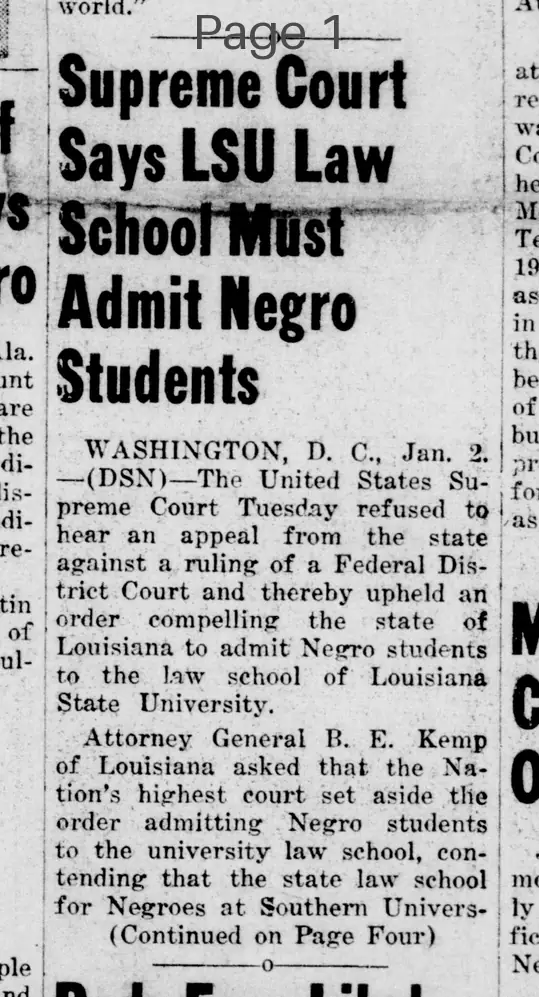
WASHINGTON, D. C., Jan. 2. -(DSN)-The United States Supreme Court Tuesday refused to hear an appeal from the state against a ruling of a Federal District Court and thereby upheld an order compelling the state of Louisiana to admit Negro students to the law school of Louisiana State University
Attorney General B. E. Kemp of Louisiana asked that the Nation's highest court set aside the order admitting Negro students to the university law school, contending that the state law school for Negroes at Southern University provided "separate but equal" facilities for Negro students. He also claimed that the state was spending five times the money at the Negro law school to that being spent at the university law school.
The lower court however found the facilities at the Negro law school to be unequal and cited the Supreme Court's decisions in the Texas and Oklahoma cases.
What sub-type of article is it?
What keywords are associated?
What entities or persons were involved?
Where did it happen?
Domestic News Details
Primary Location
Louisiana
Event Date
Jan. 2
Key Persons
Outcome
supreme court upheld lower court ruling that facilities at southern university law school are unequal, compelling admission of negro students to lsu law school.
Event Details
The United States Supreme Court refused to hear Louisiana's appeal against a Federal District Court ruling, upholding an order to admit Negro students to Louisiana State University Law School. Attorney General B. E. Kemp argued for separate but equal facilities at Southern University, claiming higher spending there, but the lower court found them unequal, citing Texas and Oklahoma cases.