Thank you for visiting SNEWPapers!
Sign up free
Story
August 17, 1850
The Mississippi Creole
Canton, Madison County, Mississippi
What is this article about?
Henry Clay delivers a passionate Senate speech urging passage of the Compromise Bill to preserve the Union, warning against disunion sentiments especially from South Carolina, and appealing to senators for patriotic unity amid threats of civil war.
Clipping
OCR Quality
75%
Good
Full Text
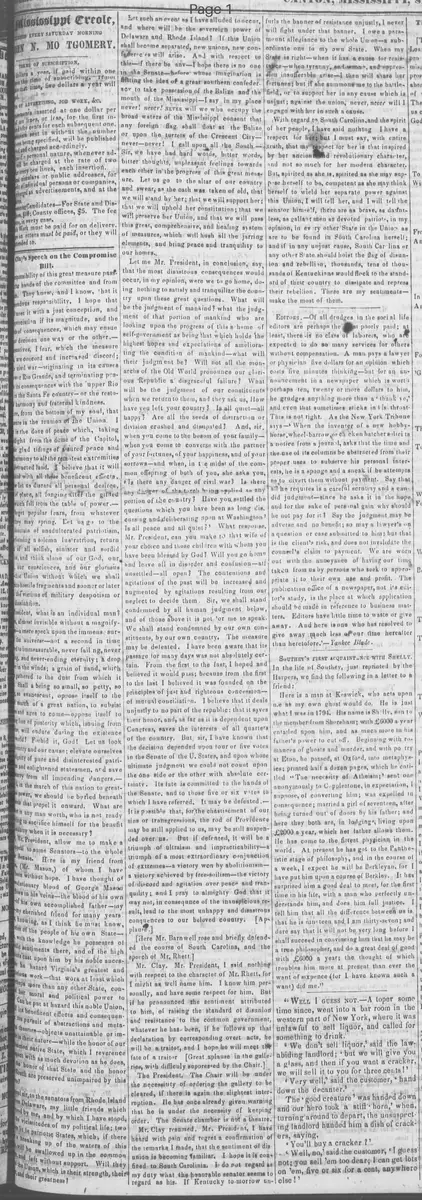
Clay's Speech on the Compromise Bill.
Responsibility of this great measure passes from the hands of the committee and from
They know, and I know, that it
enormous responsibility. I hope that
they will meet it with a just conception, and
appreciation of its magnitude, and the
of consequences, which may ensue
from its
decision one way or the other.
Motives, I fear, which the measure
are concord and increased discord;
civil war—originating in its causes
near Rio Grande, and terminating pos-
sibly
in its consequences with the upper Rio
Grande
in the Santa Fe country—or the resto-
ration of
harmony and fraternal kindness.
I pray, from the bottom of my soul, that
measure is the reunion of the Union. I
pray that it
is the dove of peace which, taking
flight from the dome of the Capitol,
shall bear
glad tidings of assured peace and
harmony to all the remotest extremities
of this distracted land. I believe that it will
be welcomed with all these beneficent effects.
Let us discard all personal desires,
of place, all longing after the gilded
crumbs which fall from the table of power.
Forget popular fears, from whatever
source
they may spring. Let us go to the
fountain of unadulterated patriotism.
Performing a solemn lustration, return
pure
of all selfish, sinister and sordid
influences
,and think alone of our God, our
country,
our consciences, and our glorious
Union without which we shall
become
to hostile fragments and sooner or later
the victims of military despotism or
domination,
President, what is an individual man?
Almost invisible without a magnify-
ing glass—a mere speck upon the immense sur-
face
of the universe—not a second in time
compared with the immeasurable, never failing, never
decaying
and never-ending eternity; a drop
in the ocean of waters; a grain of sand, which
when
gathered to the dust from which it
sprang,
shall be no longer remembered. Shall a being so small, so petty, so
evanscent, oppose itself to the
march of a great nation, to subsist
and ages to come—oppose itself to
the long line of posterity which, issuing from
us,
will endure during the existence
of the
world! Forbid it, God! Let us look
upon our country and our cause; elevate ourselves
to the dignity of pure and disinterested patri-
otism,
and enlightened statesmen, and save
our
country from all impending dangers.
In the march of this nation to great-
ness and
power, we should be buried beneath
the wheels that propel it onward. What are
we, or what is any man worth, who is not ready
willing to sacrifice himself for the benefit
of his country when it is necessary?
Mr. President, allow me to make a
appeal to some Senators—to the whole
Senate. Here is my friend from
(Mr. Mason,) of whom I have
been without hope. I have thought of
revolutionary blood of George Mason
flows in his veins—the blood of his own
grandfather—of his own accomplished father—
in
my cherished friend for many years.
Knowing, as I think he must know,
wishes of the people of his own State—
with the knowledge he possesses of
public sentiments there, and of the high
reflections cast upon him by his noble ances-
try,
can he hazard Virginia's greatest and
glorious work —that work at least which
perhaps more than any other State, con-
tributed
her moral and political power to
establish?
Can he put at hazard this noble Union,
its beneficent effects and consequen-
ces,
in the pursuit of abstractions and meta-
physical
theories—objects unattainable or im-
practicable
in their nature—while the honor of our
common native State, which I reverence
as much as he does,
and the honor of the
whole South are preserved unimpaired by this
measure?
to the senators from Rhode Island
and Delaware,
who stood by me, and by
vicissitudes of my political life; two
little patriotic
States, which,
if there
is a breaking
up
of the Union,
will be swallowed
up
in the common
ruin, and left without support.
What becomes of their power
and their greatness?
Will they
up
in the common
ruin?
Let such an event as I have alluded to occur,
and where will be the sovereign power of
Delaware and Rhode Island? If this Union
shall become separated, new unions, new con-
federacies will arise. And with respect to
this—if there be any—I hope there is no one
in the Senate—before whose imagination is
not
flitting the idea of a great southern confeder-
acy,
to take possession of the Balize and the
mouth of the Mississippi—I say in my place
never! never! Never will we who occupy the
broad waters of the Mississippi consent that
any foreign flag shall float at the Balize
or upon the turrets of the Crescent City—
never—never! I call upon all the South.—
Sir, we have had hard words, bitter words,
bitter thoughts, unpleasant feelings towards
each other in the progress of this great meas-
ure. Let us go to the altar of our country
and swear, as the oath was taken of old, that
we will stand by her; that we will support her;
that we will uphold her constitution; that we
will preserve her Union, and that we will pass
this great, comprehensive, and healing system
of measures, which will hush all the jarring
elements, and bring peace and tranquility to
our homes.
Let me Mr. President, in conclusion, say,
that the most disastrous consequences would
occur, in my opinion, were we to go home, do-
ing nothing to satisfy and tranquilize the coun-
try upon these great questions. What will
be the judgment of mankind? what the judg-
ment of that portion of mankind who are
looking upon the progress of this scheme of
self-government as being that which holds the
highest hopes and expectations of ameliora-
ting the condition of mankind—what will
their judgment be? Will not all the mon-
archs of the Old World pronounce our glori-
ous Republic a disgraceful failure? What
will be the judgment of our constituents
when we return to them, and they ask us, How
have you left your country? Is all quiet—all
happy? Are all the seeds of distraction or
division crushed and dissipated? And, sir.
when you come to the bosom of your family—
when you come to converse with the partner
of your fortunes, of your happiness, and of your
sorrows—and when, in the midst of the com-
mon offspring of both of you, she asks you,
Is there any danger of civil war? Is there
any danger of the torch being applied to any
portion of the country? Have you settled the
questions which you have been so long dis.
cussing and deliberating upon at Washington?
Is all peace and all quiet? What response,
Mr. President, can you make that wife of
your choice and those children with whom you
have been blessed by God? Will you go home
and leave all in disorder and confusion—all
unsettled—all open? The contentions and
agitations of the past will be increased and
augmented by agitations resulting from our
neglect to decide them. Sir, we shall stand
condemned by all human judgment below,
and of those above it is not for me to speak.
We shall stand condemned by our own con-
stituents, by our own country. The measure
may be defeated. I have been aware that its
passage for many days was not absolutely cer-
tain. From the first to the last, I hoped and
believed it would pass; because from the first
to the last I believed it was founded on the
principles of just and righteous concession—
of mutual conciliation. I believe that it deals
unjustly to no part of the republic: that it saves
their honor, and, as far as it is dependent upon
Congress, saves the interests of all quarters
of the country. But sir, I have known that
the decision depended upon four or five votes
in the Senate of the U. States, and upon whose
ultimate judgment we could not count upon
the one side or the other with absolute cer-
tainty. Its fate is committed to the hands of
the Senate. and to those five or six votes to
which I have referred. It may be defeated.—
It is possible that, for the chastisement of our
sins or transgressions, the rod of Providence
may be still applied to us, may be still suspen-
ded over us. But if defeated, it will be a
triumph of ultraism and impracticability—a
triumph of a most extraordinary conjunction
of extremes—a victory won by abolitionism—
a victory achieved by free-soilism—the victory
of discord and agitation over peace and tran-
quility; and I pray to almighty God that it
may not, in consequence of the inauspicious re-
sult, lead to the most unhappy and disastrous
consequences to our beloved country. [Ap-
plause.
After Mr. Clay concluded, Mr. Barnwell rose and briefly defend-
ed the course of South Carolina, and the
speech of Mr. Rhett.]
Mr. Clay. Mr. President, I said nothing
with respect to the character of Mr. Rhett. for
I might as well name him. I know him per-
sonally, and have some respect for him, But
if he pronounced the sentiment attributed
to him, of raising the standard of disunion
and resistance to the common government,
whatever he has been, if he follows up that
declaration by corresponding overt acts, he
will be a traitor, and I hope he will meet the
fate of a traitor [Great applause in the galle-
ries, with difficulty suppressed by the Chair.]
The President. The Chair will be under
the necessity of ordering the gallery to be
cleared, if there is again the slightest inter-
ruption. He has once already given warning
that he is under the necessity of keeping
order. The Senate chamber is not a theatre.
Mr. Clay resumed. Mr. President, I have
heard with pain and regret a confirmation of
the remarks I made, that the sentiment of dis-
union is becoming familiar. I hope it is con-
fined to South Carolina. I do not regard as
my duty what the honorable senator seems to
regard as his. If Kentucky to-morrow un-
furls the banner of resistance unjustly, I never
will fight under that banner. I owe a para-
mount allegiance to the whole Union—a sub-
ordinate one to my own State. When my
State is right—when it has a cause for resis-
tance—when tyranny, and wrong, and oppres-
sion insufferable arise—I then will share her
fortunes; but if she summons me to the battle-
field, or to support her in any cause which is
unjust; against the union, never, never will I
engage with her in such a cause.
With regard to South Carolina, and the spirit
of her people, I have said nothing I have a
respect for her: but I must say, with entire
frankness, that my respect for her is that inspired
by her ancient and revolutionary character,
and not so much for her modern character.
But, spirited as she is, spirited as she may sup-
pose herself to be, competent as she may think
herself to wield her separate power against
this Union, I will tell her, and I will tell the
senator himself, there are as brave, as daunt-
less, as gallant men as devoted patriots, in my
opinion, in every other State in the Union as
are to be found in South Carolina herself;
and if in any unjust cause, South Carolina or
any other State should hoist the flag of disun-
ion and rebellion, thousands, tens of thou-
sands of Kentuckians would flock to the stand-
ard of their country to dissipate and repress
their rebellion. These are my sentiments—
make the most of them.
Responsibility of this great measure passes from the hands of the committee and from
They know, and I know, that it
enormous responsibility. I hope that
they will meet it with a just conception, and
appreciation of its magnitude, and the
of consequences, which may ensue
from its
decision one way or the other.
Motives, I fear, which the measure
are concord and increased discord;
civil war—originating in its causes
near Rio Grande, and terminating pos-
sibly
in its consequences with the upper Rio
Grande
in the Santa Fe country—or the resto-
ration of
harmony and fraternal kindness.
I pray, from the bottom of my soul, that
measure is the reunion of the Union. I
pray that it
is the dove of peace which, taking
flight from the dome of the Capitol,
shall bear
glad tidings of assured peace and
harmony to all the remotest extremities
of this distracted land. I believe that it will
be welcomed with all these beneficent effects.
Let us discard all personal desires,
of place, all longing after the gilded
crumbs which fall from the table of power.
Forget popular fears, from whatever
source
they may spring. Let us go to the
fountain of unadulterated patriotism.
Performing a solemn lustration, return
pure
of all selfish, sinister and sordid
influences
,and think alone of our God, our
country,
our consciences, and our glorious
Union without which we shall
become
to hostile fragments and sooner or later
the victims of military despotism or
domination,
President, what is an individual man?
Almost invisible without a magnify-
ing glass—a mere speck upon the immense sur-
face
of the universe—not a second in time
compared with the immeasurable, never failing, never
decaying
and never-ending eternity; a drop
in the ocean of waters; a grain of sand, which
when
gathered to the dust from which it
sprang,
shall be no longer remembered. Shall a being so small, so petty, so
evanscent, oppose itself to the
march of a great nation, to subsist
and ages to come—oppose itself to
the long line of posterity which, issuing from
us,
will endure during the existence
of the
world! Forbid it, God! Let us look
upon our country and our cause; elevate ourselves
to the dignity of pure and disinterested patri-
otism,
and enlightened statesmen, and save
our
country from all impending dangers.
In the march of this nation to great-
ness and
power, we should be buried beneath
the wheels that propel it onward. What are
we, or what is any man worth, who is not ready
willing to sacrifice himself for the benefit
of his country when it is necessary?
Mr. President, allow me to make a
appeal to some Senators—to the whole
Senate. Here is my friend from
(Mr. Mason,) of whom I have
been without hope. I have thought of
revolutionary blood of George Mason
flows in his veins—the blood of his own
grandfather—of his own accomplished father—
in
my cherished friend for many years.
Knowing, as I think he must know,
wishes of the people of his own State—
with the knowledge he possesses of
public sentiments there, and of the high
reflections cast upon him by his noble ances-
try,
can he hazard Virginia's greatest and
glorious work —that work at least which
perhaps more than any other State, con-
tributed
her moral and political power to
establish?
Can he put at hazard this noble Union,
its beneficent effects and consequen-
ces,
in the pursuit of abstractions and meta-
physical
theories—objects unattainable or im-
practicable
in their nature—while the honor of our
common native State, which I reverence
as much as he does,
and the honor of the
whole South are preserved unimpaired by this
measure?
to the senators from Rhode Island
and Delaware,
who stood by me, and by
vicissitudes of my political life; two
little patriotic
States, which,
if there
is a breaking
up
of the Union,
will be swallowed
up
in the common
ruin, and left without support.
What becomes of their power
and their greatness?
Will they
up
in the common
ruin?
Let such an event as I have alluded to occur,
and where will be the sovereign power of
Delaware and Rhode Island? If this Union
shall become separated, new unions, new con-
federacies will arise. And with respect to
this—if there be any—I hope there is no one
in the Senate—before whose imagination is
not
flitting the idea of a great southern confeder-
acy,
to take possession of the Balize and the
mouth of the Mississippi—I say in my place
never! never! Never will we who occupy the
broad waters of the Mississippi consent that
any foreign flag shall float at the Balize
or upon the turrets of the Crescent City—
never—never! I call upon all the South.—
Sir, we have had hard words, bitter words,
bitter thoughts, unpleasant feelings towards
each other in the progress of this great meas-
ure. Let us go to the altar of our country
and swear, as the oath was taken of old, that
we will stand by her; that we will support her;
that we will uphold her constitution; that we
will preserve her Union, and that we will pass
this great, comprehensive, and healing system
of measures, which will hush all the jarring
elements, and bring peace and tranquility to
our homes.
Let me Mr. President, in conclusion, say,
that the most disastrous consequences would
occur, in my opinion, were we to go home, do-
ing nothing to satisfy and tranquilize the coun-
try upon these great questions. What will
be the judgment of mankind? what the judg-
ment of that portion of mankind who are
looking upon the progress of this scheme of
self-government as being that which holds the
highest hopes and expectations of ameliora-
ting the condition of mankind—what will
their judgment be? Will not all the mon-
archs of the Old World pronounce our glori-
ous Republic a disgraceful failure? What
will be the judgment of our constituents
when we return to them, and they ask us, How
have you left your country? Is all quiet—all
happy? Are all the seeds of distraction or
division crushed and dissipated? And, sir.
when you come to the bosom of your family—
when you come to converse with the partner
of your fortunes, of your happiness, and of your
sorrows—and when, in the midst of the com-
mon offspring of both of you, she asks you,
Is there any danger of civil war? Is there
any danger of the torch being applied to any
portion of the country? Have you settled the
questions which you have been so long dis.
cussing and deliberating upon at Washington?
Is all peace and all quiet? What response,
Mr. President, can you make that wife of
your choice and those children with whom you
have been blessed by God? Will you go home
and leave all in disorder and confusion—all
unsettled—all open? The contentions and
agitations of the past will be increased and
augmented by agitations resulting from our
neglect to decide them. Sir, we shall stand
condemned by all human judgment below,
and of those above it is not for me to speak.
We shall stand condemned by our own con-
stituents, by our own country. The measure
may be defeated. I have been aware that its
passage for many days was not absolutely cer-
tain. From the first to the last, I hoped and
believed it would pass; because from the first
to the last I believed it was founded on the
principles of just and righteous concession—
of mutual conciliation. I believe that it deals
unjustly to no part of the republic: that it saves
their honor, and, as far as it is dependent upon
Congress, saves the interests of all quarters
of the country. But sir, I have known that
the decision depended upon four or five votes
in the Senate of the U. States, and upon whose
ultimate judgment we could not count upon
the one side or the other with absolute cer-
tainty. Its fate is committed to the hands of
the Senate. and to those five or six votes to
which I have referred. It may be defeated.—
It is possible that, for the chastisement of our
sins or transgressions, the rod of Providence
may be still applied to us, may be still suspen-
ded over us. But if defeated, it will be a
triumph of ultraism and impracticability—a
triumph of a most extraordinary conjunction
of extremes—a victory won by abolitionism—
a victory achieved by free-soilism—the victory
of discord and agitation over peace and tran-
quility; and I pray to almighty God that it
may not, in consequence of the inauspicious re-
sult, lead to the most unhappy and disastrous
consequences to our beloved country. [Ap-
plause.
After Mr. Clay concluded, Mr. Barnwell rose and briefly defend-
ed the course of South Carolina, and the
speech of Mr. Rhett.]
Mr. Clay. Mr. President, I said nothing
with respect to the character of Mr. Rhett. for
I might as well name him. I know him per-
sonally, and have some respect for him, But
if he pronounced the sentiment attributed
to him, of raising the standard of disunion
and resistance to the common government,
whatever he has been, if he follows up that
declaration by corresponding overt acts, he
will be a traitor, and I hope he will meet the
fate of a traitor [Great applause in the galle-
ries, with difficulty suppressed by the Chair.]
The President. The Chair will be under
the necessity of ordering the gallery to be
cleared, if there is again the slightest inter-
ruption. He has once already given warning
that he is under the necessity of keeping
order. The Senate chamber is not a theatre.
Mr. Clay resumed. Mr. President, I have
heard with pain and regret a confirmation of
the remarks I made, that the sentiment of dis-
union is becoming familiar. I hope it is con-
fined to South Carolina. I do not regard as
my duty what the honorable senator seems to
regard as his. If Kentucky to-morrow un-
furls the banner of resistance unjustly, I never
will fight under that banner. I owe a para-
mount allegiance to the whole Union—a sub-
ordinate one to my own State. When my
State is right—when it has a cause for resis-
tance—when tyranny, and wrong, and oppres-
sion insufferable arise—I then will share her
fortunes; but if she summons me to the battle-
field, or to support her in any cause which is
unjust; against the union, never, never will I
engage with her in such a cause.
With regard to South Carolina, and the spirit
of her people, I have said nothing I have a
respect for her: but I must say, with entire
frankness, that my respect for her is that inspired
by her ancient and revolutionary character,
and not so much for her modern character.
But, spirited as she is, spirited as she may sup-
pose herself to be, competent as she may think
herself to wield her separate power against
this Union, I will tell her, and I will tell the
senator himself, there are as brave, as daunt-
less, as gallant men as devoted patriots, in my
opinion, in every other State in the Union as
are to be found in South Carolina herself;
and if in any unjust cause, South Carolina or
any other State should hoist the flag of disun-
ion and rebellion, thousands, tens of thou-
sands of Kentuckians would flock to the stand-
ard of their country to dissipate and repress
their rebellion. These are my sentiments—
make the most of them.
What sub-type of article is it?
Historical Event
What themes does it cover?
Moral Virtue
Justice
Providence Divine
What keywords are associated?
Compromise Bill
Union Preservation
Disunion
South Carolina
Senate Speech
Henry Clay
Civil War Threat
Patriotism
What entities or persons were involved?
Henry Clay
Mr. Mason
Mr. Barnwell
Mr. Rhett
George Mason
Where did it happen?
Senate Chamber, Washington
Story Details
Key Persons
Henry Clay
Mr. Mason
Mr. Barnwell
Mr. Rhett
George Mason
Location
Senate Chamber, Washington
Story Details
Henry Clay passionately advocates for the Compromise Bill in the Senate, emphasizing its role in preserving the Union, warning of civil war if defeated, appealing to senators' patriotism, and condemning disunion sentiments from South Carolina.