Thank you for visiting SNEWPapers!
Sign up free
St. Paul Recorder
Saint Paul, Ramsey County, Minnesota
What is this article about?
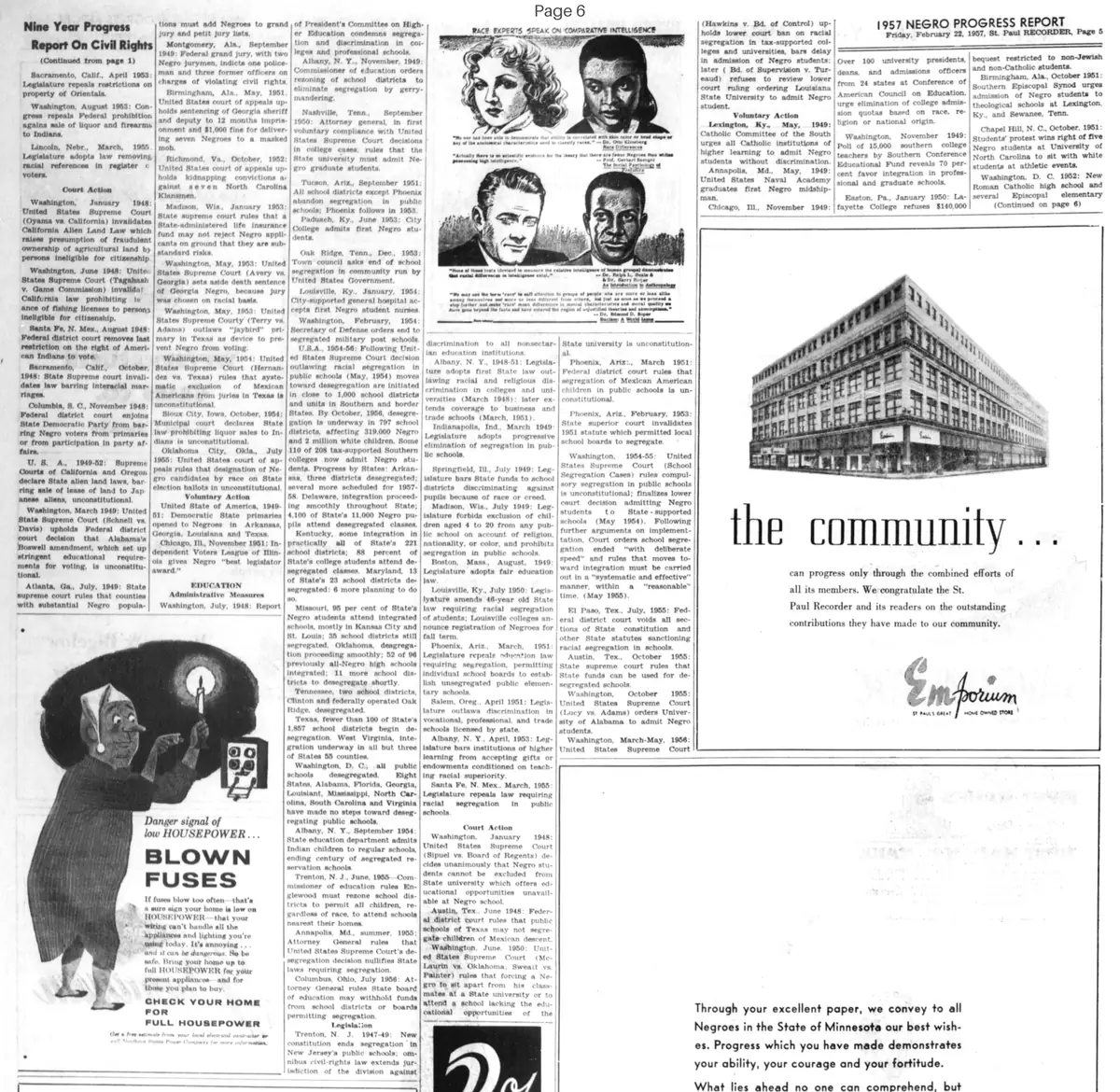
Nine-year U.S. civil rights progress report (1948-1956) highlights legislative repeals of discriminatory laws, key Supreme Court rulings against segregation in voting, education, and property, and voluntary desegregation in over 700 school districts affecting hundreds of thousands of students.
Clipping
OCR Quality
Full Text
On Civil Rights
(Continued from page 1)
Sacramento, Calif., April 1953: Legislature repeals restrictions on property of Orientals.
Washington, August 1953: Congress repeals Federal prohibition against sale of liquor and firearms to Indians.
Lincoln, Nebr., March, 1955: Legislature adopts law removing racial references in register voters.
Court Action
Washington, January 1948: United States Supreme Court (Oyama vs. California) invalidates California Alien Land Law which raises presumption of fraudulent ownership of agricultural land by persons ineligible for citizenship.
Washington, June 1948: United States Supreme Court (Takahashi v. Fish Commission) invalidates California law prohibiting issuance of fishing licenses to persons ineligible for citizenship.
Santa Fe, N. Mex., August 1949: Federal district court removes last restriction on the right of American Indians to vote.
Sacramento, Calif., October, 1948: State Supreme court invalidates law barring interracial marriages.
Columbia, S. C., November 1948: Federal district court enjoins State Democratic Party from barring Negro voters from primaries or from participation in party affairs.
U. S. A., 1949-52: Supreme Courts of California and Oregon declare State alien land laws, barring sale or lease of land to Japanese aliens, unconstitutional.
Washington, March 1949: United State Supreme Court (Schnell vs. Davis) upholds Federal district court decision that Alabama's Boswell amendment, which set up stringent educational requirements for voting, is unconstitutional.
Atlanta, Ga., July, 1949: State supreme court rules that counties with substantial Negro populations must add Negroes to grand jury and petit jury lists.
Montgomery, Ala., September 1949: Federal grand jury, with two Negro jurymen, indicts one policeman and three former officers on charges of violating civil rights.
Birmingham, Ala., May, 1951: United States court of appeals upholds sentencing of Georgia sheriff and deputy to 12 months imprisonment and $1,000 fine for delivering seven Negroes to a masked mob.
Richmond, Va., October, 1952: United States court of appeals upholds kidnapping convictions against seven North Carolina Klansmen.
Madison, Wis., January 1953: State supreme court rules that a State-administered life insurance fund may not reject Negro applicants on ground that they are sub standard risks.
Washington, May, 1953: United States Supreme Court (Avery vs. Georgia) sets aside death sentence of Georgia Negro, because jury was chosen on racial basis.
Washington, May, 1953: United States Supreme Court (Terry vs. Adams) outlaws "jaybird" primary in Texas as device to prevent Negro from voting.
Washington, May, 1954: United States Supreme Court (Hernandez vs. Texas) rules that systematic exclusion of Mexican Americans from juries in Texas is unconstitutional.
Sioux City, Iowa, October, 1954: Municipal court declares State law prohibiting liquor sales to Indians is unconstitutional.
Oklahoma City, Okla., July 1955: United States court of appeals rules that designation of Negro candidates by race on State election ballots is unconstitutional.
Voluntary Action
United State of America, 1949-51: Democratic State primaries opened to Negroes in Arkansas, Georgia, Louisiana and Texas.
Chicago, Ill., November 1951: Independent Voters League of Illinois gives Negro "best legislator award.".
EDUCATION
Administrative Measures
Washington, July, 1948: Report of President's Committee on Higher Education condemns segregation and discrimination in colleges and professional schools.
Albany, N. Y., November, 1948: Commissioner of education orders rezoning of school districts to eliminate segregation by gerrymandering.
Nashville, Tenn., September 1950: Attorney general, in first voluntary compliance with United States Supreme Court decisions in college cases, rules that the State university must admit Negro graduate students.
Tucson, Ariz., September 1951: All school districts except Phoenix abandon segregation in public schools; Phoenix follows in 1953.
Paducah, Ky., June 1953: City College admits first Negro students.
Oak Ridge, Tenn., Dec., 1953: Town council asks end of school segregation in community run by United States Government.
Louisville, Ky., January, 1954: City-supported general hospital accepts first Negro student nurses.
Washington, February, 1954: Secretary of Defense orders end to segregated military post schools.
U.S.A., 1954-56: Following United States Supreme Court decision outlawing racial segregation in public schools (May, 1954) moves toward desegregation are initiated in close to 1,000 school districts and units in Southern and border States. By October, 1956, desegregation is underway in 797 school districts, affecting 319,000 Negro and 2 million white children. Some 110 of 208 tax-supported Southern colleges now admit Negro students. Progress by States: Arkansas, three districts desegregated: several more scheduled for 1957-58. Delaware, integration proceeding smoothly throughout State: 4,100 of State's 11,000 Negro pupils attend desegregated classes.
Kentucky, some integration in practically all of State's 221 school districts; 88 percent of State's college students attend desegregated classes. Maryland, 13 of State's 23 school districts desegregated: 6 more planning to do so.
Missouri, 95 per cent of State's Negro students attend integrated schools, mostly in Kansas City and St. Louis: 35 school districts still segregated. Oklahoma, desegregation proceeding smoothly; 52 of 96 previously all-Negro high schools integrated; 11 more school districts to desegregate shortly.
Tennessee, two school districts, Clinton and federally operated Oak Ridge, desegregated.
Texas, fewer than 100 of State's 1,857 school districts begin desegregation. West Virginia, integration underway in all but three of States 55 counties.
Washington, D. C., all public schools desegregated.
Eight States, Alabama, Florida, Georgia, Louisiana, Mississippi, North Carolina, South Carolina and Virginia have made no steps toward desegregating public schools.
Albany, N. Y., September 1954: State education department admits Indian children to regular schools, ending century of segregated reservation schools.
Trenton, N. J., June, 1955: Commissioner of education rules Englewood must rezone school districts to permit all children, regardless of race, to attend schools nearest their homes.
Annapolis, Md., summer, 1955: Attorney General rules that United States Supreme Court's desegregation decision nullifies State laws requiring segregation.
Columbus, Ohio, July 1956: Attorney General rules State board of education may withhold funds from school districts or boards permitting segregation.
Legislation
Trenton, N. J., 1947-49: New constitution ends segregation in New Jersey's public schools; omnibus civil-rights law extends jurisdiction of the division against discrimination to all nonsectarian education institutions.
Albany, N. Y., 1948-51: Legislature adopts first State law outlawing racial and religious discrimination in colleges and universities (March 1948): later extends coverage to business and trade schools (March, 1951).
Indianapolis, Ind., March 1949: Legislature adopts progressive elimination of segregation in public schools.
Springfield, Ill., July 1949: Legislature bars State funds to school districts discriminating against pupils because of race or creed.
Madison, Wis., July 1949: Legislature forbids exclusion of children aged 4 to 20 from any public school on account of religion, nationality, or color, and prohibits segregation in public schools.
Boston, Mass., August, 1949: Legislature adopts fair education law.
Louisville, Ky., July 1950: Legislature amends 46-year old State law requiring racial segregation of students: Louisville colleges announce registration of Negroes for fall term.
Phoenix, Ariz., March, 1951: Legislature repeals education law requiring segregation, permitting individual school boards to establish unsegregated public elementary schools.
Salem, Oreg., April 1951: Legislature outlaws discrimination in vocational, professional, and trade schools licensed by state.
Albany, N. Y., April, 1953: Legislature bars institutions of higher learning from accepting gifts or endowments conditioned on teaching racial superiority.
Santa Fe, N. Mex., March, 1955: Legislature repeals law requiring racial segregation in public schools.
Court Action
Washington, January 1948: United States Supreme Court (Sipuel vs. Board of Regents) decides unanimously that Negro students cannot be excluded from State university which offers educational opportunities unavailable at Negro school.
Austin, Tex., June 1948: Federal district court rules that public schools of Texas may not segregate children of Mexican descent.
Washington, June, 1950: United States Supreme Court (McLaurin vs. Oklahoma; Sweatt vs. Painter) rules that forcing a Negro to sit apart from his classmates at a State university or to attend a school lacking the educational opportunities of the State university is unconstitutional.
Phoenix, Ariz., March 1951: Federal district court rules that segregation of Mexican American children in public schools is unconstitutional.
Phoenix, Ariz., February, 1953: State superior court invalidates 1951 statute which permitted local school boards to segregate.
Washington, 1954-55: United States Supreme Court (School Segregation Cases) rules compulsory segregation in public schools is unconstitutional: finalizes lower court decision admitting Negro students to State-supported schools (May 1954). Following further arguments on implementation, Court orders school segregation ended "with deliberate speed" and rules that moves toward integration must be carried out in a "systematic and effective" manner, within a "reasonable" time. (May 1955).
El Paso, Tex., July, 1955: Federal district court voids all sections of State constitution and other State statutes sanctioning racial segregation in schools.
Austin, Tex., October 1955: State supreme court rules that State funds can be used for desegregated schools.
Washington, October 1955: United States Supreme Court (Lucy vs. Adams) orders University of Alabama to admit Negro students.
Washington, March-May, 1956: United States Supreme Court (Hawkins v. Bd. of Control) upholds lower court ban on racial segregation in tax-supported colleges and universities, bars delay in admission of Negro students; later (Bd. of Supervision v. Tureaud) refuses to review lower court ruling ordering Louisiana State University to admit Negro student.
Voluntary Action
Lexington, Ky., May, 1949: Catholic Committee of the South urges all Catholic institutions of higher learning to admit Negro students without discrimination.
Annapolis, Md., May, 1949: United States Naval Academy graduates first Negro midshipman.
Over 100 university presidents, deans, and admissions officers from 24 states at Conference of American Council on Education urge elimination of college admission quotas based on race, religion or national origin.
Washington, November 1949: Poll of 15,000 southern college teachers by Southern Conference Educational Fund reveals 70 per cent favor integration in professional and graduate schools.
Easton, Pa., January 1950: Lafayette College refuses $140,000 bequest restricted to non-Jewish and non-Catholic students.
Birmingham, Ala., October 1951: Southern Episcopal Synod urges admission of Negro students to theological schools at Lexington, Ky., and Sewanee, Tenn.
Chapel Hill, N. C., October, 1951: Students' protest wins right of five Negro students at University of North Carolina to sit with white students at athletic events.
Washington, D. C., 1952: New Roman Catholic high school and several Episcopal elementary
(Continued on page 6)
1957 NEGRO PROGRESS REPORT
Friday, February 22, 1957, St. Paul RECORDER, Page 5
What sub-type of article is it?
What themes does it cover?
What keywords are associated?
Where did it happen?
Story Details
Location
United States
Event Date
1948 1957
Story Details
Nine-year progress report detailing legislative repeals of discriminatory laws, Supreme Court decisions invalidating racial restrictions on property, voting, marriage, and education, and voluntary actions toward desegregation in schools and primaries, focusing on advancements for African Americans, Orientals, Indians, and Mexican Americans.