Thank you for visiting SNEWPapers!
Sign up free
Kentucky Gazette
Lexington, Fayette County, Kentucky
What is this article about?
US President James Madison ratifies the July 3, 1815, commercial convention with Britain, signed in London by Adams, Clay, Gallatin, and British plenipotentiaries, regulating reciprocal trade between US and British European territories, with limited East Indies access. Includes declaration excluding St. Helena due to Napoleon's residence.
Clipping
OCR Quality
Full Text
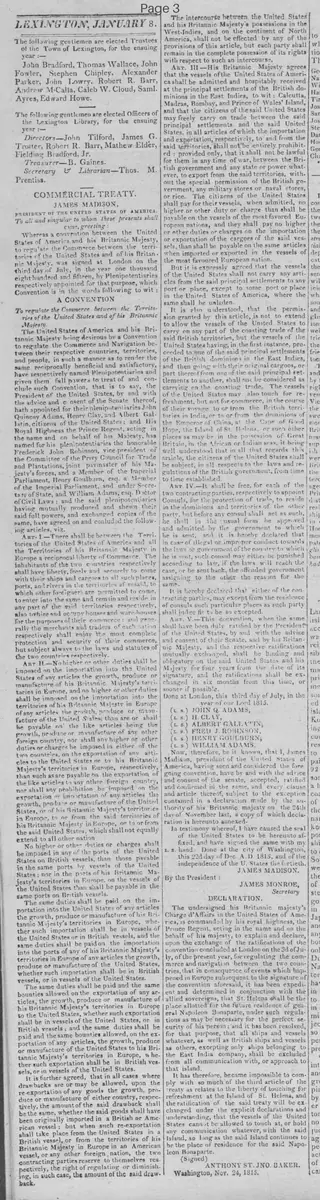
JAMES MADISON, PRESIDENT OF THE UNITED STATES OF AMERICA.
To all and singular to whom these presents shall come, greeting:
Whereas a convention between the United States of America and his Britannic Majesty, to regulate the Commerce between the territories of the United States and of his Britannic Majesty, was signed at London on the third day of July, in the year one thousand eight hundred and fifteen, by Plenipotentiaries respectively appointed for that purpose, which Convention is in the words following to wit:
A CONVENTION
To regulate the Commerce between the Territories of the United States and of his Britannic Majesty
The United States of America and his Britannic Majesty being desirous by a Convention to regulate the Commerce and Navigation between their respective countries, territories and people, in such a manner as to render the same reciprocally beneficial and satisfactory, have respectively named Plenipotentiaries and given them full powers to treat of and conclude such Convention, that is to say, the President of the United States, by and with the advice and consent of the Senate thereof, hath appointed for their plenipotentiaries John Quincy Adams, Henry Clay, and Albert Gallatin, citizens of the United States; and his Royal Highness the Prince Regent, acting in the name and on behalf of his Majesty, has named for his plenipotentiaries the honourable Frederick John Robinson, vice-president of the Committee of the Privy Council for Trade and Plantations, joint paymaster of his Majesty's forces, and a Member of the Imperial Parliament, Henry Goulburn, esq. a Member of the Imperial Parliament, and under Secretary of State, and William Adams, esq. Doctor of Civil Laws: and the said plenipotentiaries having mutually produced and shewn their said full powers, and exchanged copies of the same, have agreed on and concluded the following articles, viz.
Arr. 1. There shall be between the Territories of the United States of America and all the Territories of his Britannic Majesty in Europe a reciprocal liberty of Commerce. The inhabitants of the two countries respectively shall have liberty, freely and securely to come with their ships and cargoes to all such places, ports, and rivers in the territories aforesaid, to which other foreigners are permitted to come, to enter into the same and remain and reside in any part of the said territories respectively, also to hire and occupy houses and ware-houses for the purposes of their commerce: and generally the merchants and traders of each nation respectively shall enjoy the most complete protection and security of their commerce, but subject always to the laws and statutes of the two countries respectively.
Art. II. No higher or other duties shall be imposed on the importation into the United States of any articles the growth, produce or manufacture of his Britannic Majesty's territories in Europe, and no higher or other duties shall be imposed on the importation into the territories of his Britannic Majesty in Europe of any articles the growth, produce or manufacture of the United States than are or shall be payable on the like articles being the growth, produce or manufacture of any other foreign country, nor shall any higher or other duties or charges be imposed in either of the two countries, on the exportation of any articles to the United States or to his Britannic Majesty's territories in Europe, respectively, than such as are payable on the exportation of the like articles to any other foreign country, nor shall any prohibition be imposed on the exportation or importation of any articles the growth, produce or manufacture of the United States, or of his Britannic Majesty's territories in Europe, to or from the said territories of his Britannic Majesty in Europe, or to or from the said United States, which shall not equally extend to all other nations. No higher or other duties or charges shall be imposed in any of the ports of the United States on British vessels, than those payable in the same ports by vessels of the United States: nor in the ports of his Britannic Majesty's territories in Europe, on the vessels of the United States than shall be payable in the same ports on British vessels. The same duties shall be paid on the importation into the United States of any articles the growth, produce or manufacture of his Britannic Majesty's territories in Europe, whether such importation shall be in vessels of the United States or in British vessels, and the same duties shall be paid on the importation into the ports of any of his Britannic Majesty's territories in Europe of any articles the growth, produce or manufacture of the United States, whether such importation shall be in British vessels, or in vessels of the United States. The same duties shall be paid and the same bounties allowed on the exportation of any articles, the growth, produce or manufacture of his Britannic Majesty's territories in Europe to the United States, whether such exportation shall be in vessels of the United States, or in British vessels; and the same duties shall be paid and the same bounties allowed, on the exportation of any articles, the growth, produce or manufacture of the United States to his Britannic Majesty's territories in Europe, whether such exportation shall be in British vessels, or in vessels of the United States. It is further agreed, that in all cases where drawbacks are or may be allowed, upon the re-exportation of any goods the growth, produce or manufacture of either country, respectively, the amount of the said drawback shall be the same, whether the said goods shall have been originally imported in a British or American vessel; but when such re-exportation shall take place from the United States in a British vessel, or from the territories of his Britannic Majesty in Europe in an American vessel, or any other foreign nation, the two contracting parties reserve to themselves respectively, the right of regulating or diminishing, in such case, the amount of the said drawback.
The intercourse between the United States and his Britannic Majesty's possessions in the West-Indies, and on the continent of North America, shall not be affected by any of the provisions of this article, but each party shall remain in the complete possession of its rights with respect to such an intercourse.
Art. III. His Britannic Majesty agrees that the vessels of the United States of America shall be admitted and hospitably received at the principal settlements of the British dominions in the East Indies, to wit: Calcutta, Madras, Bombay, and Prince of Wales' Island, and that the citizens of the said United States may freely carry on trade between the said principal settlements and the said United States, in all articles of which the importation and exportation, respectively, to and from the said territories, shall not be entirely prohibited: provided only, that it shall not be lawful for them in any time of war, between the British government and any state or power whatever, to export from the said territories, without the special permission of the British government, any military stores or naval stores, or rice. The citizens of the United States shall pay for their vessels, when admitted, no higher or other duty or charge than shall be payable on the vessels of the most favored European nations, and they shall pay no higher or other duties or charges on the importation or exportation of the cargoes of the said vessels, than shall be payable on the same articles when imported or exported in the vessels of the most favoured European nation. But it is expressly agreed that the vessels of the United States shall not carry any articles from the said principal settlements to any port or place, except to some port or place in the United States of America, where the same shall be unladen. It is also understood, that the permission granted by this article, is not to extend to allow the vessels of the United States to carry on any part of the coasting trade of the said British territories, but the vessels of the United States having, in the first instance, proceeded to one of the said principal settlements of the British dominions in the East Indies, and then going with their original cargoes, or part thereof from one of the said principal settlements to another, shall not be considered as carrying on the coasting trade. The vessels of the United States may also touch for refreshment, but not for commerce, in the course of their voyage to or from the British territories in India, or to or from the dominions of the Emperor of China, at the Cape of Good Hope, the Island of St. Helena, or such other places as may be in the possession of Great Britain, in the African or Indian seas, it being well understood that in all that regards this article, the citizens of the United States shall be subject, in all respects to the laws and regulations of the British government, from time to time established.
Art. IV. It shall be free, for each of the two contracting parties, respectively to appoint Consuls, for the protection of trade, to reside in the dominions and territories of the other party, but before any consul shall act as such, he shall in the usual form be approved and admitted by the government to which he is sent, and it is hereby declared that in case of illegal or improper conduct towards the laws or government of the country to which he is sent, such consul may either be punished according to law, if the laws will reach the case, or be sent back, the offended government assigning to the other the reasons for the same. It is hereby declared that either of the contracting parties, may except from the residence of consuls such particular places as such party shall judge fit to be so excepted.
Art. V. This convention, when the same shall have been duly ratified by the President of the United States, by and with the advice and consent of their Senate, and by his Britannic Majesty, and the respective ratifications mutually exchanged, shall be binding and obligatory on the said United States and his Majesty for four years from the date of its signature, and the ratifications shall be exchanged in six months from this time, or sooner if possible.
Done at London, this third day of July, in the year of our Lord 1815.
(L. S.) JOHN Q. ADAMS,
(L. S.) H. CLAY,
(L. S.) ALBERT GALLATIN.
(L. S.) FRED. J. ROBINSON,
(L. S.) HENRY GOULBURN,
(L. S.) WILLIAM ADAMS.
Now, therefore, be it known, that I, James Madison, president of the United States of America, having seen and considered the foregoing convention, have by and with the advice and consent of the senate, accepted, ratified and confirmed the same, and every clause and article thereof, subject to the exception contained in a declaration made by the authority of his Britannic majesty on the 24th day of November last, a copy of which declaration is hereunto annexed.
In testimony whereof, I have caused the seal of the United States to be hereunto affixed, and have signed the same with my hand. Done at the city of Washington, this 22d day of Dec. A. D. 1815. and of the independence of the U. States the fortieth.
JAMES MADISON.
By the President:
JAMES MONROE,
Secretary of State.
DECLARATION.
The undersigned, his Britannic majesty's Charge d'Affairs in the United States of America, is commanded by his royal highness, the Prince Regent, acting in the name and on the behalf of his majesty, to explain and declare, upon the exchange of the ratifications of the convention concluded at London on the 3d of July, of the present year, for regulating the commerce and navigation between the two countries, that in consequence of events which happened in Europe subsequent to the signature of the convention aforesaid, it has been expedient and determined in conjunction with the allied sovereigns, that St. Helena shall be the place allotted for the future residence of general Napoleon Bonaparte, under such regulations as may be necessary for the perfect security of his person; and it has been resolved, for that purpose, that all ships and vessels whatever, as well as British ships and vessels as others, excepting only ships belonging to the East India company, shall be excluded from all communication with, or approach to that island. It has therefore, become impossible to comply with so much of the third article of the treaty as relates to the liberty of touching for refreshment at the Island of St. Helena, and the ratification of the said treaty will be exchanged under the explicit declaration and understanding, that the vessels of the United States cannot be allowed to touch at, or hold any communication whatever, with the said Island, so long as the said Island continues to be the place of residence for the said Napoleon Bonaparte.
(Signed) ANTHONY ST. JOHN BAKER.
Washington, Nov. 24, 1815.
What sub-type of article is it?
What keywords are associated?
What entities or persons were involved?
Where did it happen?
Foreign News Details
Primary Location
London
Event Date
Signed July 3, 1815; Ratified December 22, 1815
Key Persons
Outcome
ratification of commercial convention for four years, with exception excluding us vessels from st. helena due to napoleon bonaparte's residence there.
Event Details
Convention signed in London on July 3, 1815, by US plenipotentiaries John Quincy Adams, Henry Clay, Albert Gallatin and British plenipotentiaries Frederick John Robinson, Henry Goulburn, William Adams, establishing reciprocal commerce between US and British European territories, equal duties and charges, provisions for East Indies trade at specified ports, consular appointments, effective for four years upon ratification. Ratified by President James Madison on December 22, 1815, subject to British declaration of November 24, 1815, barring access to St. Helena.