Thank you for visiting SNEWPapers!
Sign up free
Story
August 14, 1941
Smyrna Times
Smyrna, Kent County, Delaware
What is this article about?
In Atlantic City, NJ, patrolman Lawrence H. Smith invents lightweight personal radio sets for police, allowing instant communication via headphones and belt-worn devices, leading to rapid crime recoveries and efficient escorts, deterring crooks nationwide attention.
Clipping
OCR Quality
95%
Excellent
Full Text
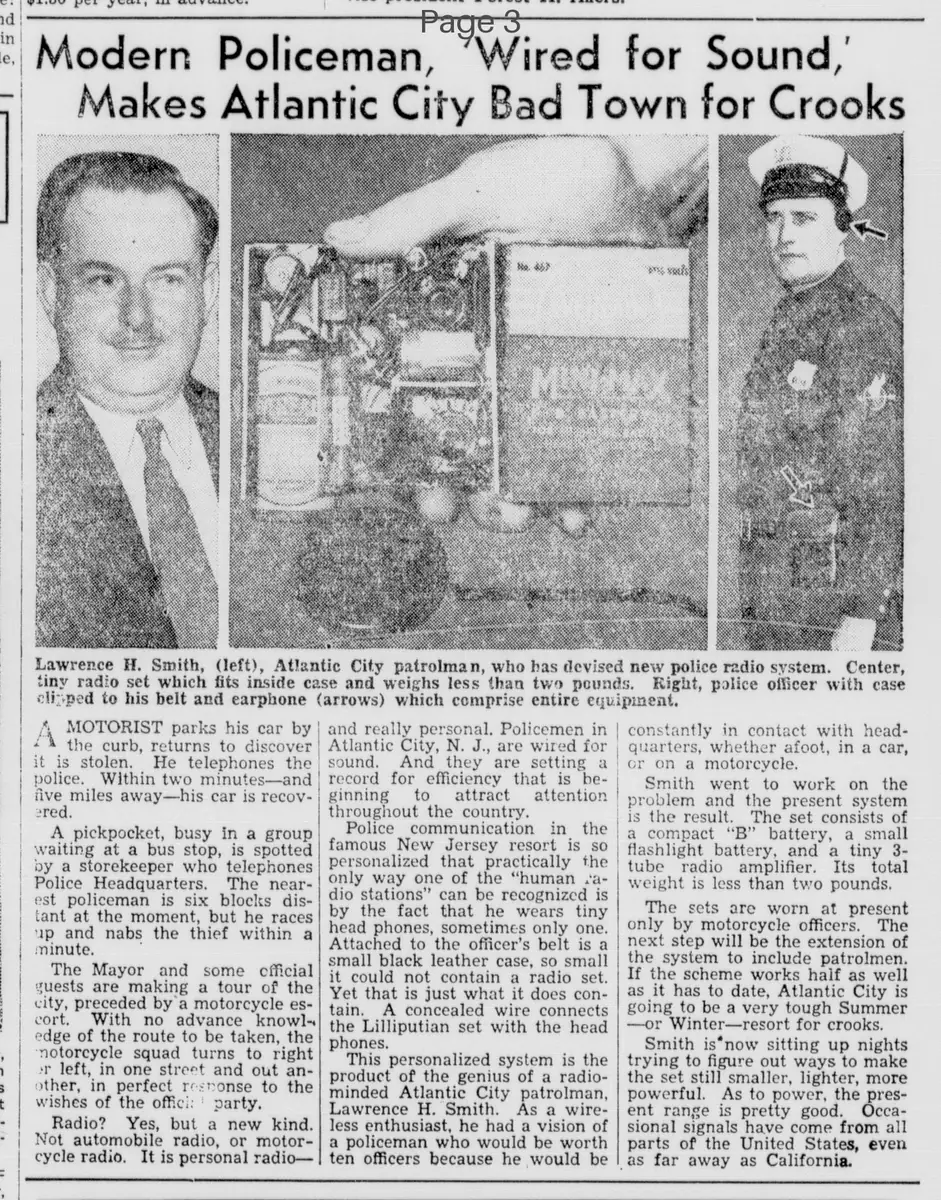
Modern Policeman, 'Wired for Sound,' Makes Atlantic City Bad Town for Crooks
MOTORIST parks his car by the curb, returns to discover it is stolen. He telephones the police. Within two minutes--and five miles away--his car is recovered.
A pickpocket, busy in a group waiting at a bus stop, is spotted by a storekeeper who telephones Police Headquarters. The nearest policeman is six blocks distant at the moment, but he races up and nabs the thief within a minute.
The Mayor and some official guests are making a tour of the city, preceded by a motorcycle escort. With no advance knowledge of the route to be taken, the motorcycle squad turns to right or left, in one street and out another, in perfect response to the wishes of the official party.
Radio? Yes, but a new kind. Not automobile radio, or motorcycle radio. It is personal radio--and really personal. Policemen in Atlantic City, N. J., are wired for sound. And they are setting a record for efficiency that is beginning to attract attention throughout the country.
Police communication in the famous New Jersey resort is so personalized that practically the only way one of the "human radio stations" can be recognized is by the fact that he wears tiny head phones, sometimes only one. Attached to the officer's belt is a small black leather case, so small it could not contain a radio set. Yet that is just what it does contain. A concealed wire connects the Lilliputian set with the head phones.
This personalized system is the product of the genius of a radio-minded Atlantic City patrolman, Lawrence H. Smith. As a wireless enthusiast, he had a vision of a policeman who would be worth ten officers because he would be constantly in contact with headquarters, whether afoot, in a car, or on a motorcycle.
Smith went to work on the problem and the present system is the result. The set consists of a compact "B" battery, a small flashlight battery, and a tiny 3-tube radio amplifier. Its total weight is less than two pounds.
The sets are worn at present only by motorcycle officers. The next step will be the extension of the system to include patrolmen. If the scheme works half as well as it has to date, Atlantic City is going to be a very tough Summer--or Winter--resort for crooks.
Smith is now sitting up nights trying to figure out ways to make the set still smaller, lighter, more powerful. As to power, the present range is pretty good. Occasional signals have come from all parts of the United States, even as far away as California.
MOTORIST parks his car by the curb, returns to discover it is stolen. He telephones the police. Within two minutes--and five miles away--his car is recovered.
A pickpocket, busy in a group waiting at a bus stop, is spotted by a storekeeper who telephones Police Headquarters. The nearest policeman is six blocks distant at the moment, but he races up and nabs the thief within a minute.
The Mayor and some official guests are making a tour of the city, preceded by a motorcycle escort. With no advance knowledge of the route to be taken, the motorcycle squad turns to right or left, in one street and out another, in perfect response to the wishes of the official party.
Radio? Yes, but a new kind. Not automobile radio, or motorcycle radio. It is personal radio--and really personal. Policemen in Atlantic City, N. J., are wired for sound. And they are setting a record for efficiency that is beginning to attract attention throughout the country.
Police communication in the famous New Jersey resort is so personalized that practically the only way one of the "human radio stations" can be recognized is by the fact that he wears tiny head phones, sometimes only one. Attached to the officer's belt is a small black leather case, so small it could not contain a radio set. Yet that is just what it does contain. A concealed wire connects the Lilliputian set with the head phones.
This personalized system is the product of the genius of a radio-minded Atlantic City patrolman, Lawrence H. Smith. As a wireless enthusiast, he had a vision of a policeman who would be worth ten officers because he would be constantly in contact with headquarters, whether afoot, in a car, or on a motorcycle.
Smith went to work on the problem and the present system is the result. The set consists of a compact "B" battery, a small flashlight battery, and a tiny 3-tube radio amplifier. Its total weight is less than two pounds.
The sets are worn at present only by motorcycle officers. The next step will be the extension of the system to include patrolmen. If the scheme works half as well as it has to date, Atlantic City is going to be a very tough Summer--or Winter--resort for crooks.
Smith is now sitting up nights trying to figure out ways to make the set still smaller, lighter, more powerful. As to power, the present range is pretty good. Occasional signals have come from all parts of the United States, even as far away as California.
What sub-type of article is it?
Curiosity
Personal Triumph
Historical Event
What themes does it cover?
Triumph
Justice
What keywords are associated?
Personal Radio
Police Innovation
Atlantic City
Lawrence Smith
Crime Fighting
Motorcycle Officers
What entities or persons were involved?
Lawrence H. Smith
Where did it happen?
Atlantic City, N. J.
Story Details
Key Persons
Lawrence H. Smith
Location
Atlantic City, N. J.
Story Details
Atlantic City police use personal radio sets invented by patrolman Lawrence H. Smith, enabling quick responses to crimes and efficient coordination, making the city tough for crooks.