Thank you for visiting SNEWPapers!
Sign up free
Editorial
July 19, 1810
Alexandria Daily Gazette, Commercial & Political
Alexandria, Virginia
What is this article about?
Editorial from Boston Repertory defends American merchants against blame in National Intelligencer for current commercial difficulties, attributing issues to Jefferson administration's refusal to renew favorable treaties with Britain and France, and excessive negotiation demands.
Clipping
OCR Quality
98%
Excellent
Full Text
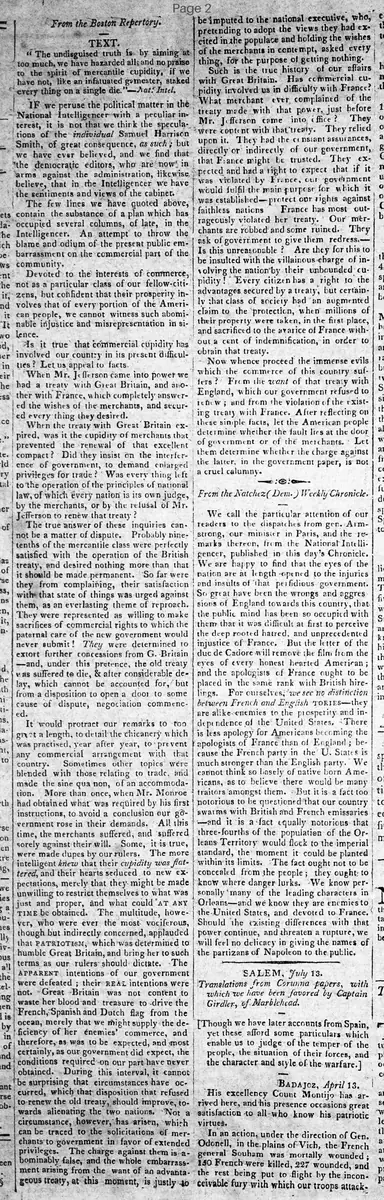
From the Boston Repertory
TEXT
"The undisguised truth is, by aiming at too much, we have hazarded all, and no praise to the spirit of mercantile cupidity, if we have not, like an infatuated gamester, staked every thing on a single die." Nat. Intel.
If we peruse the political matter in the National Intelligencer with a peculiar interest, it is not that we think the speculations of the individual Samuel Harrison Smith, of great consequence, as such; but we have ever believed, and we find that the democratic editors, who are now in arms against the administration, likewise believe, that in the Intelligencer we have the sentiments and views of the cabinet. The few lines we have quoted above, contain the substance of a plan which has occupied several columns, of late, in the Intelligencer. An attempt to throw the blame and odium of the present public embarrassment on the commercial part of the community.
Devoted to the interests of commerce, not as a particular class of our fellow-citizens, but confident that their prosperity involves that of every portion of the American people, we cannot witness such abominable injustice and misrepresentation in silence.
Is it true that commercial cupidity has involved our country in its present difficulties? Let us appeal to facts.
When Mr. Jefferson came into power we had a treaty with Great Britain, and another with France, which completely answered the wishes of the merchants, and secured every thing they desired.
When the treaty with Great Britain expired, was it the cupidity of merchants that prevented the renewal of that excellent compact? Did they insist on the interference of government, to demand enlarged privileges for trade? Was every thing left to the operation of the principles of national law, of which every nation is its own judge, by the merchants, or by the refusal of Mr. Jefferson to renew that treaty?
The true answer of these inquiries cannot be a matter of dispute. Probably nine-tenths of the mercantile class were perfectly satisfied with the operation of the British treaty, and desired nothing more than that it should be made permanent. So far were they from complaining, their satisfaction with that state of things was urged against them, as an everlasting theme of reproach. They were represented as willing to make sacrifices of commercial rights to which the paternal care of the new government would never submit! They were determined to extort further concessions from G. Britain--and, under this pretence, the old treaty was suffered to die, & after considerable delay, which cannot be accounted for, but from a disposition to open a door to some cause of dispute, negociation commenced.
It would protract our remarks to too great a length, to detail the chicanery which was practised, year after year, to prevent any commercial arrangement with that country. Sometimes other topics were blended with those relating to trade, and made the sine qua non, of an accommodation. More than once, when Mr. Monroe had obtained what was required by his first instructions, to avoid a conclusion our government rose in their demands. All this time, the merchants suffered, and suffered sorely against their will. - Some, it is true, were made dupes by our rulers. The more intelligent knew that their cupidity was flattered, and their hearts seduced to new expectations, merely that they might be made unwilling to restrict themselves to what was just and proper, and what could at ANY TIME be obtained. The multitude, however, who were ever the most vociferous, though but indirectly concerned, applauded that PATRIOTISM, which was determined to humble Great Britain, and bring her to such terms as our rulers should dictate. The APPARENT intentions of our government were defeated; their REAL intentions were not. Great Britain was not content to waste her blood and treasure to drive the French, Spanish and Dutch flag from the ocean, merely that we might supply the deficiency of her enemies' commerce, and therefore, as was to be expected, and most certainly, as our government did expect, the conditions required on our part have never obtained. -During this interval, it cannot be surprising that circumstances have occurred, which that disposition that refused to renew the old treaty, should improve, towards alienating the two nations. Not a circumstance, however, has arisen, which can be traced to the solicitations of merchants to government in favor of extended privileges. The charge against them is abominably false, and the whole embarrassment arising from the want of an advantageous treaty, at this moment, is justly to
TEXT
"The undisguised truth is, by aiming at too much, we have hazarded all, and no praise to the spirit of mercantile cupidity, if we have not, like an infatuated gamester, staked every thing on a single die." Nat. Intel.
If we peruse the political matter in the National Intelligencer with a peculiar interest, it is not that we think the speculations of the individual Samuel Harrison Smith, of great consequence, as such; but we have ever believed, and we find that the democratic editors, who are now in arms against the administration, likewise believe, that in the Intelligencer we have the sentiments and views of the cabinet. The few lines we have quoted above, contain the substance of a plan which has occupied several columns, of late, in the Intelligencer. An attempt to throw the blame and odium of the present public embarrassment on the commercial part of the community.
Devoted to the interests of commerce, not as a particular class of our fellow-citizens, but confident that their prosperity involves that of every portion of the American people, we cannot witness such abominable injustice and misrepresentation in silence.
Is it true that commercial cupidity has involved our country in its present difficulties? Let us appeal to facts.
When Mr. Jefferson came into power we had a treaty with Great Britain, and another with France, which completely answered the wishes of the merchants, and secured every thing they desired.
When the treaty with Great Britain expired, was it the cupidity of merchants that prevented the renewal of that excellent compact? Did they insist on the interference of government, to demand enlarged privileges for trade? Was every thing left to the operation of the principles of national law, of which every nation is its own judge, by the merchants, or by the refusal of Mr. Jefferson to renew that treaty?
The true answer of these inquiries cannot be a matter of dispute. Probably nine-tenths of the mercantile class were perfectly satisfied with the operation of the British treaty, and desired nothing more than that it should be made permanent. So far were they from complaining, their satisfaction with that state of things was urged against them, as an everlasting theme of reproach. They were represented as willing to make sacrifices of commercial rights to which the paternal care of the new government would never submit! They were determined to extort further concessions from G. Britain--and, under this pretence, the old treaty was suffered to die, & after considerable delay, which cannot be accounted for, but from a disposition to open a door to some cause of dispute, negociation commenced.
It would protract our remarks to too great a length, to detail the chicanery which was practised, year after year, to prevent any commercial arrangement with that country. Sometimes other topics were blended with those relating to trade, and made the sine qua non, of an accommodation. More than once, when Mr. Monroe had obtained what was required by his first instructions, to avoid a conclusion our government rose in their demands. All this time, the merchants suffered, and suffered sorely against their will. - Some, it is true, were made dupes by our rulers. The more intelligent knew that their cupidity was flattered, and their hearts seduced to new expectations, merely that they might be made unwilling to restrict themselves to what was just and proper, and what could at ANY TIME be obtained. The multitude, however, who were ever the most vociferous, though but indirectly concerned, applauded that PATRIOTISM, which was determined to humble Great Britain, and bring her to such terms as our rulers should dictate. The APPARENT intentions of our government were defeated; their REAL intentions were not. Great Britain was not content to waste her blood and treasure to drive the French, Spanish and Dutch flag from the ocean, merely that we might supply the deficiency of her enemies' commerce, and therefore, as was to be expected, and most certainly, as our government did expect, the conditions required on our part have never obtained. -During this interval, it cannot be surprising that circumstances have occurred, which that disposition that refused to renew the old treaty, should improve, towards alienating the two nations. Not a circumstance, however, has arisen, which can be traced to the solicitations of merchants to government in favor of extended privileges. The charge against them is abominably false, and the whole embarrassment arising from the want of an advantageous treaty, at this moment, is justly to
What sub-type of article is it?
Trade Or Commerce
Foreign Affairs
Partisan Politics
What keywords are associated?
Merchants
Commercial Treaties
Jefferson Administration
Great Britain
National Intelligencer
Trade Negotiations
Mercantile Cupidity
What entities or persons were involved?
Samuel Harrison Smith
National Intelligencer
Mr. Jefferson
Mr. Monroe
Great Britain
France
Merchants
Democratic Editors
Cabinet
Editorial Details
Primary Topic
Defense Of Merchants Against Blame For Commercial Difficulties
Stance / Tone
Pro Merchant Criticism Of Jefferson Administration
Key Figures
Samuel Harrison Smith
National Intelligencer
Mr. Jefferson
Mr. Monroe
Great Britain
France
Merchants
Democratic Editors
Cabinet
Key Arguments
Commercial Cupidity Did Not Cause Current Difficulties; Government Policies Did.
Merchants Were Satisfied With Existing Treaties With Britain And France.
Jefferson Refused To Renew The British Treaty Despite Merchant Satisfaction.
Government Used Pretenses And Excessive Demands To Prevent Commercial Arrangements.
Merchants Suffered Due To Government's Chicanery And Failure To Negotiate.
No Merchant Solicitations Pushed For Extended Privileges; Charge Is False.