Thank you for visiting SNEWPapers!
Sign up free
Story
April 25, 1816
Daily National Intelligencer
Washington, District Of Columbia
What is this article about?
Mr. Huger concludes his speech opposing a bill to change congressional compensation from per diem to salary, arguing it would shorten sessions, rush legislation, increase executive influence, and prioritize personal gain over public duty amid post-war financial burdens.
Clipping
OCR Quality
98%
Excellent
Full Text
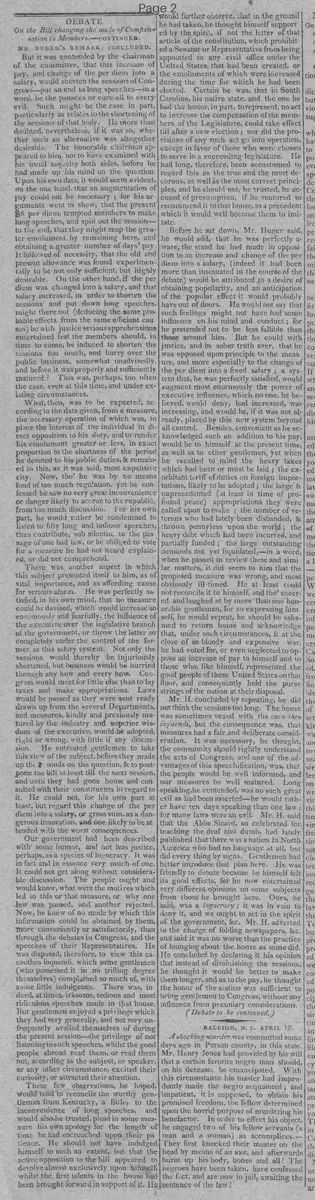
DEBATE
On the Bill changing the mode of Compensation to Members.--continued.
MR. HUGER'S REMARK CONCLUDED.
But it was contended by the chairman of the committee, that this increase of pay, and change of the per diem into a salary, would shorten the sessions of Congress—put an end to long speeches—in a word, be the panacea or cure-all to every evil. Such might be the case in part particularly as relates to the shortening of the sessions of that body. He more than doubted, nevertheless, if it was so, whether such an alternative was altogether desirable. The honorable chairman appeared to him, not to have examined with his usual sagacity both sides, before he had made up his mind on the question.
Upon his own data, it would seem evident, on the one hand, that an augmentation of pay could not be necessary; for his arguments went to shew, that the present 6 per diem, tempted members to make long speeches, and spin out the session—to the end, that they might reap the greater emolument by remaining here, and obtaining a greater number of days' pay.
It followed of necessity, that the old and present allowance was found experimentally to be not only sufficient, but highly desirable. On the other hand, if the per diem was changed into a salary, and that salary increased, in order to shorten the sessions and put down long speeches, might there not (deducing the same probable effects from the same efficient causes) be with justice serious apprehensions entertained lest the members should, in time to come, be induced to shorten the sessions too much, and hurry over the public business, somewhat unadvisedly, and before it was properly and sufficiently matured? This was, perhaps, too often the case, even at this time, and under existing circumstances.
What, then, was to be expected, according to the data given, from a measure, the necessary operation of which was, to place the interest of the individual in direct opposition to his duty, and to render his emolument greater or less, in exact proportion to the shortness of the period he devoted to his public duties, & remained in this, as it was said, most expensive city. Now, tho' he was by no means fond of too much regulation, yet he confessed he saw no very great inconvenience or danger likely to accrue to the republic, from too much discussion. For his own part, he would rather be condemned to listen to fifty long and tedious speeches, than contribute, sub silentio, to the passage of one bad law, or be obliged to vote for a measure he had not heard explained, or did not comprehend.
There was another aspect in which this subject presented itself to him, as of vital importance, and as affording cause for serious alarm. He was perfectly satisfied, in his own mind, that no measure could be devised, which would increase so enormously and fearfully, the influence of the executive over the legislative branch of the government, or throw the latter so completely under the control of the former, as this salary system. Not only the sessions would thereby be injuriously shortened, but business would be hurried through any how and every how. Congress would meet for little else than to lay taxes and make appropriations. Laws would be passed as they were sent ready drawn up from the several Departments, and measures, kindly and previously matured by the industry and superior wisdom of the executive, would be adopted, right or wrong, with little if any discussion. He entreated gentlemen to take this view of the subject, before they made up their minds on the question, & to postpone the bill at least till the next session, and until they had gone home and consulted with their constituents in regard to it. He could not, for his own part at least, but regard this change of the per diem into a salary, or gross sum, as a dangerous innovation, and one likely to be attended with the worst consequences.
Our government had been described with some humor, and not less justice, perhaps, as a species of logocracy. It was in fact and in essence very much of one. It could not get along without considerable discussion. The people ought and would know, what were the motives which led to this or that measure, or why one law was passed, and another rejected.
Now, he knew of no mode by which this information could be obtained by them, more conveniently or satisfactorily, than through the debates in Congress, and the speeches of their Representatives. He was disposed, therefore, to view this cacoethes loquendi, which some gentlemen (who possessed it in no trifling degree themselves) complained so much of, with some little indulgence. There was, indeed, at times, irksome, tedious and most ridiculous speeches made in that house. But gentlemen enjoyed a privilege which they had very generally, and not very unfrequently availed themselves of during the present session—the privilege of not listening to such speeches, whilst the good people abroad read them, or read them not, according as the subject, or speaker, or any other circumstance, excited their curiosity, or attracted their attention.
These few observations, he hoped would tend to reconcile the worthy gentleman from Kentucky, a little, to the inconvenience of long speeches, and would also, he trusted, plead in some measure his own apology for the length of time he had encroached upon their patience. He should not have indulged himself to such an extent, but that the active opposition to the bill appeared to devolve almost exclusively upon himself whilst the first talents in the house had been brought forward in support of it.
He would further observe, that in the ground he had taken, he thought himself supported by the spirit, if not the letter of that article of the constitution, which prohibited a Senator or Representative from being appointed to any civil office under the United States, that had been created, or the emoluments of which were increased during the time for which he had been elected. Certain he was, that in South Carolina, his native state, and the one he had the honor, in part, to represent, no act to increase the compensation of the members of the Legislature, could take effect till after a new election; nor did the provisions of any such act go into operation, except in favor of those who were chosen to serve in a succeeding legislature. He had long, therefore, been accustomed to regard this as the true and the most decorous, as well as the most correct principle, and he should not, he trusted, be accused of presumption, if he ventured to recommend it to that house, as a precedent which it would well become them to imitate.
Before he sat down, Mr. Huger said, he would add, that he was perfectly aware, the stand he had made in opposition to an increase and change of the per diem into a salary, (indeed it had been more than insinuated in the course of the debate) would be attributed to a desire of obtaining popularity, and an anticipation of the popular effect it would probably have out of doors. He would not say that such feelings might not have had some influence on his mind and conduct; for he pretended not to be less fallible than those around him. But he could with justice, and in sober truth aver, that he was opposed upon principle to the measure, and more especially to the change of the per diem into a fixed salary; a system that, he was perfectly satisfied, would augment most enormously the power of executive influence, which no one, he believed, would deny, had increased, was increasing, and would be, if it was not already, placed by this new system beyond all control. Besides, convenient as he acknowledged such an addition to his pay, would be to himself at the present time, as well as to other gentlemen, yet when he recalled to mind the heavy taxes which had been or must be laid; the exorbitant tariff of duties on foreign importations, likely to be adopted; the large & unprecedented (at least in time of profound peace) appropriations they were called upon to make; the number of veterans who had lately been disbanded, & thrown pennyless upon the world; the heavy debt which had been incurred, and partially funded; the large outstanding demands not yet liquidated,—in a word, when he passed in review these and similar matters, it did seem to him that the proposed measure was wrong, and most obviously ill-timed. He at least could not reconcile it to himself, and tho' sneered and laughed at by more than one honorable gentleman, for so expressing himself, he would repeat, he should be ashamed to return home and acknowledge that, under such circumstances, & at the close of so bloody and expensive war, he had voted for, or even neglected to oppose an increase of pay to himself and to those who, like himself, represented the good people of these United States on that floor, and consequently held the purse strings of the nation at their disposal.
Mr. H. concluded by repeating, he did not think the sessions too long. The house was sometimes vexed with the cacoethes loguendi, but the consequence was, that measures had a fair and deliberate consideration. It was necessary, he thought, the community should rightly understand the acts of Congress, and one of the advantages of this speechification, was, that the people would be well informed, and our measures be well matured. Long speaking, he contended, was no such great evil as had been asserted—he would rather have ten days speaking than one law; for many laws were an evil. Mr. H. said that the Abbe Sicard, so celebrated for teaching the deaf and dumb, had lately published that there was a nation in North America who had no language at all, but did every thing by signs. Gentlemen had better introduce that plan here. He was friendly to debate because he himself felt its good effects, for he now entertained very different opinions on some subjects from those he brought here. Ours, he said, was a logocracy; it was in vain to deny it, and we ought to act in the spirit of the government, &c. Mr. H. adverted to the charge of folding newspapers, &c. and said it was no worse than the practice of lounging about the house as some did. He concluded by declaring it his opinion that instead of diminishing the sessions, he thought it would be better to make them longer, and as to the pay, he thought the honor of the station was sufficient to bring gentlemen to Congress, without any influence from pecuniary considerations.
(Debate to be continued.)
On the Bill changing the mode of Compensation to Members.--continued.
MR. HUGER'S REMARK CONCLUDED.
But it was contended by the chairman of the committee, that this increase of pay, and change of the per diem into a salary, would shorten the sessions of Congress—put an end to long speeches—in a word, be the panacea or cure-all to every evil. Such might be the case in part particularly as relates to the shortening of the sessions of that body. He more than doubted, nevertheless, if it was so, whether such an alternative was altogether desirable. The honorable chairman appeared to him, not to have examined with his usual sagacity both sides, before he had made up his mind on the question.
Upon his own data, it would seem evident, on the one hand, that an augmentation of pay could not be necessary; for his arguments went to shew, that the present 6 per diem, tempted members to make long speeches, and spin out the session—to the end, that they might reap the greater emolument by remaining here, and obtaining a greater number of days' pay.
It followed of necessity, that the old and present allowance was found experimentally to be not only sufficient, but highly desirable. On the other hand, if the per diem was changed into a salary, and that salary increased, in order to shorten the sessions and put down long speeches, might there not (deducing the same probable effects from the same efficient causes) be with justice serious apprehensions entertained lest the members should, in time to come, be induced to shorten the sessions too much, and hurry over the public business, somewhat unadvisedly, and before it was properly and sufficiently matured? This was, perhaps, too often the case, even at this time, and under existing circumstances.
What, then, was to be expected, according to the data given, from a measure, the necessary operation of which was, to place the interest of the individual in direct opposition to his duty, and to render his emolument greater or less, in exact proportion to the shortness of the period he devoted to his public duties, & remained in this, as it was said, most expensive city. Now, tho' he was by no means fond of too much regulation, yet he confessed he saw no very great inconvenience or danger likely to accrue to the republic, from too much discussion. For his own part, he would rather be condemned to listen to fifty long and tedious speeches, than contribute, sub silentio, to the passage of one bad law, or be obliged to vote for a measure he had not heard explained, or did not comprehend.
There was another aspect in which this subject presented itself to him, as of vital importance, and as affording cause for serious alarm. He was perfectly satisfied, in his own mind, that no measure could be devised, which would increase so enormously and fearfully, the influence of the executive over the legislative branch of the government, or throw the latter so completely under the control of the former, as this salary system. Not only the sessions would thereby be injuriously shortened, but business would be hurried through any how and every how. Congress would meet for little else than to lay taxes and make appropriations. Laws would be passed as they were sent ready drawn up from the several Departments, and measures, kindly and previously matured by the industry and superior wisdom of the executive, would be adopted, right or wrong, with little if any discussion. He entreated gentlemen to take this view of the subject, before they made up their minds on the question, & to postpone the bill at least till the next session, and until they had gone home and consulted with their constituents in regard to it. He could not, for his own part at least, but regard this change of the per diem into a salary, or gross sum, as a dangerous innovation, and one likely to be attended with the worst consequences.
Our government had been described with some humor, and not less justice, perhaps, as a species of logocracy. It was in fact and in essence very much of one. It could not get along without considerable discussion. The people ought and would know, what were the motives which led to this or that measure, or why one law was passed, and another rejected.
Now, he knew of no mode by which this information could be obtained by them, more conveniently or satisfactorily, than through the debates in Congress, and the speeches of their Representatives. He was disposed, therefore, to view this cacoethes loquendi, which some gentlemen (who possessed it in no trifling degree themselves) complained so much of, with some little indulgence. There was, indeed, at times, irksome, tedious and most ridiculous speeches made in that house. But gentlemen enjoyed a privilege which they had very generally, and not very unfrequently availed themselves of during the present session—the privilege of not listening to such speeches, whilst the good people abroad read them, or read them not, according as the subject, or speaker, or any other circumstance, excited their curiosity, or attracted their attention.
These few observations, he hoped would tend to reconcile the worthy gentleman from Kentucky, a little, to the inconvenience of long speeches, and would also, he trusted, plead in some measure his own apology for the length of time he had encroached upon their patience. He should not have indulged himself to such an extent, but that the active opposition to the bill appeared to devolve almost exclusively upon himself whilst the first talents in the house had been brought forward in support of it.
He would further observe, that in the ground he had taken, he thought himself supported by the spirit, if not the letter of that article of the constitution, which prohibited a Senator or Representative from being appointed to any civil office under the United States, that had been created, or the emoluments of which were increased during the time for which he had been elected. Certain he was, that in South Carolina, his native state, and the one he had the honor, in part, to represent, no act to increase the compensation of the members of the Legislature, could take effect till after a new election; nor did the provisions of any such act go into operation, except in favor of those who were chosen to serve in a succeeding legislature. He had long, therefore, been accustomed to regard this as the true and the most decorous, as well as the most correct principle, and he should not, he trusted, be accused of presumption, if he ventured to recommend it to that house, as a precedent which it would well become them to imitate.
Before he sat down, Mr. Huger said, he would add, that he was perfectly aware, the stand he had made in opposition to an increase and change of the per diem into a salary, (indeed it had been more than insinuated in the course of the debate) would be attributed to a desire of obtaining popularity, and an anticipation of the popular effect it would probably have out of doors. He would not say that such feelings might not have had some influence on his mind and conduct; for he pretended not to be less fallible than those around him. But he could with justice, and in sober truth aver, that he was opposed upon principle to the measure, and more especially to the change of the per diem into a fixed salary; a system that, he was perfectly satisfied, would augment most enormously the power of executive influence, which no one, he believed, would deny, had increased, was increasing, and would be, if it was not already, placed by this new system beyond all control. Besides, convenient as he acknowledged such an addition to his pay, would be to himself at the present time, as well as to other gentlemen, yet when he recalled to mind the heavy taxes which had been or must be laid; the exorbitant tariff of duties on foreign importations, likely to be adopted; the large & unprecedented (at least in time of profound peace) appropriations they were called upon to make; the number of veterans who had lately been disbanded, & thrown pennyless upon the world; the heavy debt which had been incurred, and partially funded; the large outstanding demands not yet liquidated,—in a word, when he passed in review these and similar matters, it did seem to him that the proposed measure was wrong, and most obviously ill-timed. He at least could not reconcile it to himself, and tho' sneered and laughed at by more than one honorable gentleman, for so expressing himself, he would repeat, he should be ashamed to return home and acknowledge that, under such circumstances, & at the close of so bloody and expensive war, he had voted for, or even neglected to oppose an increase of pay to himself and to those who, like himself, represented the good people of these United States on that floor, and consequently held the purse strings of the nation at their disposal.
Mr. H. concluded by repeating, he did not think the sessions too long. The house was sometimes vexed with the cacoethes loguendi, but the consequence was, that measures had a fair and deliberate consideration. It was necessary, he thought, the community should rightly understand the acts of Congress, and one of the advantages of this speechification, was, that the people would be well informed, and our measures be well matured. Long speaking, he contended, was no such great evil as had been asserted—he would rather have ten days speaking than one law; for many laws were an evil. Mr. H. said that the Abbe Sicard, so celebrated for teaching the deaf and dumb, had lately published that there was a nation in North America who had no language at all, but did every thing by signs. Gentlemen had better introduce that plan here. He was friendly to debate because he himself felt its good effects, for he now entertained very different opinions on some subjects from those he brought here. Ours, he said, was a logocracy; it was in vain to deny it, and we ought to act in the spirit of the government, &c. Mr. H. adverted to the charge of folding newspapers, &c. and said it was no worse than the practice of lounging about the house as some did. He concluded by declaring it his opinion that instead of diminishing the sessions, he thought it would be better to make them longer, and as to the pay, he thought the honor of the station was sufficient to bring gentlemen to Congress, without any influence from pecuniary considerations.
(Debate to be continued.)
What sub-type of article is it?
Historical Event
What themes does it cover?
Moral Virtue
Justice
What keywords are associated?
Congressional Compensation
Per Diem To Salary
Executive Influence
Long Speeches
Post War Finances
Logocracy
What entities or persons were involved?
Mr. Huger
Chairman Of The Committee
Gentleman From Kentucky
Where did it happen?
Congress, Most Expensive City
Story Details
Key Persons
Mr. Huger
Chairman Of The Committee
Gentleman From Kentucky
Location
Congress, Most Expensive City
Story Details
Mr. Huger opposes the bill to replace per diem pay with salary, arguing it would shorten sessions, rush business, increase executive influence, and conflict with legislative duty, especially post-war; advocates for debate and consultation with constituents.